




JOHOR BARU: The specific fares for the Johor Baru-Singapore Rapid Transit System Link (RTS Link) will only be announced later this year, pending agreement between the Malaysian and Singaporean governments, says Anthony Loke.
The Transport Minister said the rail’s operator, RTS Operations Pte Ltd (RTSO), is expected to present the proposed rates in the third quarter.
“The presentation is to obtain agreement from both governments through Malaysia’s Land Public Transport Agency and Singapore’s Land Transport Authority before the fares can be announced to the public,” he said after a site visit here yesterday.
Asked whether a season pass would be introduced to provide a special rate for frequent cross-border travellers, Loke said the government welcomes the proposal, but it must be commercially viable.
“A season pass for public transportation services usually involves government subsidies, so we will look into how we can help Malaysians.
“For our part, we are not going to subsidise foreigners. I am sure Singapore will also do the same.”
Loke also said discussions about such passes have to be held with RTSO, which is a joint venture between Malaysia and Singapore, as the rail services involve international travel.
“They have to ensure the revenue can cover the expenses, so any type of season pass must be commercially viable,” he added.
In February, Loke said fares for the RTS Link are expected to cost around S$5 to S$7 (RM15.60 to RM21.90) for each one-way trip.
Following that, MCA president Datuk Seri Dr Wee Ka Siong proposed a RM300 monthly RTS Link pass for commuters travelling daily across the border.
Loke also added that the geopolitical situation and conflict in the Middle East have had a minimal impact on the ongoing construction of the RTS Link.
He said the physical work on the Bukit Chagar Station and the Immigration, Customs and Quarantine Complex (ICQ) is nearing full completion, with systems being installed in phases, which minimises fuel costs.
“The present situation will not affect the project’s progress. The contractor has not highlighted any issues or requests related to the cost of the project.
“I am confident the cost is still under control according to the original costing,” he said.
Loke added that the installation of e-gates at the ICQ building has been fully completed while installation works for body scanners and baggage scanners have begun.
“Once completed, the hall will be equipped with 10 security screening lanes, 18 baggage scanners and 100 e-gate lanes, including dedicated lanes for passengers without baggage,” he said.
The next phase of the project includes system installation, acceptance testing, integration and dynamic testing, all of which will lead to the final field readiness stage, set to start in September.
Loke said he would be meeting his counterparts in Singapore at the end of the month to discuss the progress of the project.
Asked whether talks would include extending the Shuttle Tebrau service, which connects JB Sentral and Woodlands Train Checkpoint in a five-minute rail journey, Loke said the matter was brought up with Singapore previously.
“According to the bilateral agreement, the Shuttle Tebrau service will end six months after the RTS Link commences.
“We hope that the services continue to provide an alternative route for travellers, but the matter requires an agreement with Singapore,” he said.
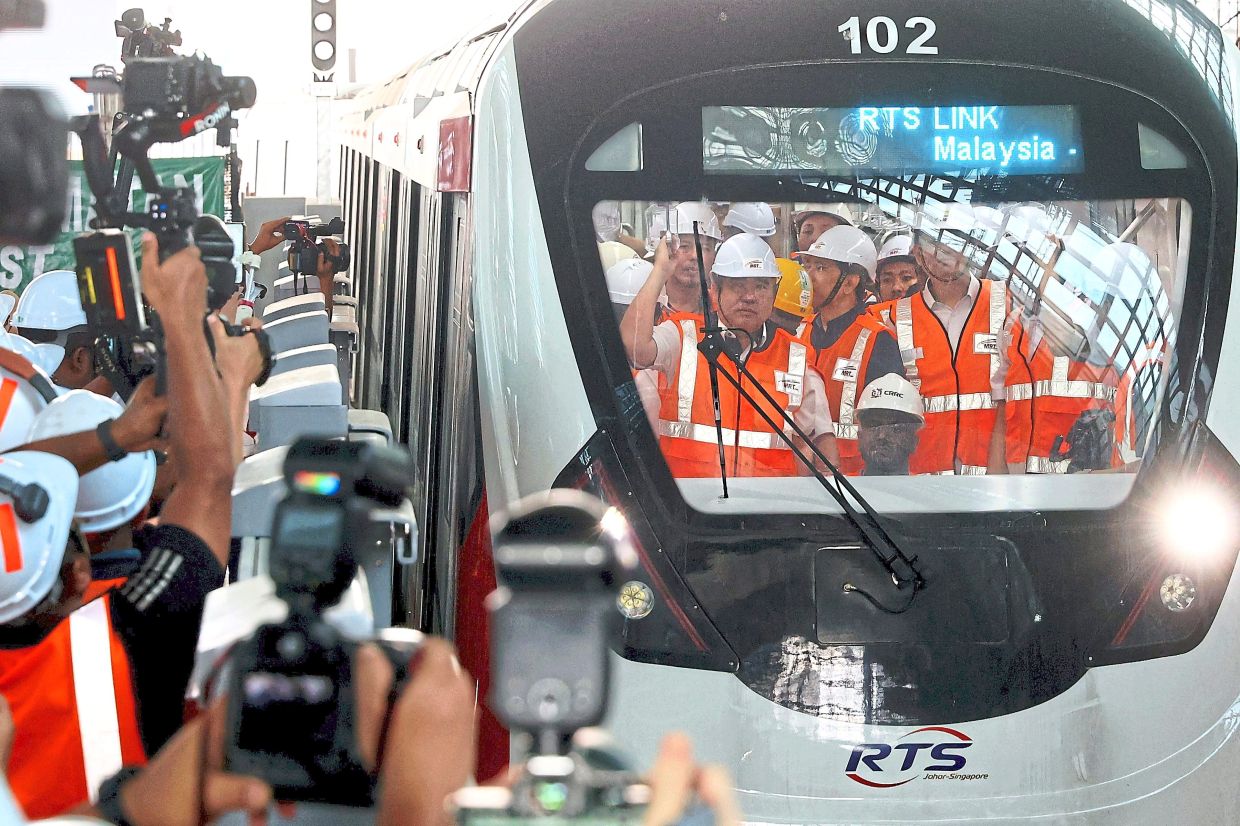
The RTS Link is a railway shuttle link about 4km in length with two stations, one in Bukit Chagar, Johor Baru, and one in Woodlands, Singapore.
The link is designed to accommodate up to 10,000 passengers per hour in each direction, with an anticipated daily ridership of about 40,000 passengers once it opens Jan 1, 2027.


