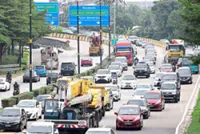
Johor government has identified 77 traffic congestion hotspots across Greater Johor Baru as part of its preparations for the upcoming Rapid Transit System (RTS) Link operations.
State works, transportation, infrastructure and communications committee chairman Mohamad Fazli Mohamad Salleh (pic) said the findings were based on a comprehensive traffic study conducted by Perbadanan Pengangkutan Awam Johor (PAJ).
The study, titled “Greater Johor Baru and JS-SEZ Traffic Dispersal and Congestion Action Plan”, involved both macro and micro traffic modelling.
“The study identified 77 congestion hotspots and grouped them into 41 clusters, with 24 clusters categorised as serious, involving four local authorities,” he said during the state assembly sitting at Bangunan Sultan Ismail in Kota Iskandar.
He was responding to questions from Marina Ibrahim (PH-Skudai) and Datuk Pandak Ahmad (BN-Kota Iskandar) on traffic management and public transport connectivity ahead of the start of RTS Link operations.
Fazli said priority projects under the Skudai corridor were the upgrading of Jalan Kempas Lama, the Tun Aminah intersection and the Perling interchange to improve traffic capacity and flow.
“Several mitigation measures had been implemented, including traffic dispersal, upgrades to critical junctions and the use of smart traffic light systems.
“As part of on-ground intervention, the state has closed Jalan Ledang, an exit route from Taman Johor into Jalan Skudai, which has helped reduce traffic conflicts and stabilise traffic flow along Jalan Skudai,” said Fazli.
A contra-flow lane would be introduced along the Senai-Johor Baru corridor, particularly on Jalan Skudai, one of the busiest routes into the city during morning peak hours, he said.
The first phase will cover a 6km stretch from Batu 7 Jalan Skudai to Bandar Baru Uda, operating from 5.30am to 9am and limited to light vehicles.
“This approach uses a movable barrier system, supported by LED signage and traffic control personnel to ensure safety and smooth operations,” Fazli said.
He said the three-month pilot project was targeted for implementation in the third quarter of 2026, subject to approvals.
‘The measure would allow for immediate capacity increase without waiting for large-scale infrastructure projects, serving as a practical interim solution to reduce congestion and travel time.”
Fazli also said the Public Works Department (JKR) would carry out upgrade works at the Perling interchange, including a full closure of the flyover towards Perling from May 22 to July 20.
During the period, traffic from Skudai heading towards the flyover will be temporarily diverted, while vehicles heading to Pasir Gudang can still use the existing left slip road.
On public transport connectivity, Fazli said the state was strengthening integration through Bas.my Johor as the main service and Bas Muafakat Johor as feeder buses, especially for residential areas such as Gelang Patah, Bukit Indah and Nusajaya.
He said the first- and last-mile connectivity would also be improved through better pedestrian walkways, cycling lanes and park-and-ride facilities at strategic locations such as Sunway Big Box and Nusa Perintis.
Addressing concerns over cargo truck congestion in Kota Iskandar, Fazli said the state was studying more systematic heavy vehicle traffic management measures.
These, he said, included route coordination, separation of logistics traffic from daily commuters, designated routes, and scheduling aligned with port and border operations.
He said the state was encouraging the use of rail freight to reduce reliance on roads, citing the upgraded Kempas Baru–Pasir Gudang cargo rail line.
“The 39.9km line connects Kempas Baru, Seelong and Johor Port in Pasir Gudang, and has been fully upgraded at a cost of RM55mil.
“Since resuming operations in May 2025, cargo train frequency has increased from two to six trips daily, with container handling rising threefold from 140 to 420 twenty-foot equivalent units (TEUs) per day,” he said.
He added that the rail line would strengthen connectivity between Pasir Gudang Port and Port of Tanjung Pelepas.
Fazli said the state government was taking a data-driven approach to ensure infrastructure readiness and minimise congestion when the RTS Link began operations.
“We are committed to ensuring that when the RTS Link becomes operational, it will ease movement without adding pressure to the existing traffic system.” — By MOHD FARHAAN SHAH