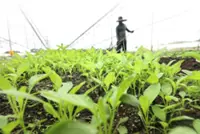
Govt to boost local output and tighten imports
PETALING JAYA: The focus will shift to the domestic vegetable supply as the government moves to strengthen food security and stabilise the market amid rising farming costs fuelled by the Middle East conflict.
With this in mind, the Agriculture and Food Security Ministry will review its vegetable production database to better match domestic supply with imports.
Deputy Minister Datuk Chan Foong Hin said, to enhance accuracy and timeliness, the ministry is progressively expanding digital reporting tools and encouraging greater farmer participation.
ALSO READ: Meeting with farmers to resolve cost issues
He said the Agriculture Department maintains an extensive database to support supply monitoring, strategic planning, and policy formulation.
The AgrisGeoPortal system, developed in 2009, supports national-level monitoring and management of food crop production, while the GeoTanaman system, introduced in 2017, enhances geospatial data visualisation, integration, and accessibility for stakeholders.
“Both systems were designed to collect, integrate, and standardise data from multiple sources, enabling continuous monitoring, accurate forecasting, and in-depth trend analysis.
ALSO READ: Minister calls for home farming as food risks rise
“This allows the government to formulate informed policies, plan strategic initiatives, and respond proactively to emerging challenges,” he told The Star.
Chan said the database is restricted to authorised government use due to the sensitivity of information, but added that the ministry is exploring secure ways to allow limited access in line with the government’s open data policy.
He said there is room for improvement, noting that some data collection processes are still manual, while farmer registration remains voluntary.
ALSO READ: ‘Reinstate APs for imported produce’
Chan said efforts were also ongoing to strengthen the domestic vegetable sector through improved productivity, adoption of modern agrotechnology, and better post-harvest management to enhance long-term resilience and competitiveness.
Federation of Vegetable Farmers Associations president Lim Ser Kwee, in backing the proposal, said a comprehensive database system would help better manage domestic vegetable supply, allowing imports only during genuine shortfalls.
Such a system, he said, would enable tighter control over imports, ensuring that certain items, such as beans, are not brought in excessively.
Agricultural economics expert Prof Datuk Dr Nasir Shamsudin said he supported a comprehensive production database to better align vegetable imports with actual domestic supply gaps.
“This will support local farmers and prevent an oversupply that depresses farm-gate prices.”
Prof Nasir said Malaysia’s current vegetable self-sufficiency ratio remained relatively low at 45.4% in 2023, with key crops such as round cabbage at 41%, chilli at 37.1% and ginger at 16.9%.
He said the country continued to rely on imports from China, Thailand, Indonesia and India to supplement local production.
“A comprehensive database with real-time data on output, acreage, yields, and demand will allow farmers to make more informed planting decisions and help the government manage imports effectively.
“This would prevent excessive imports from undercutting local prices and discouraging production.”
Prof Nasir, who is with the Putra Business School, said implementation has been challenging as the local agriculture sector is dominated by smallholders, fragmented data collection, low digital adoption, and weak inter-agency coordination.
He said overcoming these structural constraints was essential for a more resilient and efficient food system.
“Malaysia’s vegetable sector shows mixed performance, with productivity uneven among smallholders due to rising costs, labour shortages, ageing farmers and limited technology adoption, he said.
“To strengthen self-sufficiency, the government should invest in precision agriculture, quality inputs and data-driven planning, while farmers embrace modern technologies and better management practices,” he said.