
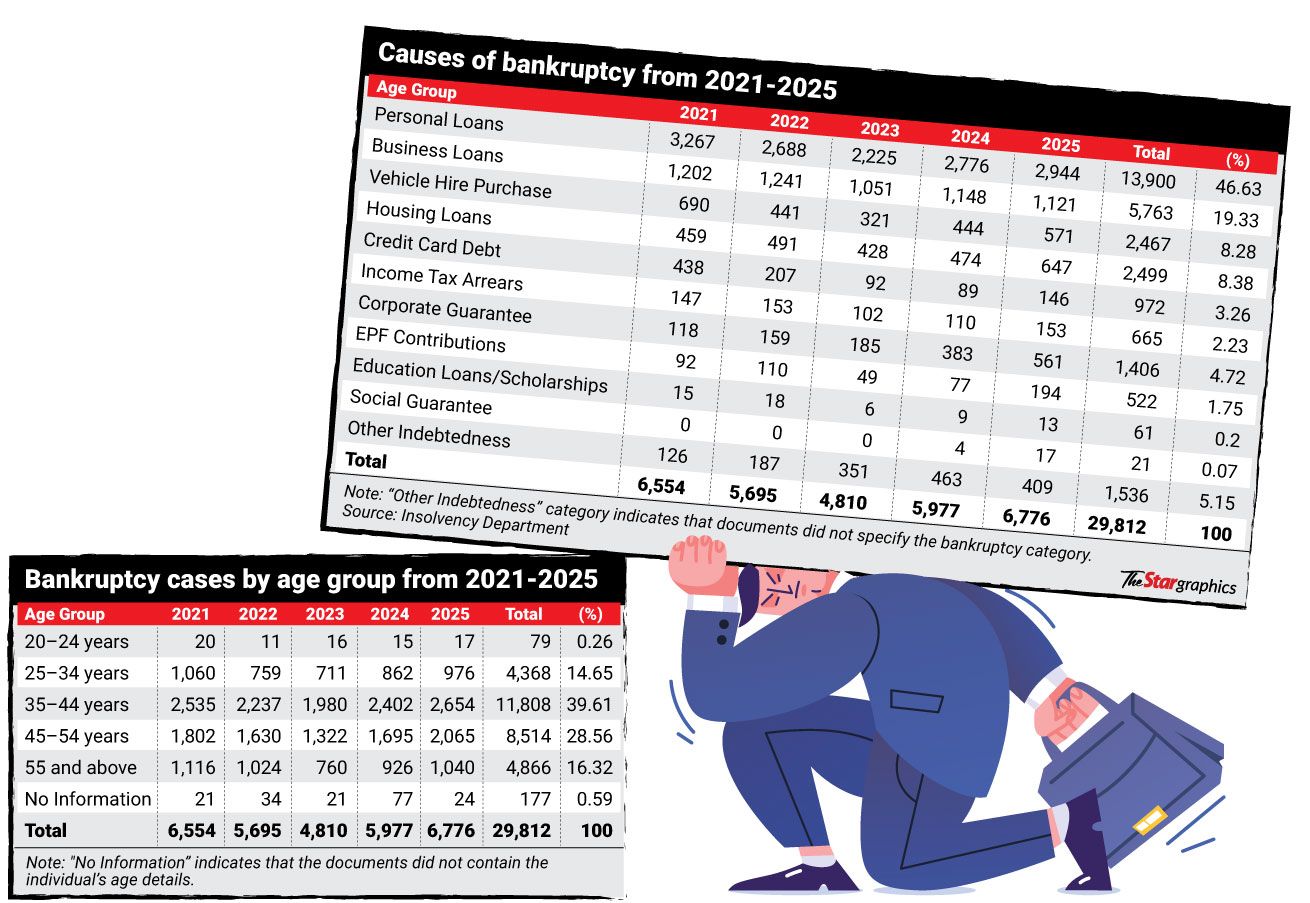
PETALING JAYA: Malaysians aged 35 to 44 form the largest share of bankruptcy cases, accounting for 39.61% of all instances recorded between 2021 and December 2025.
A total of 11,808 individuals in that age group were declared bankrupt during the five-year period, underscoring growing financial strain during what should be peak earning years.
Financial Planning Association of Malaysia (FPAM) president Alvin Tan Chin Cherng said this stage of life is often when financial commitments collide.
ALSO READ: Squeezed for cash and caught in the middle
“You’d expect people in their prime earning years to be the most financially stable. But this is also the season of life where financial obligations peak simultaneously,” he said.
Adding to the strain is the kind of debt involved. Data shows personal loans were the main cause of bankruptcy, making up 46.63% of all cases between 2021 and 2025.
Tan said personal loans are often taken to manage short-term cash flow issues.
ALSO READ: Teachers in Selangor among most likely to have serious debts
“They usually begin with legitimate needs such as medical expenses, home repairs or consolidating other debts.
“The problem arises when borrowers take additional loans to service existing ones,” he said.
Because personal loans are unsecured and carry higher interest rates, repayments can quickly consume monthly income.
“The margin between what they earn and what they owe can be surprisingly thin.
“Many had taken on long-term debt earlier in life on the assumption that income growth would keep pace,” he said.
“When that growth falls short, amid rising living costs, financial cracks begin to surface,” he added.
At the household level, Tan urged early intervention.
“Do a simple financial health review, build a small emergency buffer and seek professional advice early. Don’t wait until the situation worsens,” he said.
Sunway University economics professor Dr Yeah Kim Leng said the figures lend weight to concerns about the so-called sandwich generation.
“Many in this age group have both children and aged parents to support. Those with many children are especially vulnerable to rising financial strains that typically include dual car and house loan obligations.
“Longer life expectancy and inadequate retirement savings among older Malaysians add to the burden, particularly in urban areas where expenses are higher.
“Wage compression and uneven income growth further intensify the squeeze,” he said.
Universiti Teknologi Mara’s Dr Mohamad Idham Md Razak said the vulnerability of this age group is structural.
“This is the phase when financial commitments are at their highest. Even moderate economic shocks such as job disruption, health expenses or interest rate adjustments can quickly strain cash flow and push financially stretched households into insolvency,” he said.
He noted that personal loans are frequently used to bridge liquidity gaps or consolidate debt, but repeated reliance on unsecured borrowing weakens repayment capacity over time.
“To mitigate risks, policies should aim at boosting wage growth, productivity and job creation are crucial, alongside expanded financial literacy initiatives,” he said.