
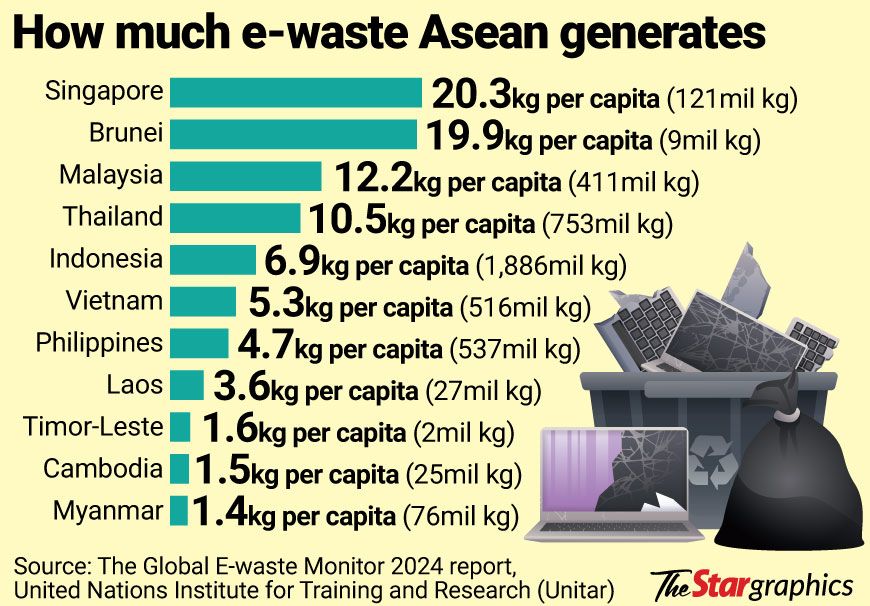
PETALING JAYA: Each person in Malaysia produces an average of 12.2kg of electronic waste (e-waste), the third highest in Asean.
The figure is also well above the global average of 7.8kg, according to data from the Global E-waste Monitor 2024, published by the United Nations Institute for Training and Research.
Across Asean, Singapore tops the list with 20.3kg per capita, followed closely by Brunei (19.9kg,) with Thailand ranking fourth (10.5kg).
At the global level, the report estimates that 62 million tonnes of e-waste were generated by 2022.
However, only 2.3% of the total mass was documented as formally collected and recycled in an environmentally sound manner.
On the ground, many Malaysians are trying to manage their personal “digital footprint”.
ALSO READ : Free pick-up services could boost e-waste recycling participation
Engineer Termizi Muhamad, 33, said he sorts his used electrical and electronic items before sending them to recycling centres or mall kiosks.
“Items like batteries, devices and appliances are separated according to disposal guidelines. If something is still repairable, I offer it to others who can fix it themselves,” he said.
However, he noted that while some centres offer cash incentives, rewards or vouchers to encourage recycling, more facilities are needed.
“More collection facilities should be set up closer to residential communities and private companies should be encouraged to allocate space for e-waste collection in housing area.
“Most importantly, there needs to be greater public education and awareness about proper e-waste disposal,” he said.
Environmental officer Ainatul Mardhiah Arshad, 28, said that sentimental value often leads her to keep old mobile phones, though she recycles other hardware.
“For devices such as printers and WiFi routers, I send them to a recycling centre in Putrajaya,” she said.
Ainatul added that more promotion of e-waste recycling centre locations and the introduction of vending machine-style collection points for small items could improve public participation.
“Cash rewards encourage more people to recycle,” she said.
Businessman Iqtidar Ahmad Bashir Ahmad, 35, from Gombak said in order to tackle the e-waste issue, there should be a law mandating how people discard their gadgets.
“In Germany, every type of waste is separated. They also use different coloured plastic bags for recyclable and non-recyclable waste.
“So if you have a law in place mandating separation at source, including e-waste, then people will be more aware of what they are discarding. If they don’t comply, a fine can be imposed,” he said.
Addressing the issue of illegal waste entry, Natural Resources and Environmental Sustainability Minister Datuk Seri Arthur Joseph Kurup recently revealed that more than half of the 1,241 shipping containers inspected between 2021 and 2025 were found to contain e-waste.
Of these, 428 containers have since been returned to their countries of origin.
To help the public properly dispose of e-waste, the Department of Environment e-waste portal lists registered e-waste collection centres and authorised points at https://ewaste.doe.gov.my/index.php/about/list-of-collectors.