
GAMUDA Technologies is expanding its Gamuda AI Academy (GAIA) across Malaysia, with campuses now operating in Kuala Lumpur, Sabah and Sarawak.
This is a move to address the shortage of AI-ready talent in the country, which could deter Malaysia’s digital ambitions.
Launched in KL in 2024, in collaboration with Google Cloud, the academy was officiated by Digital Minister Gobind Singh Deo and has since trained close to 350 graduates.
Gamuda group chief digital officer John Lim said the programme is open to everyone, carries no bond obligation and requires only a three-month commitment from participants.
He explained that GAIA was born out of necessity before it was ever a business proposition.
“We know we have the skills, and that we could pass those skills on and give people a pathway into the industry,” he said.
“We were not just trying to solve a problem for ourselves, but for the wider ecosystem.
“In today’s AI landscape, there’s no reason why Malaysians can’t compete on the global stage if we have the heart and skills.”
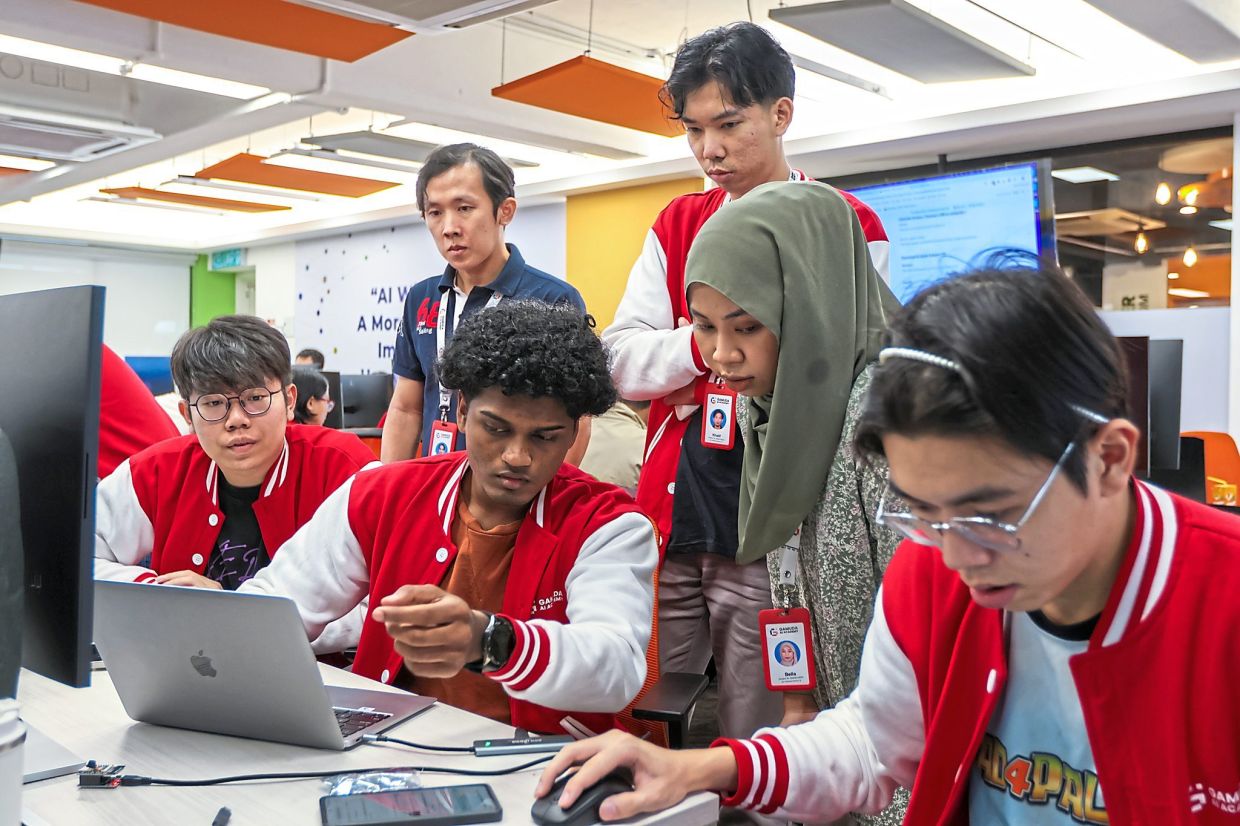
Inclusive by design
Entry to GAIA is open to applicants from any academic or professional background.
The sole requirement is an open-book entrance test designed to assess coding aptitude – one that participants are permitted to complete with AI assistance.
Lim said the programme has attracted a broad cross-section of Malaysian society, with gender representation at a 70-30 split and spread across socioeconomic groups with B40 participation at 70%.
“The only criterion for entry is an entrance test. You just need to demonstrate an interest in coding. You don’t have to be an engineer, but you have to demonstrate a proficiency in coding,” he said.
Upon completing the programme, graduates are free to pursue opportunities with Gamuda or explore careers with other organisations.
Lim noted that numerous alumni have since taken up roles at various industries ranging from fintech, digital natives and IT companies.
“It’s really a social agenda – combining the noble intention of creating talent, and a business model that sustains it, so that we can keep growing the programme to provide opportunities to young Malaysians,” he said.
“It would be a shame to just train people and not give them a pathway to succeed.”
Decentralisation
GAIA’s expansion beyond KL is deliberate as Lim said the academy’s underlying premise is that digital work removes the need for talent to relocate to the capital city – and that states outside the Klang Valley represent a significant untapped resource.
“In the digital world, anyone can work from anywhere. You can be working in Sabah, dialling in on a video call, and still be working on a project with us,” he said.
“So, if we’re able to reach this untapped talent base, it could become a valuable platform to nurture local professionals.”
The Sabah campus initially operated from the Sabah State Library before moving to a dedicated premise at Menara MAA, Kota Kinabalu. Lim said the campus now consistently recruits full cohorts each intake.
He added that the academy’s most recent and ambitious expansion is happening in Sarawak.
Gamuda Technologies formalised its partnership with Centre for Technology Excellence Sarawak (CENTEXS) in February, introducing the state’s first Digital Construction, as well as AI and Cloud for Construction training programmes, at its inaugural CENTEXS Kuching campus.
Lim credited the Sarawak state government as a key enabler of the expansion.
“Our move into Sarawak would not have been possible without their support,” he said.
“The Sarawak government is able to take what they are hoping to do and turn it into an executable plan – from training to what’s next.”
Sustainable pipeline
A portion of GAIA graduates are recruited directly into Gamuda Technologies, where they work on the company’s commercial AI product portfolio – including SpatialQ, Agentlinc and Trudax – supported by dedicated teams across business development, sales, marketing and engineering.
Lim said the structure is intentional, arguing that coding skills alone are insufficient without a pathway to commercial viability.
“A lot of these products are ready to go to market, and they are developed by GAIA graduates,” he said.
“There’s no point being able to just code but not being able to turn it into business revenue to sustain and compete at a global level.”
He described the model as a deliberate pairing of social mission and commercial sustainability – using the academy as a talent engine for a broader ambition to position Malaysia as an exporter of AI capability, not just a recipient of foreign technology investment.
“We want to be that champion, as a premier full-stack AI company with a mission for applied intelligence for the most critical environments.
“We hope to bring our products into many other markets, beyond Malaysia, and we want to do it with local talent, so that our offerings are built in Malaysia, by Malaysians and exported around the world.”