PUTRAJAYA: Malaysia and India have agreed to accelerate wide-ranging bilateral initiatives, with a strong focus on strategic sectors such as semiconductors and digital trade, following the exchange of 11 agreements and memoranda of understanding (MOUs) between the two countries.
Prime Minister Datuk Seri Anwar Ibrahim said Malaysia and India would further strengthen cooperation in areas such as trade and investment, local currency trade, tourism, education and security, with the aim of exceeding last year’s total of US$18.59bil (RM73.3bil) in investments.
“It is really comprehensive, and we believe that we can advance and execute this in a speedy manner with the commitment of both governments, as well as both foreign ministers,” he told a joint press conference with Indian Prime Minister Narendra Modi at his official residence yesterday.
Modi was on a two-day official visit to Malaysia starting Saturday at Anwar’s invitation, reciprocating the Malaysian leader’s visit to India in August 2024.
Anwar also highlighted that Malaysia and India had witnessed 11 documents, including MOUs, in 10 exchanges of letters, which extended beyond normal bilateral arrangements.
Among the documents exchanged were a joint statement on Modi’s visit; MOUs on audiovisual co-production, disaster management, anti-corruption and labour; an exchange of letters extending United Nations peacekeeping cooperation; and exchanges of notes on semiconductors, healthcare, technical and vocational education and training (TVET) as well as security.
Malaysia and India, Anwar added, also agreed to expedite the use of the ringgit and rupee in bilateral trade and investment.
He said Bank Negara and the central bank of India would continue to work closely to promote local currency settlement using the ringgit and rupee to facilitate more efficient and cost-effective transactions.
“One remarkable feat is the decision to use local currency as far as possible, and Bank Negara and the Reserve Bank of India have worked on this area for the ringgit and rupee in bilateral trade and investment, and similarly in digital connectivity, energy and semiconductors,” he added.
Malaysia’s exports amounted to US$12.24bil (RM52.3bil) and imports totalled US$6.35bil (RM27.19bil), with key export items comprising palm oil and palm oil-based agricultural products, as well as electrical and electronic products, while imports mainly consisted of agricultural, petroleum and chemical products.
Anwar said Malaysia, in the Asean context, would benefit immensely if the region could secure more ways and opportunities to collaborate with India.
He said both countries also agreed to expedite the review and optimise the Malaysia-India Comprehensive Economic Cooperation Agreement, and strengthen cooperation in high- value sectors including semiconductors, digital trade, green technology and advanced manufacturing.
“We also welcome the establishment of the Malaysia-India Digital Council and ongoing discussions on bilateral payment linkages between NPCI International Payments Ltd and PayNet Malaysia,” he said.
Meanwhile, Anwar said Malaysia also requested India’s consideration to further expand air traffic rights, including additional capacity and access to more secondary cities, to support growing demand for tourism, trade and people-to-people exchanges.
Additionally, he welcomed the progress by Petroliam Nasional Bhd and Gentari in India to strengthen semiconductor value-chain cooperation and talent development.
On regional and international matters, Anwar noted that both leaders had reaffirmed support for South-East Asian unity and centrality under the Asean umbrella, as well as alignment with the Asean Outlook on the Indo-Pacific and India’s Indo-Pacific Oceans Initiative.
They also exchanged views on global developments, including Palestine, stressing the need for a ceasefire, humanitarian access and a peaceful resolution through dialogue and international law.
Anwar added that Malaysia supported India in opening a consulate in Kota Kinabalu.
Earlier yesterday, the two leaders held a closed-door meeting before leading wider delegation talks.
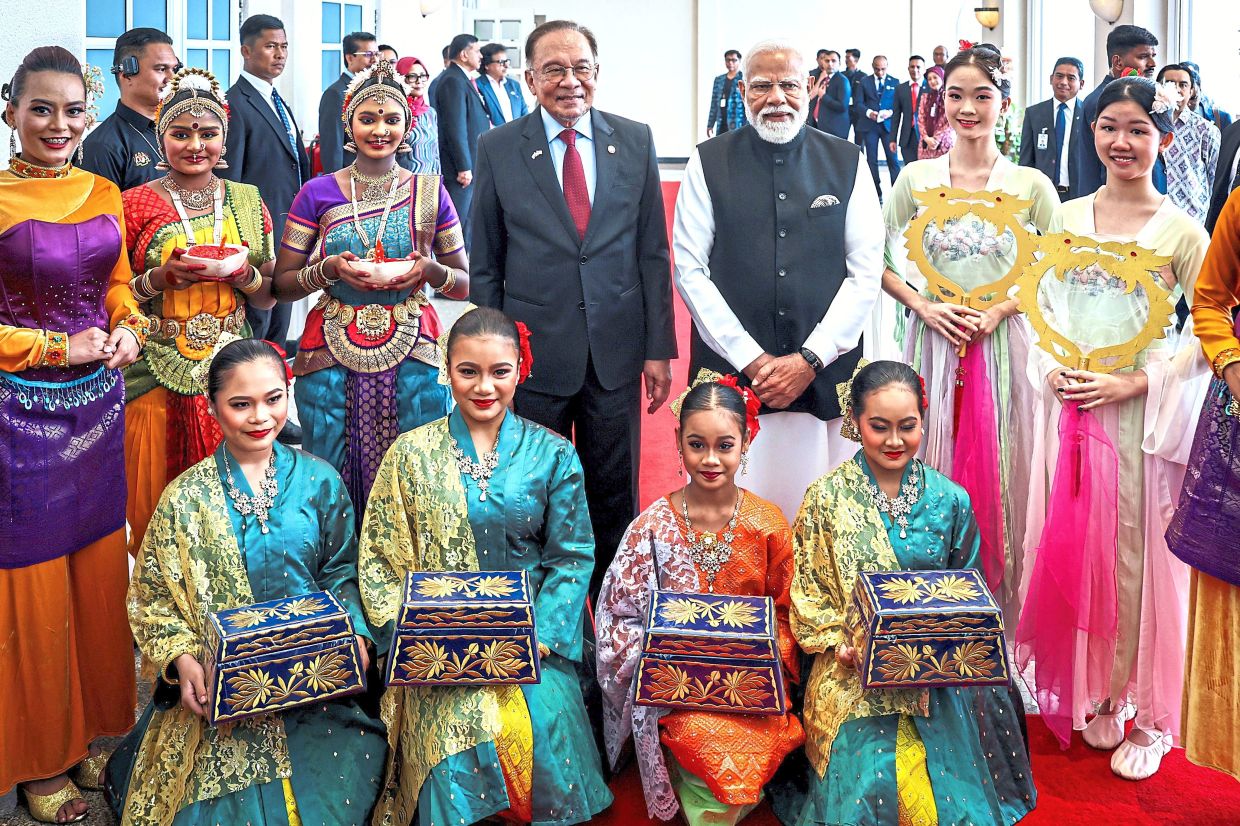
Modi arrived at 9.35am and was welcomed with a cultural performance.