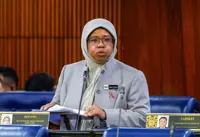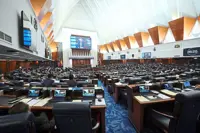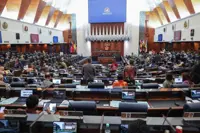
KUALA LUMPUR: A question on the proposed Ombudsman turned into a fiery back-and-forth in the Dewan Rakyat after Khoo Poay Tiong (PH-Kota Melaka) pressed the government on the whereabouts of Tan Sri Muhyiddin Yassin’s son-in-law, who is wanted by the Malaysian Anti-Corruption Commission (MACC).
On Tuesday (Nov 18), Khoo asked whether or not the future Ombudsman would provide checks and balances on the MACC and if incentives for whistleblowers would also apply to informants abroad.
He went on to question challenges in bringing back corruption suspects who flee to countries without extradition treaties with Malaysia.
Citing the case of Muhyiddin’s son-in-law, Khoo said: "As an example, the son-in-law of Pagoh (Muhyiddin's constituency), who is involved in a corruption case – MACC wants to charge him, but he has fled abroad.
"Soon after his father-in-law, Pagoh, was charged in court, he (the son-in-law) left for another country.
"So, can incentives also be given to whistle-blowers overseas? And since the son-in-law has fled, have we asked his father-in-law where he has gone?" Khoosaid.
The remark triggered an objection from Datuk Abdul Khalib Abdullah (PN-Rompin), who cited Standing Order 36(10)(c), accusing Khoo of provoking ill feeling.
"How many times has Kota Melaka asked the same question – son-in-law, son-in-law, son-in-law? It’s really upsetting us," he said, before Speaker Tan Sri Johari Abdul interjected.
Johari instructed Khoo to sit down, but Khalib continued, saying: "If I ask about the tunnel case, how would he feel?", referring to the ongoing Penang undersea tunnel corruption trial involving DAP adviser Lim Guan Eng.
Khoo shot back: "Tak sakit hati pun (I wouldn’t feel upset)."
Responding to Khoo’s initial question, Prime Minister Datuk Seri Anwar Ibrahim said the government is studying the Ombudsman model based on the Islamic concept of hisbah, an institution of public accountability that historically oversaw governance across all branches of authority.
"If we look at Islamic civilisation, the Ombudsman is tied to the institution of hisbah. It provides public accountability and overrides enforcement bodies.
"So, can it monitor institutions? Yes, hisbah oversees the executive, legislative and judiciary if there is misconduct or corruption, including MACC. We are examining this in detail," he said.
On incentives for overseas whistleblowers, Anwar said he would need to refer to existing regulations but stressed that enforcement agencies have the flexibility to determine the best approach.
"In cases where suspects flee abroad, the process continues, whether by the police or MACC, although it becomes more difficult," he added.
Datuk Awang Solahuddin Hashim (PN-Pendang) then raised Standing Order 36(5), arguing that Khoo should not have mentioned "Pagoh" in the House.
"Earlier, Kota Melaka mentioned Pagoh. We have the police and Interpol engagement. Kota Melaka is trying to show police weaknesses in bringing people back.
"He should also investigate the RM97mil (case) involving officers from ministries represented by DAP ministers, but he focuses only on this," he said.
Johari dismissed the objection, clarifying that no rule was breached.
“He did not mention the name; he mentioned a constituency.
"What is prohibited is mentioning the name, for example, 'Tan Sri Muhyiddin Yassin'. 'Pagoh' is the name of the constituency," he said.
Johari reminded the House that the matter had been raised several times and answered, adding: "I think it need not be raised again unless there are new developments."