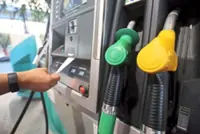
PETALING JAYA: Exasperated e-hailing drivers have criticised the Budi RON95 scheme, saying that it defeats the purpose if their personal 300 litres are being swallowed up by work.
They argue that lumping it together with the additional 300 litres for e-hailing work deprives them and their families of subsidised petrol meant for personal use.
Just a month after the scheme began, frustration has set in – the petrol quota could barely last for three weeks. This leaves them with no other option but to buy unsubsidised petrol that costs an extra 61sen per litre.
Meanwhile, p-hailing drivers are bearing a bigger burden.
While e-hailing drivers receive an additional 300 litres of RON95 monthly, p-hailing drivers rely solely on their personal 300-litre quota, as the government has yet to announce any extra subsidised fuel for their use.
The drivers said the current quota falls far short and have called for a monthly minimum of 1,000 litres of subsidised petrol.
Malaysian P-Hailing Delivery Association deputy president Abdul Hakim Abdul Rani said p-hailing drivers are operating on their personal quota of 300 litres as no additional allocation has been unveiled.
“It was announced earlier this month that p-hailing drivers will receive the same as our e-hailing counterpart, but we have yet to hear more about it and we want to know why.
“Also, why is the baseline 300-litre quota meant for personal use being lumped together with the quota meant for our work?
“This is unfair as we too need subsidised fuel for personal use. Our survey showed that our members used up their initial 300 litres in just a week after the Budi RON95 scheme was rolled out.
“Apart from cars, p-hailing drivers also operate lorries and vans, which consume more fuel.
“Our drivers incurred additional costs of roughly RM500 over the past month buying unsubsidised petrol,” he said, urging the government to hold a town hall meeting with both groups of drivers to iron out the issue.
Abdul Hakim has yet to receive similar complaints from delivery riders, so he assumed the situation is more manageable for them due to the lower fuel consumption of motorcycles.
Grab Drivers Malaysia Association president Mohd Azril Ahmat said that based on information received from association members, 70% to 80% of e-hailing drivers based in places such as the Klang Valley, Johor Baru and Penang had exhausted their 600-litre quota in less than three weeks.
“We have received complaints from hundreds of members saying that they had no choice but to opt for unsubsidised petrol when their current 600-litre quota ran out.
“Many of them had to resort to asking their friends and family members to spare them some subsidised petrol from their personal quota.
“How long can they go on pestering others this way? On average, full-time e-hailing drivers using a sedan or compact car use about 30 litres of petrol per day, travelling between 300km and 350km.
“This would be higher for those who drive MPVs, SUVs or other higher-performance cars,” he said.
Mohd Azril also urged the government to hold discussions with the drivers and increase their quota to at least 1,000 litres.
“Ideally, the quota should be at least 1,200 litres. Many of us regularly make long trips to KL International Airport, and a single round trip from Kuala Lumpur alone can clock up to 120km. It is also different for drivers in smaller towns, who may find the current quota sufficient as they may not take lengthy trips,” he said.
Malaysian United Delivery Partners Association president Haris Fadillah Arsyad, who raised similar issues faced by his members, said drivers in the industry not only use their vehicles to earn a living but also for personal transportation.
“This is why the first 300 litres should be reserved for personal use, instead of being lumped together with the additional fuel meant for e-hailing and p-hailing drivers. We also have families and need petrol for our own travel,” he said.
Malaysian E-Hailing Drivers Association president Daryl Chong said fuel consumption varies depending on driving patterns.
He said those who operate solely within city limits may clock lower mileage.
However, e-hailing drivers are not restricted to city trips and can accept long-distance bookings.
“For instance, a Johor Baru-based driver may receive a request to travel to Bukit Kayu Hitam, where a round trip would be about 1,650km. With an average fuel efficiency of 13km per litre, this single journey alone would require roughly 252 litres of fuel.
“In view of this, we propose increasing the monthly subsidised fuel quota for e-hailing drivers to at least 900 litres,” he said.
Meanwhile, consumer groups said the personal fuel quota under the Budi95 scheme should be strictly reserved for household use and not for work-related purposes.
Federation of Malaysian Consumers Associations (Fomca) chief executive officer Dr Saravanan Thambirajah said allowing the 300-litre monthly RON95 quota to be used for business or work purposes would defeat the scheme’s original intent of easing household living costs.
“From a consumer rights standpoint, the personal fuel quota must be protected for household use.
“The core purpose of the RON95 subsidy under the Budi95 framework is to help families manage the cost of living and ensure they have access to affordable transportation,” he said when contacted.
Saravanan cautioned that diverting personal fuel quota for work would erode the benefits meant for ordinary households, particularly vulnerable groups such as low-income families, retirees and rural residents who depend heavily on personal vehicles for essential travel.
He said the household quota should therefore be “ring-fenced and safeguarded” to ensure the subsidy remains equitable and consistent with its purpose of promoting fair and responsible fuel consumption.
Echoing similar sentiments, Consumers Association of Penang (CAP) president Mohideen Abdul Kader said the targeted subsidy should cover only personal fuel consumption, while work-related usage should fall under a separate fleet-card system.
“This distinction ensures clarity on who benefits and for what purpose, preventing misuse or confusion with resale activities since work-related fuel use tends to be higher than normal household needs,” he said.
Mohideen said CAP’s feedback shows that most consumers have adapted well to the new mechanism, with only isolated cases of being charged unsubsidised prices – often due to specific technical circumstances.
“Consumers have generally reported getting more fuel for the same amount they paid.
“Communication has been clear through mass and social media, and despite initial anxiety, most found little change in their refuelling experience,” he said.
He added that no major safeguards were currently necessary, as reports of resale attempts had dropped and irregular transactions could be easily detected and addressed.
Petroleum Dealers Association of Malaysia president Datuk Khairul Annuar Abdul Aziz said fuel stations observed a slight decline in refuelling volumes towards the end of the month.
“However, this is influenced by several factors such as the Deepavali festive season, the Asean Summit period and other travel-related fluctuations.
“The Budi quota has become an additional factor in consumer behaviour, as motorists now plan their journeys with their remaining quota in mind,” he said.
On the proposal to separate personal and work-related fuel quotas, Khairul said such a move would be impractical at the pump level.
“It would be difficult to manage at the station level. Many road users exhaust their Budi quota due to work-related travel, which falls outside their personal allocation.
“A more practical approach would be for employers or companies to reimburse staff based on the prevailing pump price rather than the subsidised rate.
“That would ensure fairness without burdening station operations or creating verification complications,” he said.