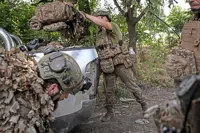
THE screens covering a command post wall served up live video feeds from bomber drones, a ground drone trundling down a mud path and surveillance drones scoping out a burning house – a catalogue of modern warfare.
One thing missing from the picture were the tanks that gave the 33rd Separate Mechanised Brigade’s battalion its name.
Once Ukraine’s most sought-after Western weapons, tanks now mostly sit idle, hidden in forests and collecting cobwebs.
The US$10mil machines, procured with great fanfare, proved no match for cheap drones that now dominate the battlefield.
Yet Ukraine still maintains them and trains soldiers to use them, while trying to imagine new ways to deploy them.
“We’re making virtually no use of armoured vehicles,” Oleksandr Syrskyi, who until July was Ukraine’s top general, said recently.
“This raises the question: how can we neutralise this advantage enjoyed by drones and give our armour a new lease on life?”
That question was at the heart of a clash over war strategy that led Syrskyi to be relieved of his command.
Some of Ukraine’s premier tank divisions are not waiting around for the answer.
Tank crews should not be stagnant, said a fresh-faced commander in the 33rd, who, like most soldiers interviewed, gave only his call sign, Morpheus, in keeping with military protocol.
That’s why, he said, he tells his battalion that they need to learn something new.
Vulnerable to drones
Ukraine started asking for Western-made tanks almost immediately after Russia’s full-scale invasion in February 2022, when they seemed essential.
Ukraine’s allies resisted sending them until January 2023, when Britain, Germany and the United States changed course following fraught negotiations and public pressure.
The 33rd Brigade was formed in part to receive those Western tanks. But by the time they entered the fight late that spring, cheap drones were already inflicting a deadly toll and were able to strike tanks at their most vulnerable points.
Russian forces started covering their tanks with anti-drone meshes and cages.
“People laughed at them back then, saying they were making BBQ grills,” recalled a tank maintenance chief with the 33rd whose call sign is Energetyk. “But they were heading in the right direction.”
Ukraine followed suit, adding protective cages and reactive armour – external panels that detonate when struck to deflect attacking munitions – in hopes of maintaining tanks’ relevance.
But soon both sides stopped using heavy armour for assaults.
Prepping for a comeback
Tank crews must remain ready, said a company commander, call sign Fin, so his men stay busy training, maintaining the tanks and welding on new protections.
In combat or not, there is no rest, said Fin, 26, fiddling with the Virgin Mary charm on his black rope bracelet.
The 33rd carries out live-fire exercises every two weeks or so, to keep its skills fresh.
One sunny morning, between sunflower fields, troops positioned a tank and set up targets in the distance.
Commanders sat with other soldiers under a makeshift shade, snacking on seeds and sharing a cola.
Yuri Kosenko, 57, had just come off two weeks in a front-line dugout that he said smelt like dampness and mould.
There had been no tank fighting but so many “mosquitoes”, he said – rubbing his arm then pointing to the sky to make clear he meant both the biting kind and the exploding kind – that he had to carry a drone detector to the latrine.
Like most soldiers interviewed, Kosenko said that he was fine without combat engagements because he had seen enough battle.
“War is war. There’s nothing to like about it,” the soldier said as shells were loaded into the tank.
Soon the crew climbed in and spun the gun around. The first few rounds were off the mark. Orders went back and forth by radio, requesting adjustments.
Three more shells fired, each setting off a blast that made only half the soldiers flinch.
“You guys missed,” radioed the commander.
“We know – we can see it from here,” a crew member replied.
The cola bottle was nearly empty by that point.
A tank driver, Mechan, took out pancakes filled with shredded chicken to share, brought back from his recent leave.
The end of tanks?
Fin, the company commander, insisted that tanks would not remain sidelined, because new technology would allow them to adapt.
Maybe they will be outfitted with artificial intelligence to create protective domes, he said, or their own drone interceptors.
But back at the command post, Morpheus said that about half his battalion had retrained as drone operators.
It’s about trying to find ways to use his personnel, Morpheus said, jiggling his leg as he watched the bank of screens.
Getting tanks back into battle would require a major technological breakthrough, he said.
“I’m convinced that tanks still have a future, but there’s one caveat,” Morpheus said, adding, “I think they will be unmanned.” — ©2026 The New York Times Company
This article originally appeared in The New York Times
Already a subscriber? Log in
Get 20% OFF The Star Digital Access
Cancel anytime. Ad-free. Unlimited access with perks.