MUBIN M. can spend all day at his school’s community farm. He loves being out in the sun, feeling the soil in his hands and most of all, watching what he plants grow. But when asked if he would want to make farming his career in the future, the 16-year-old was horrified.
“No way. Will I be able to make money? There are too many risks: extreme weather, insects, the crops can get spoilt.
“And I think it will be too expensive to even start – land, fertiliser, machinery, workers...” he rattles on.
When asked what if he could use agricultural technology, he gets quiet; “You mean, like AI, drones and robots?”
That is why Naviin Thiaga can count himself lucky that his exposure to agriculture and agricultural technology (agri-tech) started early.
Although he grew up in a farming family, the founder and CEO of organic farming business Sayur Kita Asia might not have ventured into agriculture if he did not learn of its potential from young.
His secondary school was one of the very few with agricultural science as an elective subject, he says. Most importantly, he adds, his teacher was very encouraging and advised them that agriculture would become one of the country’s most promising sectors.
Malaysia’s agricultural sector is vital for the country’s food security and economic resilience.
And beyond ensuring adequate food supply, the agricultural sector is also one of the main drivers of economic growth. It contributes significantly to reducing dependence on imports, supporting processing industries, creating employment opportunities, and increasing household income, particularly among farmers.
However, it faces a huge challenge: the agricultural workforce is ageing, while fewer young Malaysians are choosing to build their futures in the sector.
More than 45% of Malaysia’s agricultural producers are aged 60 years and above, highlighting the challenge of building a workforce capable of sustaining the sector for decades to come. With increasingly intense weather patterns expected in the years ahead, strengthening Malaysia’s food security is critical.
To nurture this industry, it is crucial to understand why youth shy away and what can bring them in.
More than TVET
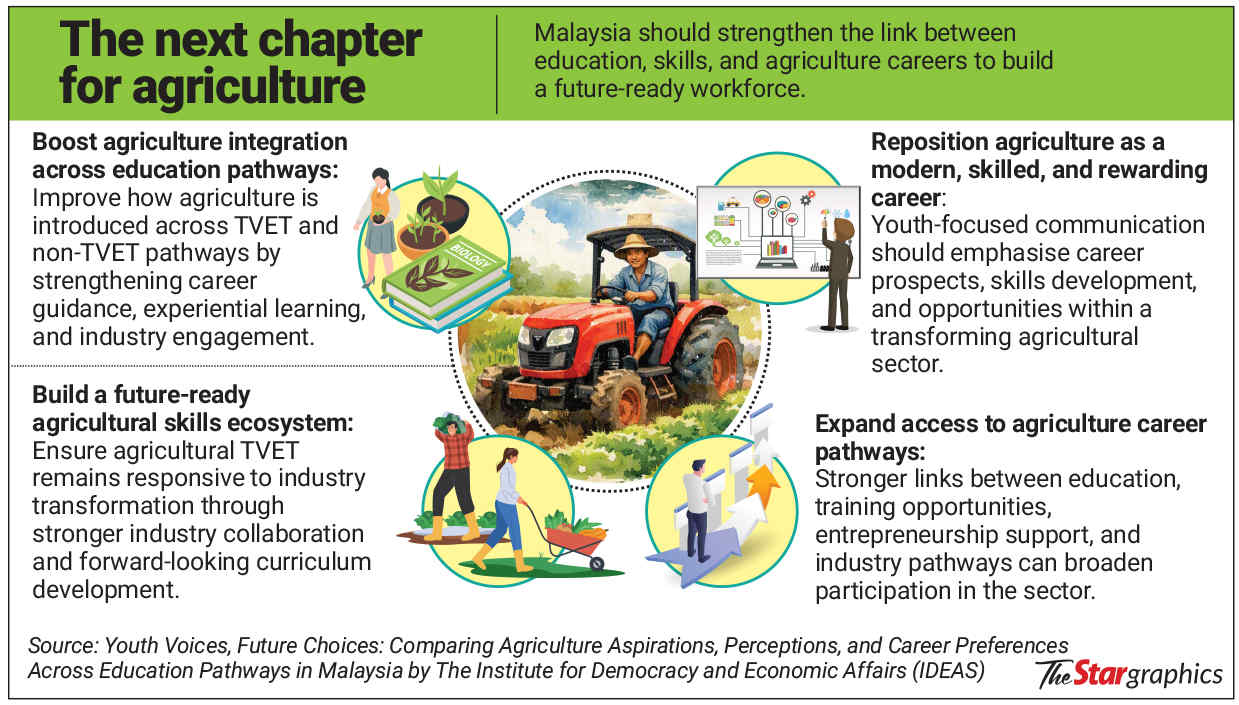
According to a recent report by the Institute for Democracy and Economic Affairs (Ideas), early exposure to agriculture in schools and stronger education pathways are key to attracting more young Malaysians into the sector.
The study, Youth Voices, Future Choices: Comparing Agriculture Aspirations, Perceptions, and Career Preferences Across Education Pathways in Malaysia, found that Technical and Vocational Education and Training (TVET) students are more likely than their non-TVET peers to consider careers in agriculture, but they are no more likely to pursue modern agri-tech jobs.
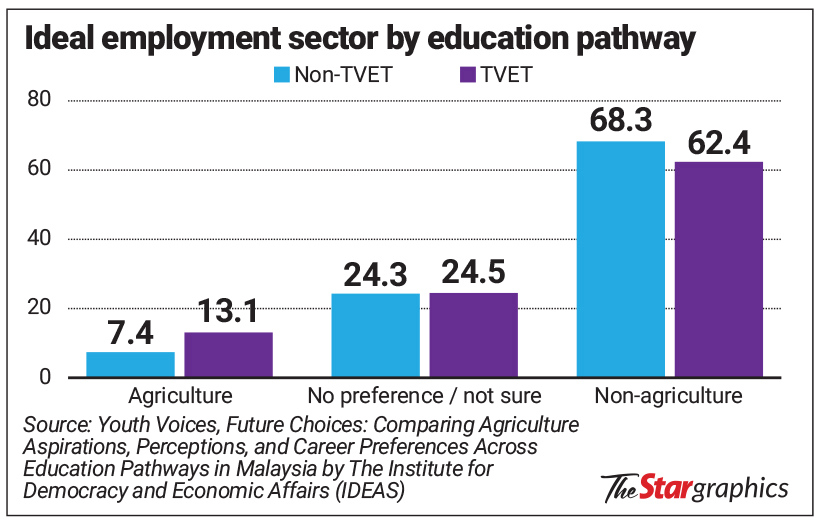
This suggests that TVET continues to channel students towards traditional rather than technology-driven agriculture careers, highlighting the gap between Malaysia’s ambition to modernise the agricultural sector and the career preferences of its future workforce.
The findings are particularly relevant as Malaysia is investing heavily in modernising agriculture through initiatives including the 13th Malaysia Plan, the National Agrofood Policy 2021–2030, the Digital AgTech programme and the New Industrial Master Plan 2030.

Report co-authors, Ideas research director Dr Stewart Nixon and research executive Priya Kaur Sachdev raise the concern that youth perceptions of agriculture careers do not appear to be updating with sector modernisation.
“Only around half the students surveyed view agriculture as a modern, high-tech industry, which suggests a need to increase youth exposure to the breadth and sophistication of employment opportunities available,” they say in a written response to Sunday Star. Two of the other co-authors are Prof Dr M. Niaz Asadullah and Naveen Mahasen.
Agriculture in education
The Ideas study surveyed 14,305 students aged 15 and 16 from 88 public secondary schools and vocational colleges nationwide to examine how different education pathways influence perceptions of agriculture and career aspirations.
Studying agriculture-related subjects was one of the strongest predictors of interest in agricultural careers among both TVET and non-TVET students.

While this may suggest revisiting the education syllabus to introduce agriculture earlier and more broadly across the system, the authors caution that any changes will require thorough evaluation before implementation.
“Classroom exposure increases familiarity and direct links to the sector, making career prospects more visible and tangible. Changes to academic and TVET curricula to increase exposure to agriculture and agri-tech warrants further consideration, but at what age, for which students, and what other learnings would be replaced require careful assessment,” they say.

The priority for policymakers should be to ensure that students who are favourably disposed towards agriculture receive greater exposure to specific education options and tangible career pathways in modern agriculture.
“Modernising the curriculum and industry partnerships offers the highest likelihood of generating and sustaining interest in the sector and supporting wider objectives like boosting food security and reducing youth unemployment,” the authors say.
Attracting youth to agri-tech
The report found that students with interest in agriculture tend to gravitate towards specialised careers. TVET students were more likely to lean towards engineering and machinery-related agriculture careers, while non-TVET students showed stronger preferences for plant and animal science pathways, reflecting differences in education exposure.
“Among the more curious findings is that while TVET students express greater interest than academic students in agriculture careers, they are not noticeably more interested in agri-tech occupations specifically.
"This seems contradictory because the survey also confirms that vocational students have greater exposure to the sector,” the authors say.
“The missing link is most likely a TVET ecosystem that remains grounded in traditional industry partnerships and which could refresh its connections and curricula to increase tech emphasis.
"A balance must be struck here however, with evidence also suggesting that TVET performs well in preparing students for traditional, physically-demanding agriculture jobs,” they explain.
Modernising agriculture
The social stigma associated with agriculture is also less severe than perhaps thought, with the sector viewed more positively than construction and mining, the authors noted.
“More importantly, the report found that the vast majority of students who express interest in agriculture careers come from non-agriculture families.
"Building a stronger talent pipeline starts by recognising that attracting youth to the sector rather than retaining them within the sector engages a much wider population, with education, career pathways, and job promotion activities benefiting from this understanding,” they say.
While higher salaries remained the strongest incentive for choosing agricultural careers, TVET students placed greater value on training and skills development opportunities.
According to the report, most students, including those from agricultural households, hoped to work outside their parents’ economic sectors, emphasising the need to position agriculture as a modern, innovative, and attractive career for a new generation.
“Young people’s career decisions are shaped by a range of economic, educational and social factors, with effective policies needing to reflect these realities.
"There’s further to explore and better evidence needed around the roles of parents, teachers, employers and industry in shaping career aspirations. This would help policymakers design more targeted and effective interventions,” the authors say, emphasising the need to ground workforce policies in evidence.
Another study released last month, Graduate Outcomes of Agricultural TVET in Malaysia by PNB Research Institute (PNBRI) and the Agriculture and Food Security Ministry also highlighted the need to strengthen agricultural career pathways and long-term interest in the field, amid declining youth participation and an ageing workforce.
For Malaysia, securing the future of agriculture means securing the next generation of talent. Attracting young people will mean showing them that agriculture can be a field of technology, innovation, entrepreneurship and opportunity.