SCIENTISTS who study global warming are currently wrestling with a question that, while seemingly technical, is profoundly consequential: Is climate change accelerating?
The debate spilled into the open this month, after new research found that the rate of global warming has nearly doubled over the last decade. The findings set scientific circles buzzing, and not all researchers agree with the conclusion.
But while the debate about accelerating global warming remains unsettled, a growing number of scientists do agree on another troubling development: The effects of climate change are intensifying in ways that have surprised even experts.
Many of the consequences of global warming – such as more intense storms, warming oceans and melting glaciers – are arriving faster and more powerfully than many scientists had expected.
“Key impacts are exceeding what models predicted when it comes to extreme weather, the intensification of hurricanes, ice sheet disintegration, and sea level rise,” says Michael Mann, a professor of environmental science at the University of Pennsylvania, United States.
In March in the US, extreme weather pushed temperatures above 38°C in parts of California and the South-West, even as it is still winter, and recent research has found that the duration and intensity of heatwaves is accelerating. At the same time, blizzard conditions whipped the upper Mid-West and severe thunderstorms moved east from Arkansas to the Gulf.
Around the world, anomalous weather and shattered records are sending new waves of concern through the scientific community, which was already well aware that some ecosystems are showing signs of intense stress.
“Things are getting really outside of what humans have ever seen,” says Friederike Otto, a professor of climate science at Imperial College London. “Almost every part of the world is experiencing these extreme events.”
The debate
An acceleration in the pace of climate change could have dire implications for a planet grappling with more powerful storms, floods, and heat waves.
Global average temperatures have already climbed nearly 1.5°C above preindustrial levels, a threshold that is seen as crucial for avoiding the worst effects of climate change.
A study about the pace of global warming, published on March 6, found that, even after accounting for other phenomena such as volcanic eruptions, solar radiation, and natural variability, the rate of global warming has accelerated since 2015.
“Over the last 10 years, the warming trend has been faster than in the previous decades,” says Stefan Rahmstorf, a climate scientist at the Potsdam Institute for Climate Impact Research in Germany, and one of the authors of the study published in the journal Geophysical Research Letters.
Pennsylvania University’s Mann is among those who are unconvinced. He says the evidence for an uptick in the rate of warming is “not statistically detectable”, adding that “the anomalous warmth in recent years was due to a natural El Niño spike”.
El Niño is the warm phase of a natural climate pattern that shapes weather patterns worldwide, typically bringing wet and cool conditions with increased flooding to the southern United States, and warmer, drier winters to the northern United States and Canada.
It appears that El Niño may return this June, raising the prospect of even more extreme weather in the months ahead.
Warming oceans
As the atmosphere warms, so do the seas, which have been showing signs of strain in recent years. Ocean temperatures are hitting record highs around the globe, resulting in mass coral bleaching from the Caribbean to Australia, and a sharp decline in fish populations.
The oceans, which absorb more than 90% of the excess heat trapped in the Earth’s atmosphere, are warming at an accelerating rate, leading to bathtub-like temperatures off the coast of Florida, United States.
Each of the past eight years set a record for ocean heat, with the rate of ocean warming roughly doubling over the past two decades compared with the longer-term trend.
Marine heat waves now affect more than half of the global ocean in a typical year, according to the US National Oceanic and Atmospheric Administration. The world experienced its fourth global coral bleaching event starting in 2023, with reefs across the Caribbean, Pacific, and Indian Oceans suffering extensive damage. It was still in progress in 2025.
Glaciers, ice and rising seas
As oceans have warmed, the North and South poles have both experienced abnormal heat, and in Antarctica, the Thwaites Glacier is melting at an alarming rate. If it breaks apart entirely, global sea levels could rise by 0.6m over the course of several decades, putting millions at risk.
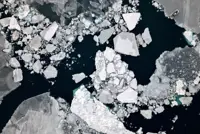
Antarctic sea ice is also plummeting, with the four lowest readings in the 47-year satellite record all occurring over the past four years.
“Sea ice loss in Antarctica is very concerning, because if it continues to melt, we risk self-perpetuating processes, whereby you expose more of the ocean, and that warms the surface of the ocean,” says Bethan Davies, a geologist at Newcastle University, United Kingdom.
“It’s a tipping point.”
Outside the poles, other glaciers are also melting at an accelerating rate.
For the second consecutive year in 2024, all 58 of the main glaciers tracked by the World Glacier Monitoring Service across five continents lost mass, the greatest average ice loss in 55 years of records.
The European Alps lost roughly 10% of their remaining glacier volume in just two years, while Venezuela became the first Andes nation to lose all of its glaciers.
Melting glaciers can push sea levels higher. Worldwide, the rate of sea level rise is now picking up pace, more than doubling since satellite measurements began in 1993, leading to warnings about the fate of coastal cities from Miami to Jakarta.
Connected systems
The changes to Earth’s natural patterns reveal an interconnected web of ecological systems that are undergoing profound changes beyond what many researchers have predicted.
Scientists say the culprit is clear: Ever since the Industrial Revolution, the relentless burning of fossil fuels, including coal, oil, and gas, has been adding heat-trapping gasses to the atmosphere, leading to a sharp rise in global temperatures. The hottest year in recorded history is now 2024, and each of the 10 warmest years on record have come in the past decade.
Since 1997, when nations agreed to limit planet-warming gases as part of the landmark Kyoto Protocol, humanity has released more greenhouse gases than in all prior history.
The temperature rise associated with that growing volume of heat-trapping gas has kicked in, and is continuing to rise.
And at the same time, the ability of the planet’s natural systems to absorb planet-warming gasses such as carbon dioxide appears to be diminishing. Oceans, which have absorbed much of the carbon dioxide that humans have added to the atmosphere, are becoming less efficient at storing carbon. The same is true for forests and soils.
“Taken together, we see the first signs of a planet that is losing resilience, or losing strength to buffer heat stress,” says Johan Rockström, director of the Potsdam Institute for Climate Impact Research.
“The consequence of such loss of resilience will be an increased rate of warming.” — ©2026 The New York Times Company
This article originally appeared in The New York Times.