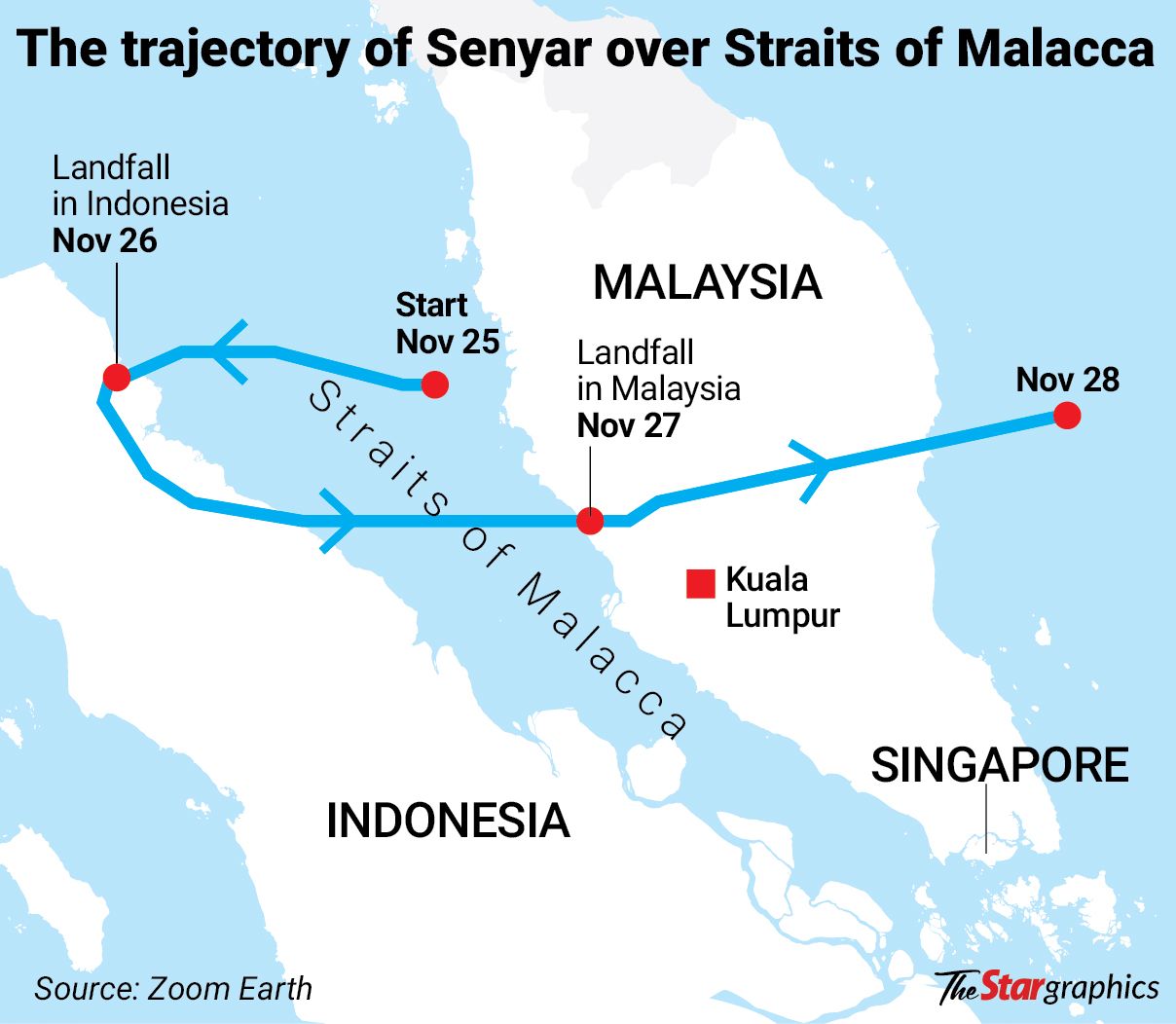
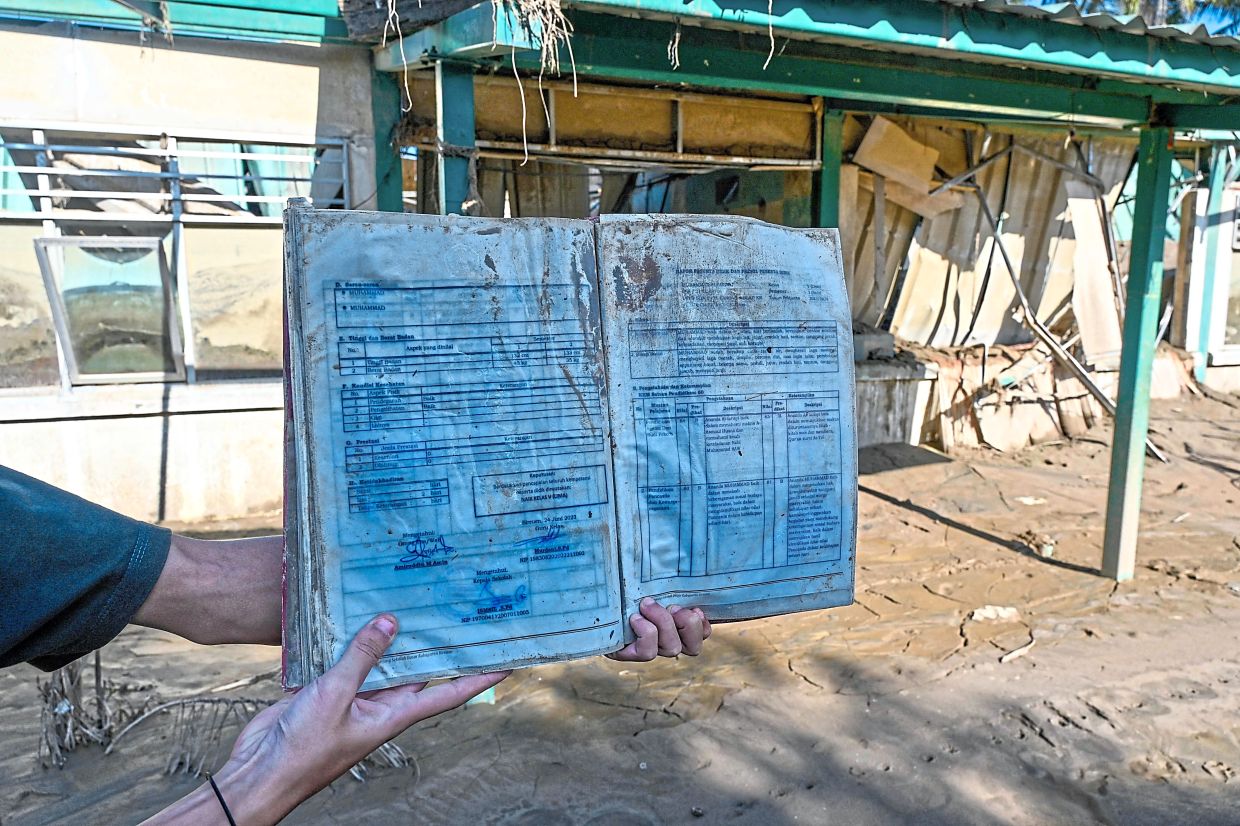
SOME two months after Cyclone Senyar unleashed its fury over the Straits of Malacca in November 2025, scenes of destruction are still coming out of Aceh in Sumatra.
Images of piles of debris, people wading through mud-choked streets, and scores of villages flattened by landslides are not only heart-wrenching but also so shocking that people are talking about how this is the second worst natural disaster to hit Aceh after the Boxing Day tsunami of 2004.
As of Jan 3, 1,157 people are confirmed to have been killed in Sumatra while 166 people, including a Malaysian, remain missing.
But Senyar did not just hit Sumatra; it also caused severe flooding and landslides in Hat Yai, southern Thailand – remember the photos of inundated cars all over social media? – as well as in Selangor and Negri Sembilan.
Luckily, Malaysia seemed to escape the worst of the tropical cyclone before it veered off towards Sumatra.
If there are still people who doubt our climate is changing, this is more proof. Because tropical Cyclone Senyar was not only unusually severe but its very existence was strange: it’s rare for a cyclone to form so close to the equator and over a narrow body of water like the Malacca Straits.
But the climate crisis is changing what’s normal.
Paying for the damage
In December 2025, new research by the World Weather Attribution group confirmed that climate change is making cyclones like Senyar more frequent and the associated rainfall more intense.
Sarah Kew, Royal Netherlands Meteorological Institute climate researcher and lead author of the study, called “the combination of heavy monsoon rains and climate change a deadly mix”.
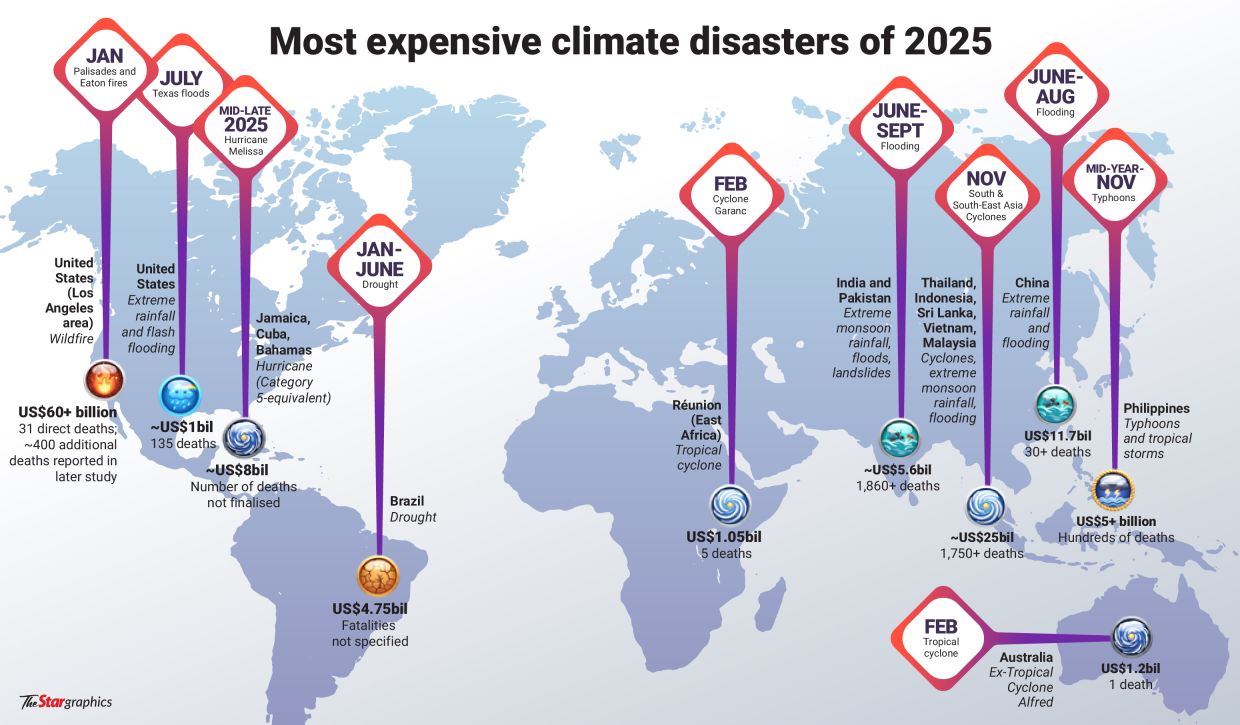
A study by the Christian Aid NGO put destruction from Senyar’s swath as the second costliest natural disaster last year (see graphic). Senyar caused US$25bil (RM101.5bil) in damages, while the January 2025 California fires cost more than US$60bil (RM282bil). They killed 31 people and incinerated nearly 17,000 structures in Los Angeles, including the homes of many A-listers like Paris Hilton, Anthony Hopkins, and Billy Crystal.
Other costly disasters last year include the flooding in China and Hurricane Melissa in Jamaica, Cuba, and the Bahamas. The report is based on loss estimates published regularly by insurance company Aon.
Who bears the cost of all this damage?
Greenhouse gas emissions effectively began with industrialisation in what are now First World countries. Historically as well as currently, it is these countries that emit the most greenhouse gases.
And countries like the United States – the world’s second biggest emitter of carbon after China – can pick themselves up after climate losses more easily than Third World countries.
Logically, then, First World countries should bear the brunt of the cost of climate change.
That has been the thrust of the argument put forward by developing countries during negotiations at the COP – Conference of the Parties – meetings on climate change under the United Nations.
Financial headwinds
Apart from urgently needed aid for immediate loss and damage, longer-term funding is also needed for a “just transition and adaptation” – ie, moving away from a high-carbon economy to a climate-resilient one in a fair and inclusive manner.
Third World Network deputy executive director Meenakshi Raman says that when it comes to climate finance, the biggest stumbling block is the lack of political appetite and willingness among developed countries.
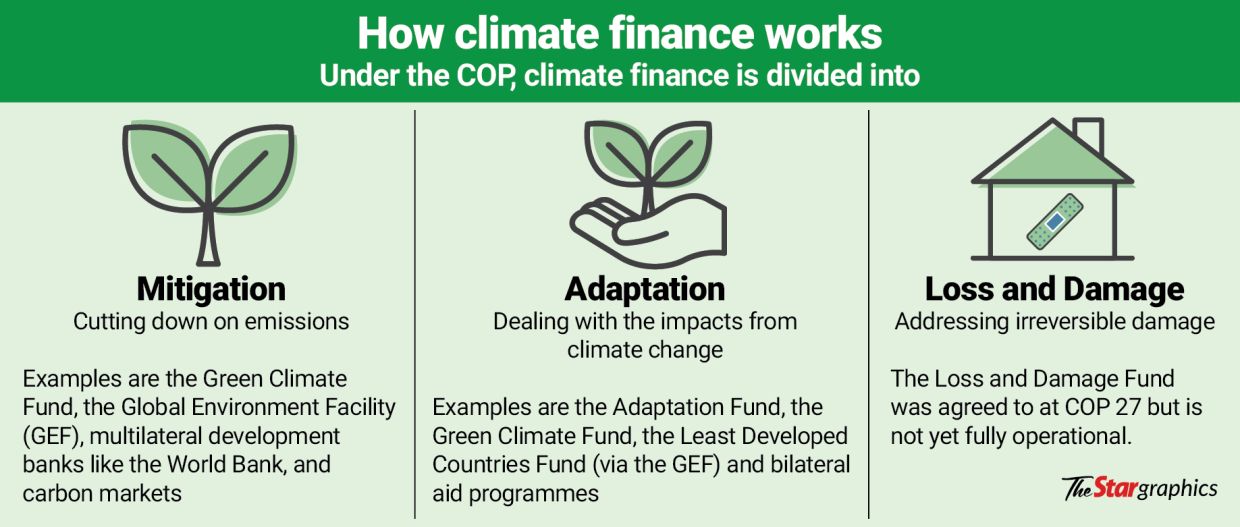
Within the COP framework, climate finance is basically divided into mitigation, adaptation, and loss and damage, each with its own purpose (see graphic).
The landmark Paris Agreement adopted in 2015 makes it clear that developed countries are to provide funds for the mitigation and adaptation efforts of developing countries.
“Yet developed countries are reluctant to make clear their commitment to climate finance and prefer to focus on finance mobilisation, shifting the responsibility to the private sector and multilateral development banks like the World Bank,” she says.
Meenakshi, who is also Sahabat Alam Malaysia president, was involved in negotiations at her 17th COP last year.
She reveals that during November 2025’s 30th COP meeting in Belém, Brazil, developed countries only agreed to establish a two-year work programme on climate finance after a huge fight with developing countries, led by the group of Like-Minded Developing Countries, or LMDC.
The LMDC group, which includes China, Egypt, India, and Saudi Arabia, is a negotiating bloc within the UN climate talks.
“This was an important big win in Brazil for developing countries to keep up the pressure on developed countries meeting their obligations,” says Meenakshi.
Asked if the lack of financial commitment from developed countries is due to developing countries lacking a voice, she says that is not entirely true: “Develo-ping countries usually come together as the Group of 77/China in a united voice on finance issues in the negotiations.
“There are also subgroups of developing countries like the LMDC, Alliance of Small Island States, Least Developed Countries, the African Group, and so on.
“We do have a voice. If these subgroups all speak with one strong, united voice under the G77/China bloc, then we get a better outcome. If we are divided, then our voice is weakened.”
As the world turns
But with the pace and scale of climate change seemingly doubling every year while negotiations progress at a snail’s pace, is there a risk of funds being “too little, too late”?
Should we throw caution to the wind and dunk consensus as a decision-making tool at the climate meetings to get things moving faster?
The current rules at COP meetings, says Meenakshi, only recognise consensus decision-making.
“...To make any changes for a voting procedure also requires consensus. Developed countries will not agree to voting on finance-related matters as they can be out-voted by developing countries. Hence, consensus is the only way possible for now,” she says.
What is most important, says Meenakshi, is for the global South to be united – this is the only guarantee for a successful outcome, as seen at COP27 in Egypt in 2022 when the fund for addressing loss and damage (FRLD) was agreed upon.
“This was indeed a very big win for developing countries since there is now a dedicated fund to provide aid to countries suffering loss and damage.
“The problem now, of course, is filling the fund with more resources, which is a challenge as only US$300mil to US$400mil [RM1.22bil to RM1.62bil] is currently available when what is required is in the order of hundreds of billions annually given the climate disasters we are facing,” she says.
With about US$18bil (RM73.08bil) in pledges, the Green Climate Fund is currently the largest dedicated fund for climate change mitigation, adaptation, and cross-cutting projects and programmes.
Other funds include the Adaptation Fund, which mobilised US$135mil (RM548mil) at COP30 – but that, according to Meenakshi, also needs funds, “of course, in the hundreds of billions” – the Global Environmental Facility (GEF), the Least Developed Countries Fund (via the GEF), as well as bilateral aid programmes, the FRLD, and carbon markets.
“Civil society groups are also involved in pressuring for more resources, including the Third World Network and Sahabat Alam Malaysia.
“We are also pushing for other forms of revenue generation, for example a UN tax convention that would allow for the taxing of billionaires, and other forms of revenue generation through international efforts,” she says.
Ultimately, what developed countries are willing to spend on or pledge for climate change is not reflecting the realities on the ground, putting the lives of many millions – most of them in poverty-stricken, vulnerable countries – on the line.
“There is a lot to do,” says Meenakshi.
An understatement, indeed.
Already a subscriber? Log in
Get 20% OFF The Star Digital Access
Cancel anytime. Ad-free. Unlimited access with perks.