
MALAYSIA has made notable progress in building institutions and frameworks to address climate change, but significant gaps remain in coordination, implementation and public engagement, according to a joint report by the World Bank and the Natural Resources and Environmental Sustainability Ministry (NRES).
Their recently launched Malaysia National Climate Change Institutional Assessment 2026 – Turning Vision Into Action report noted that while the country is in the process of finalising an overarching regulatory framework on climate change, the absence of a comprehensive law has left existing efforts somewhat fragmented. As such, the report suggests that greater clarity and detail will be needed to ensure the framework can effectively guide action across sectors.
“NRES could consider making national target-setting mandatory to strengthen accountability.
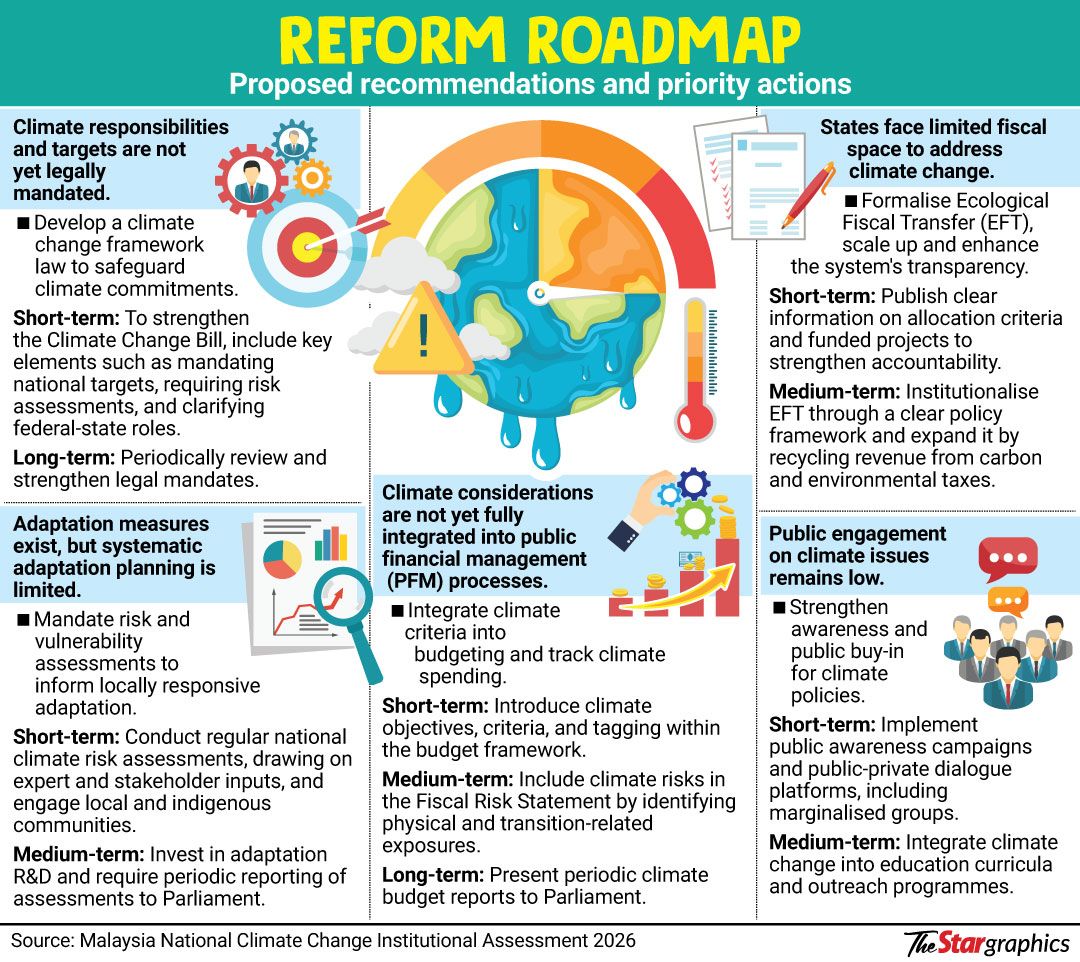
“The framework may also benefit from including mandatory risk and vulnerability assessments, independent expert input, defined roles for state governments, and standardised emission reporting,” reads the report.
At the same time, institutional arrangements, while well- defined, still present their own challenges.
After the restructuring in 2023, which saw the former Natural Resources, Environment and Climate Change Ministry split into two separate entities – the NRES and the Energy Transition and Water Transformation Ministry (Petra) – responsibilities for climate and environmental matters are now distributed across multiple ministries.
“While the roles of NRES and Petra are clear, further reshuffles could disrupt climate action progress.
“Studies show that such reshuffles reduce government effectiveness, as new ministers need time to understand their portfolios.”
This challenge is further compounded by Malaysia’s federal structure, as authority over key areas such as forestry and land management lies with state governments.
This could potentially create friction when federal policies and state priorities do not align, particularly in cases where states’ reliance on revenue from natural resources may discourage stronger environmental protections, while existing fiscal arrangements limit the federal government’s ability to incentivise compliance.
As a result, achieving consistent climate action across the country remains a complex task.
Even when planning frameworks are in place, there are questions about balance and focus.
For instance, the report finds Malaysia’s climate strategies to be well-developed and increasingly integrated into sectoral policies, particularly in energy and industry, but much of this planning skews towards prioritising mitigation over adaptation.
This imbalance is becoming more pronounced as the country faces growing exposure to climate risks, including rising temperatures and more frequent extreme weather events, underscoring the need for stronger adaptation planning.
Implementation of the policies presents another layer of challenge: While Malaysia has mechanisms such as MyProjek (which tracks development projects) to monitor climate-related programmes, current practices tend to focus on compliance and financial tracking rather than evaluating long-term outcomes.
Coordination among agencies also remains uneven, and consultative processes are described as limited in depth.
Together, these factors can weaken the overall effectiveness of climate initiatives, even when policies are well-designed.
Meanwhile, capacity across the government is also limited, with many ministries and agencies lacking a dedicated climate unit or staff, according to the report.
This capacity gap could hinder effective policy implementation and coordination.
“Institutional capacity gaps are widely recognised, yet Malaysia has not undertaken a systematic assessment or developed a coordinated strategy to address them,” the report notes.
Transparency and access to information are also areas of concern, because information about the activities of the various climate-related councils and coordinating committees is not always readily available.
“There are no dedicated platforms for public access to meeting details or activities, with information typically released through news or press statements.
“Follow-up measures and progress on decisions are rarely disclosed publicly.”
This contributes to a broader perception gap, because despite the ongoing efforts by the government, many Malaysians feel that not enough is being done to address climate change.
Strengthening transparency, improving coordination and addressing capacity gaps will be critical as Malaysia moves forward with its climate agenda.
As the country works to finalise its regulatory framework and refine its institutional approach, ensuring that policies are not only well-designed but also effectively implemented and communicated will be key to building both public trust and long-term resilience.