MALAYSIA is well placed to meet growing demand for skilled seafarers, but experts say it must first strengthen its maritime talent pipeline through better training, industry collaboration and greater career awareness.
According to the Baltic and International Maritime Council (Bimco) and the International Chamber of Shipping (ICS) 2026 Seafarer Workforce Report, 2.57 million seafarers currently serve aboard the world’s 85,148 merchant ships.
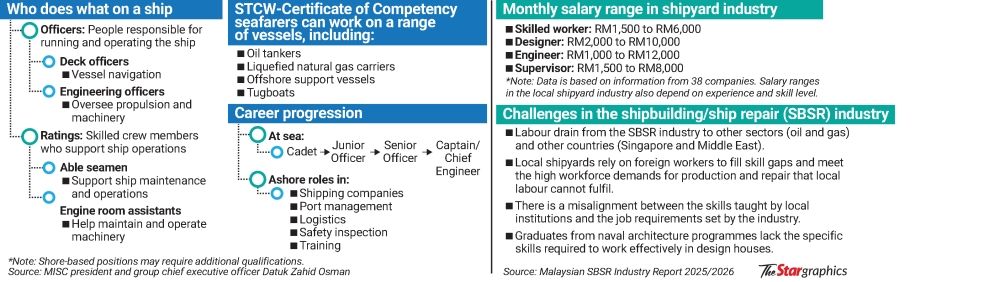
However, despite that workforce, the report, released in June, projects a shortage of 39,100 Standards of Training, Certification and Watchkeeping (STCW) certified officers this year, even as the industry maintains a surplus of 56,890 ratings or non-officer crew members (see infographic).
Netherlands Maritime University College founder and chairman Prof Datuk Seri Dr Capt Razali Yaacob said this highlights the need for countries such as Malaysia to produce more STCW-certified officers who can meet internationally recognised standards and access professional seafaring careers globally.
The STCW is an international framework established by the International Maritime Organisation to ensure maritime professionals meet minimum standards of training and competency.
“The global shortage of these officers presents an opportunity for the country to strengthen its position as a maritime talent hub.
“Malaysia already possesses the essential ecosystem, including ports, shipping companies, maritime institutions and regulatory expertise,” he told StarEdu.
However, he said ensuring more Malaysians attain STCW certification would require greater awareness of maritime careers, expanded training capacity and stronger partnerships between maritime institutions and the shipping industry.

“What is needed now is greater coordination and investment to expand the supply of STCW-certified officers,” he said, adding that if Malaysia moves decisively, it can not only meet domestic needs but also become a major exporter of highly skilled maritime professionals to the international shipping industry.
Agreeing, Malaysia International Shipping Corporation (MISC) president and group chief executive officer Datuk Zahid Osman said strengthening Malaysia’s maritime talent pipeline is crucial to producing more STCW-certified officers, ensuring the global shipping industry has the qualified talent it needs, safeguarding safety at sea and supporting economic growth.
“The STCW certificate provides a clear ladder of progression at sea and a strong foundation for diverse leadership roles ashore, making it a lifelong profession with global reach.
“With our strategic location along the Strait of Malacca and a strong tradition in maritime training, Malaysia is well placed to supply competent, future‑ready maritime professionals to meet both domestic and international demand,” he said.
Opening young eyes
Despite the international demand and structured career progression available, Prof Razali said maritime careers remain relatively overlooked by many young Malaysians due to outdated perceptions of seafaring and limited awareness.
“Many young people and their parents still associate seafaring with long periods away from home, physically demanding work and uncertain career prospects,” he said.
He noted that the profession has evolved significantly, with modern ships equipped with advanced technologies, automation and digital navigation systems, alongside improved welfare standards.
He added that a seafaring career could also open doors to numerous shore-based opportunities, including port management, maritime logistics, shipping management, offshore energy, marine surveying, maritime law, education and government administration.
“Many students simply do not realise that they can enjoy rewarding international careers with competitive salaries while contributing to global trade and national economic development.
“Unlike medicine, engineering or aviation, maritime careers receive relatively little exposure in schools,” he said.
Reinforcing this point, Zahid said this is why maritime careers need greater promotion, particularly through earlier exposure in schools.
“Rather than waiting until students reach tertiary education to introduce them to the sector, young people should be made aware of maritime career options before they make decisions about their future studies.
“Promotion must highlight modern career pathways, from sea-going roles like officers and ratings to shore-based opportunities in logistics, port management and maritime safety,” he said.
Beyond the numbers
For Malaysia to build a sustainable maritime workforce, Zahid said simply producing more graduates will not be enough.
He identified three priorities: expanding training capacity, strengthening industry partnerships to provide structured sea-time placements, and providing government support through scholarships, sponsorships and policies that make maritime careers more accessible.
“This includes investing in facilities and simulators while ensuring training institutions have enough qualified instructors to meet rising demand,” he said.
This push, he stressed, must also extend to increasing women’s participation in an industry that remains traditionally male-dominated.
Citing data from the Malaysian Maritime Academy (Alam), he said female cadet participation has risen from 9.4% in 2023 to 11.15% in 2025, considerably higher than the global seafaring average of about 1% to 2%.
“Through Alam, the MISC has steadily opened a traditionally male-dominated industry to a new generation of women.
“In 2006, Alam welcomed its very first batch of female cadets, enrolling women into the Diploma in Nautical Studies and Diploma in Marine Engineering, many of whom went on to be part of the MISC’s seafaring workforce,” he said.
He added that attracting and retaining more women in the workforce requires early outreach in schools, targeted scholarships, mentorship networks, inclusive workplace policies and clear pathways to shore-based leadership.
“Ultimately, increasing women’s participation must be coupled with ensuring that they have the support, opportunities and working environment to build lasting careers and progress into leadership,” he said.
Joining forces
Prof Razali said stronger collaboration between the government, shipping companies and maritime institutions is essential to guarantee cadet placements.
He identified cadet sea-time placement as the biggest bottleneck, pointing out that many students successfully completed their academic training but were unable to obtain the mandatory onboard training required for STCW certification.
He emphasised that a whole-of-industry approach must be adopted to attract young Malaysians and meet future demand.
“Young people are more likely to choose maritime careers when they can clearly see long-term career progression,” he said.
Most importantly, he said Malaysia needs a sustained national awareness campaign to showcase maritime careers as prestigious, high-income and global professions.
“As over 90% of world trade is carried by sea, the shipping industry will remain indispensable to the global economy,” he said.