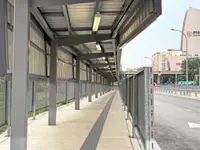
News reports surrounding the opening of the LRT Shah Alam Line reveals more than just missing pedestrian walkways.
It raises a deeper question about how public transport is planned, delivered and ultimately valued in our cities.
The line itself has already been delayed for years.
Yet when it finally opened, passengers were expected to navigate incomplete pedestrian connections to reach several stations safely.
It was only after videos highlighting these shortcomings went viral on social media that inspections were carried out, explanations offered and deadlines announced to complete the missing links.
The timing of the response is telling. Had those videos never circulated, would the missing pedestrian infrastructure have been addressed with the same urgency? It is a reasonable question to ask.
What makes the situation even more puzzling was Shah Alam City Council’s (MBSA) subsequent clarification that pedestrian walkways had not been an afterthought.
According to MBSA, these links were already imposed as conditions of the Development Order approvals granted in 2019, requiring Prasarana Malaysia Bhd and surrounding developments to provide pedestrian connections as part of the overall planning approval.
If that were the case, then the public is entitled to ask why these essential connections remained incomplete when the line commenced operations.
Why was a public transport system considered ready for passengers when part of the very infrastructure needed to access it had yet to be completed?
The episode also exposes a broader imbalance on the treatment of different transport users.
Road projects are rarely regarded as complete if motorists cannot safely and conveniently access them.
Yet, public transport users are often expected to accept missing footpaths, unsafe crossings and incomplete pedestrian links as temporary inconveniences.
This sends an unfortunate message that pedestrians and public transport users are expected to settle for less.
In a society that remains overwhelmingly car-centric, it reinforces the perception that they are treated as second-class citizens.
Yet these are the very people who are doing what governments have long encouraged – choosing public transport, helping to reduce congestion, lowering emissions and contributing to a more sustainable urban future.
They too, contribute to nation-building through the taxes they pay and deserve infrastructure that is safe, accessible and complete from day one.
If Malaysia is serious about encouraging a meaningful shift from private cars to public transport, first- and last-mile connectivity cannot continue to be treated as an afterthought.
It must be recognised as an integral part of the transport system itself.
A railway line is not complete simply because trains are running. It is complete only when people can reach its stations safely, conveniently and with dignity.
SHING SI YAN
Kuala Lumpur