




WHEN tourists from China witness the activities of the Nine Emperor Gods Festival in Penang for the first time, many are left mesmerised.
They have never seen it before because it was never done like this in China or at least, not the way we do it here.
The Chinese diaspora who settled in South-East Asia had taken this festival much more seriously and thus, developed elaborate rituals over the centuries.
The Nine Emperor Gods Festival is deeply rooted in the astronomical and spiritual worship of the Big Dipper (Ursa Major), a constellation of seven bright stars in the form of a ladle or sauce pan.
For millennia, travellers from the northern hemisphere have used two stars at the edge of its bowl to find north.
In Taoism, there is a deity named Doumu, who is regarded as the “Mother of the Dipper”.
The seven stars of Big Dipper and the two others deemed more invisible are marked as her nine sons, the Nine Emperor Gods.
This belief is at least 3,000 years old and vegetarianism is part of the festival’s observances.
When the forefathers of the Chinese came to South-East Asia, they continued with nearly all their traditional practises.
Those who settled down in Phuket, Thailand, and Penang somehow shaped the Nine Emperor Gods Festival into something much more intense.
Today, it has evolved to become almost a folk religion with a strong focus on cleansing the body and mind.
There are those who regard themselves not merely as Taoists but also Nine Emperor Gods devotees.
During the festival, the purists wear white while their vegetarian meals are prepared with cookware that has never been in contact with meat.
Many devotees eat out during this time, buying food from the hundreds of temporary stalls draped in yellow cloth and banners to indicate dietary compliance with the festival requirements.
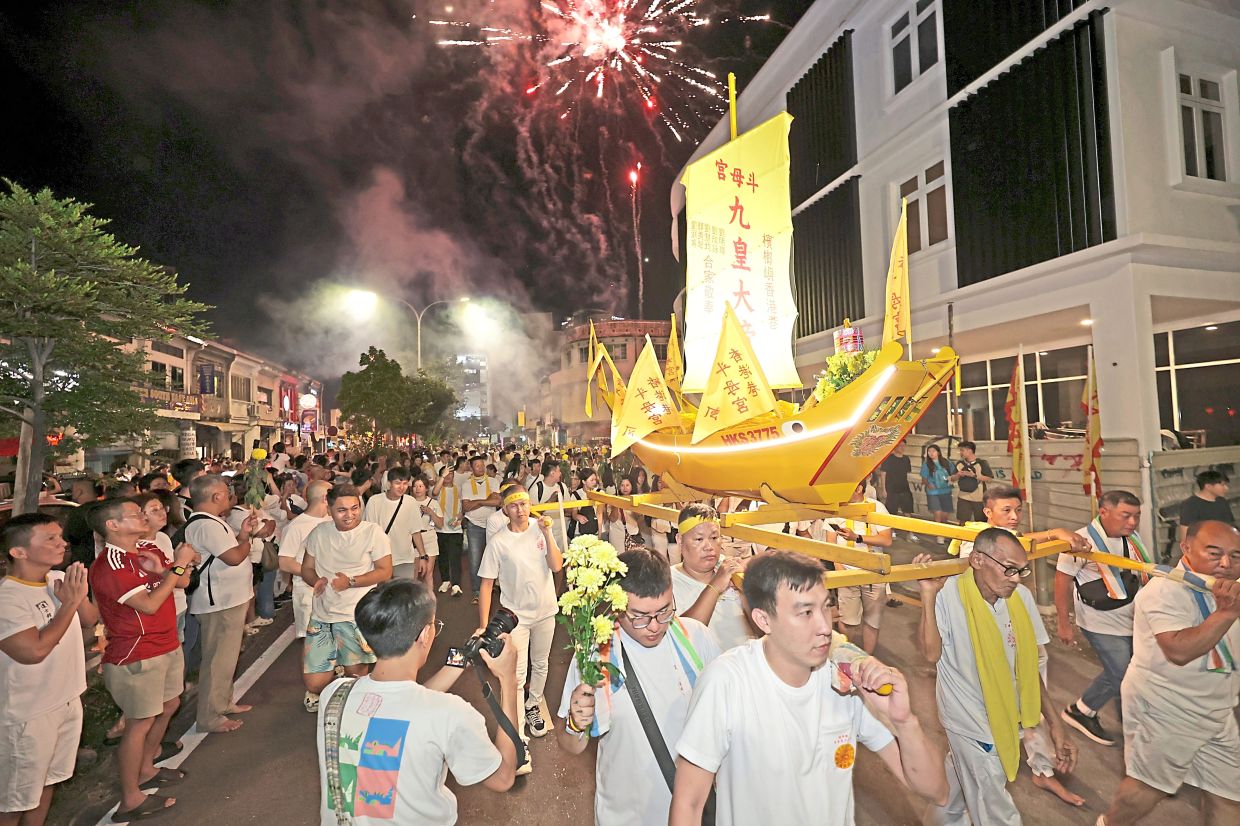
At home, devotees keep a set of utensils reserved only for use during these nine days.
Some stick to strict vegetarianism for 11 days, with additional days before and after the festival’s nine days.
Perhaps the South-East Asian climate may have influenced the festival’s spiritual rigour.
The festival is typically held at the start of the ninth Chinese lunar month.
This is usually the start of the inter-monsoon period, often a wet spell.
Devotees believe that it will rain throughout the nine days of the festival.
This year, in Penang, the festival began on Oct 10 and indeed, there was rain for hours each day.
With bodily and spiritual cleansing being such an outstanding feature of the festival, the rain can be perceived as part of the purification process.
The festival has been celebrated in Phuket and Penang since the 1800s.
The Kathu shrine in Phuket is the oldest known Nine Emperor Gods temple in the region, and when Captain Francis Light first brought people to settle in Penang in 1786, he invited the Chinese from Phuket.
Effectively, China tourists in Penang were witnessing overseas Chinese rituals that have evolved to a much grander scale than what it would historically have been in the motherland.


