
LONG before festive delicacies are prepared or guests arrive, a familiar greeting marks the entrance of an Indian home during Deepavali: a brightly drawn kolam (or rangoli).
Made up of intricate lines, delicate curves, dots and geometric patterns, the traditional floor art is more than a decorative feature.
For many families, it is a meaningful expression of culture, hospitality and hope for good fortune and prosperity.
While traditional kolam comes in many forms, shifting lifestyles are reshaping Deepavali preparations, with hand-drawn patterns increasingly giving way to ready-made stickers and foam cut-outs.
For 72-year-old artist and painter R. Karunagaran, each kolam design he draws or paints is a labour of love that requires a steady hand, patience and an eye for detail.
Over the past decades, the grandfather of one has been continuing the tradition that was passed down through generations.
Karunagaran used to observe his mother draw the rice flour kolam at the entrance of their house when he was just a child.
“Drawing a kolam at the entrance of a house or temple has long been part of the Tamil culture; it is traditionally drawn daily to welcome good fortune and prosperity.
“I remember my mother explaining how in the early days in India, womenfolk drew kolam using rice or rice flour as food offering to birds and ants around the home,” said Karunagaran.
“This is an ancient south Indian and Hindu tradition representing hospitality and harmony with nature.
“When festivals and special occasions are around the corner, more elaborate and intricate kolam designs are then put up at the entrance.
“Households also put up decorations such as thoranam (hanging decorations made of mango, coconut or neem leaves that are weaved together) and vazhai maram (young banana plants) over the doorway,” he said.
The retiree spoke to StarMetro while putting some final touches to the painted kolam at the entrance of the Arulmigu Sri Mahamariamman Temple in Queen Street, Penang, for the coming Deepavali festival.
Karunagaran, who is a former Telekom Malaysia employee, has been drawing kolam at temple entrances as part of Deepavali preparations for the past 30 years.
Wall to floor
Karunagaran said his artistic side emerged after he was asked to paint a lotus – known in Tamil as kamalam – a motif often featured on the ceilings of traditional Hindu temples.
“I was only about 18 or 19 at the time and had already painted the temple walls,” he said.
Painting the kamalam on the ceiling, he said, prompted him to wonder why he could not create similar designs on the floor.
Although kolam drawing was often seen as a woman’s domain, Karunagaran said men have also embraced the traditional art, proving that it is a skill that transcends gender.
Over the years, he has drawn traditional kolam using rice, coloured rice, rice flour and paint to form designs featuring flowers, dots and geometric patterns.
“Drawing a kolam requires patience and practice. You cannot simply rush through it, because one wrong line can affect the entire design,” he said.
Karunagaran, whose works can be found within the Little India enclave, usually begins by marking out the basic pattern before carefully connecting the lines and filling the spaces with colour.
“After doing this for so many years, my hands know what to do. But when I first started, I had to concentrate on every line,” he said.
While he remains passionate about preserving traditional kolam, Karunagaran noted that many families now opted for the convenience of ready-made stickers or polystyrene foam cut-outs for Deepavali.
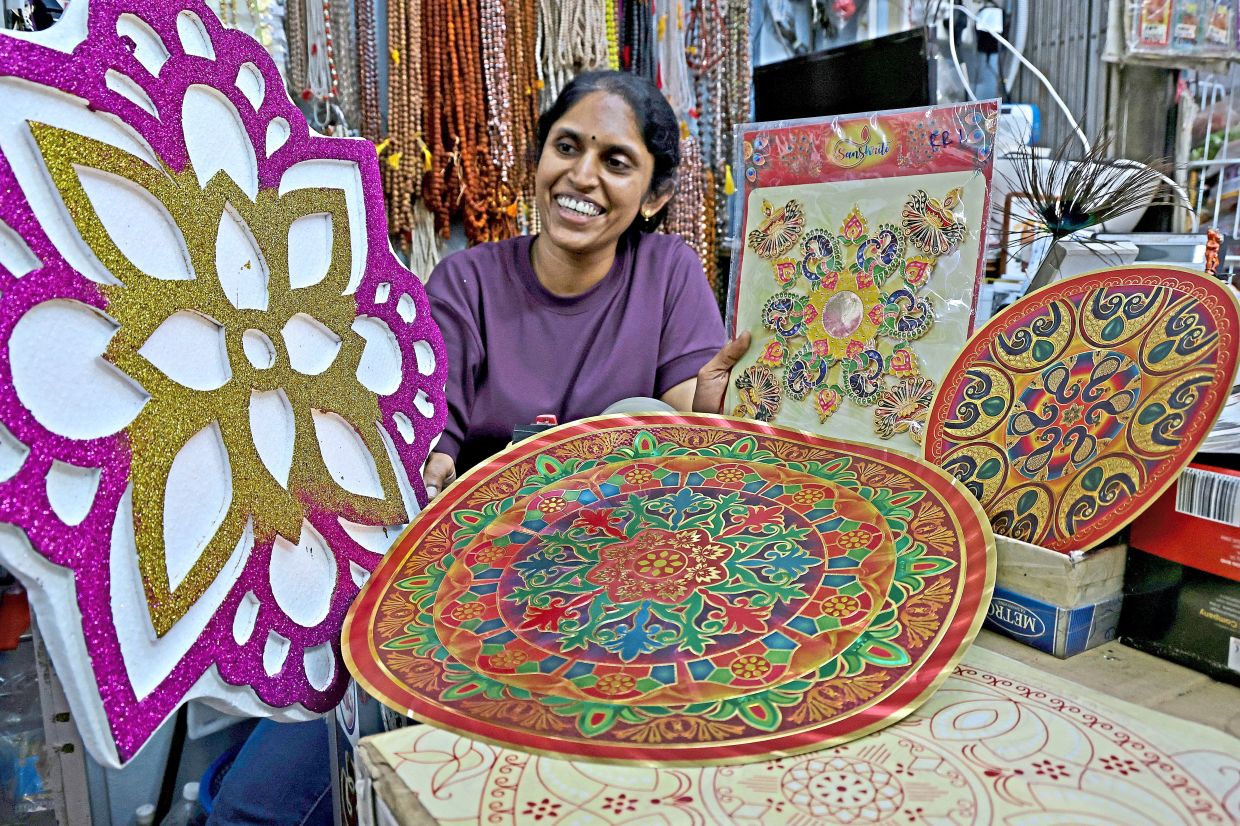
The pre-cut decorative design made from a thin foam sheet, often polystyrene, is placed on the floor while the sticker kolam is a ready-made design with an adhesive backing that sticks to any surface. Depending on the product, it may be made from vinyl or other material.
“With a sticker, you just peel it off and place it on the floor. It looks neat and saves time, especially for people who are busy with work and other preparations,” said Karunagaran.
“But when you draw a kolam yourself, you are involved in the whole process. You have to plan the design, control the powder and take care with every line.
“There is satisfaction in seeing the pattern come together,” he said.
He does not consider sticker kolam a bad thing, as they allow more people to decorate their homes for the festival.
“Not everyone has the time or skill to draw a kolam. Stickers are convenient, and I understand why people use them, especially at the entrance of their flats or apartments.
“But I hope the younger generation will also learn to draw one by hand.
“If we stop practising, the skills passed down by our elders may eventually be lost,” he said.
He hopes that more young people will take an interest in learning the art rather than seeing it as an unnecessary task.
“Even if they use stickers at home, they can still learn how to draw a simple kolam. What matters is that they understand the tradition and pass it on to the next generation,” he added.
Karunagaran is proud that both his sons, who are in their 30s, have followed in his footsteps.
“They are both part-time painters and artists too; they are keen on continuing this tradition and to pass it on to their children,” he said, adding that his six-year-old granddaughter has also started showing keen interest in art and painting kolam designs.
“I hope to pass down my skills to her in the future, so that this tradition will not be forgotten,” he said.
Sticky solution
Sticker and polystyrene kolam gained popularity in Malaysia by the early 2010s, appealing to those who wanted quick, reusable decorations without spending hours drawing intricate patterns.
The contrast between the two methods offers a glimpse into how Deepavali traditions are being practised by different generations.
A check at Penang’s Little India, located in George Town’s Unesco World Heritage Zone, showed that kolam stickers are a popular item for Deepavali, especially among the younger generation.
Kalaivani Book Centre owner P. Santhanakumari, 40, who also sells Deepavali decorative items at her shop, said her customers would usually buy a bigger sticker kolam for the entrance.
“These kolam stickers come in different sizes. Some customers get both the bigger and smaller ones and decorate their entrance accordingly,” she said, adding that customers had started shopping for Deepavali decorative items two weeks ago.
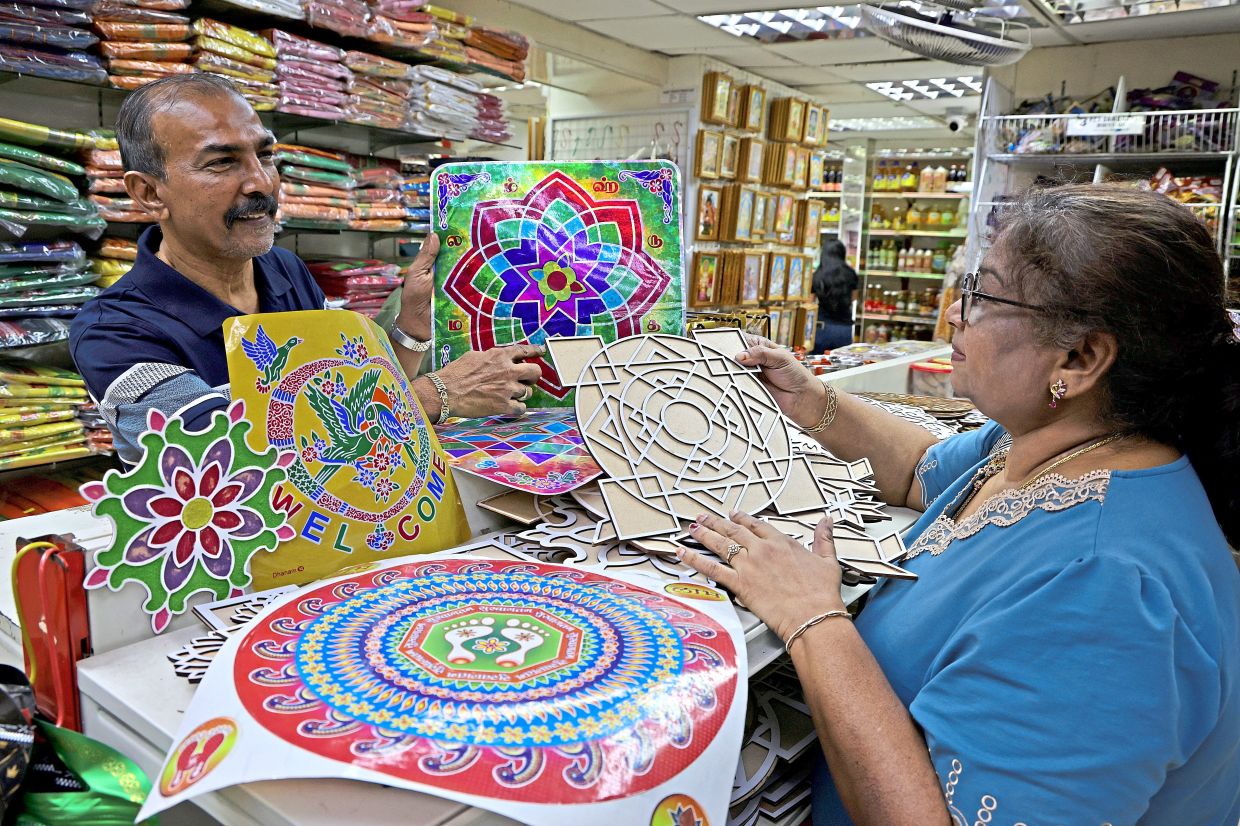
Retired teachers G. Chandra Segaran, 68, and his wife K. Valarmathi, 64, were spotted shopping for decorative items, including kolam sticker at a shop in Little India.
“We are from Sungai Petani, but we come to Penang’s Little India every year to do our Deepavali shopping.
“Since we will be celebrating Deepavali at our daughter’s house in Kuala Lumpur this year, we came to shop for some items as we won’t have the time to do any shopping later,” said Valarmathi.
Celebrating Deepavali in her new home for the first time is auditor S. Uma, 44, who was shopping for kolam stickers and decorative lights with her daughter J. Rashitra, 16, and son J. Lakkesh, 14.
“This year we started our Deepavali shopping much earlier because we wanted to decorate our new house and make it grand, to feel festive when our family and friends come over,” said the single mother.
Uma also bought traditional clothes for her three children, besides household items and traditional Deepavali snacks.
For her, the preparations are about more than just putting up decorations, as the family looks forward to creating new memories together.
Celebratory mood
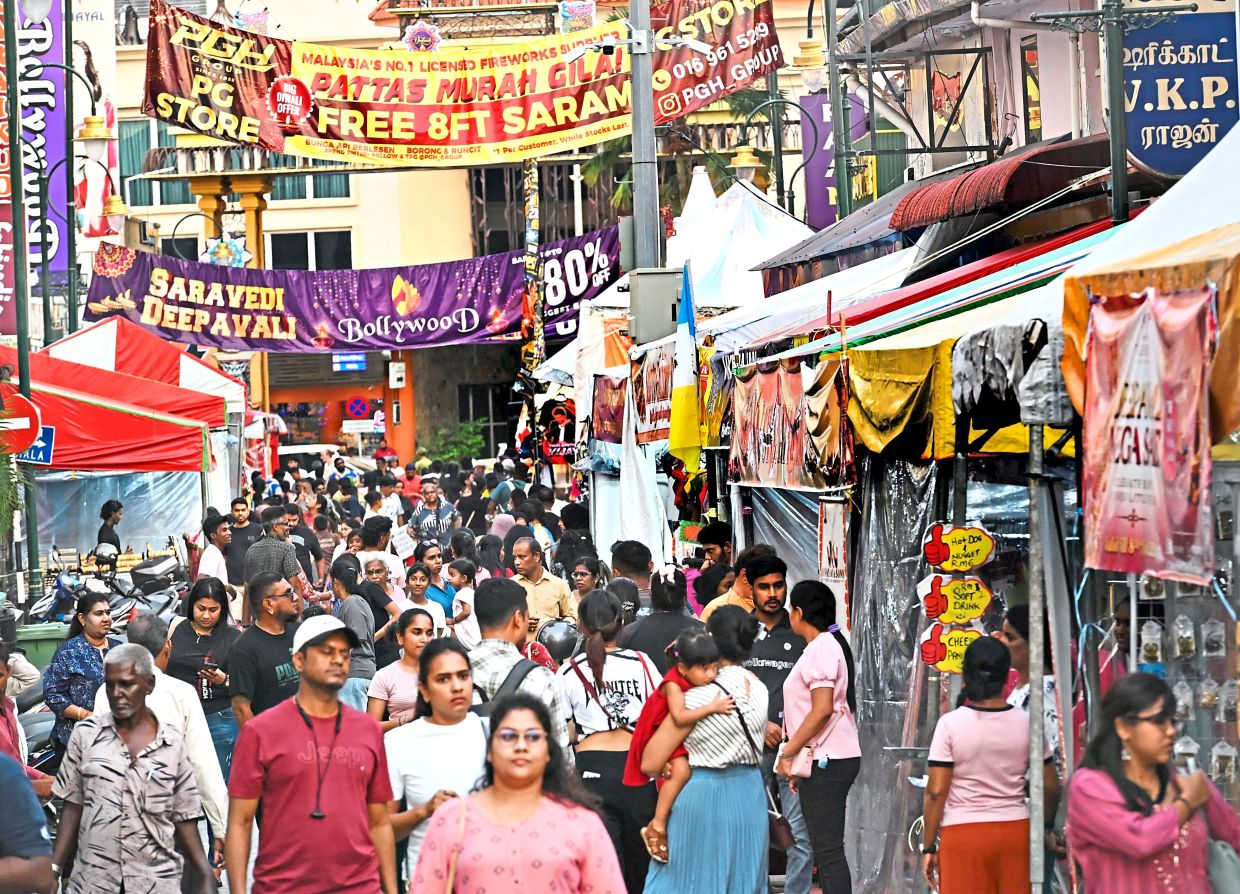
With Deepavali just days away, Little India has become a hive of activity as shoppers throng its narrow streets in search of new clothes, festive treats and decorations.
Nephrologist Dr A. Kavitha,36, and her husband Dr I. Mahendran, 40, said they would usually visit the area a few weeks before the festival to avoid the last-minute rush.
Dr Kavitha said she enjoyed the lively atmosphere as shopkeepers displayed colourful sarees, traditional outfits and festive decorations.
“I always look forward to coming here before Deepavali. The shops are filled with colours, and you can feel the excitement in the air,” she said.
She noted that buying new clothes was among the family’s most important Deepavali preparations.
Apart from clothing, she also bought muruku, traditional Indian sweets and ingredients for preparing festive meals at home.
“Deepavali is not just about wearing new clothes or decorating the house. It is also about gathering with family, visiting relatives and sharing food,” she said.
Although online shopping had made it easier to buy clothes and household items, Dr Kavitha preferred visiting the shops in Little India to choose her festive purchases in person.
“When buying clothes, I want to feel the fabric and see the colours for myself.
“Shopping here also gives me the chance to support local traders,” she said.
“The festive atmosphere, from the decorations to the crowds moving between shops, makes the shopping trip special.
“For me, Deepavali would not feel complete without coming here to shop. It is something I grew up doing with my family, and I hope my children will continue the tradition,” added Dr Kavitha.
That blend of family tradition and seasonal style is reflected in the bustling aisles of local boutiques.
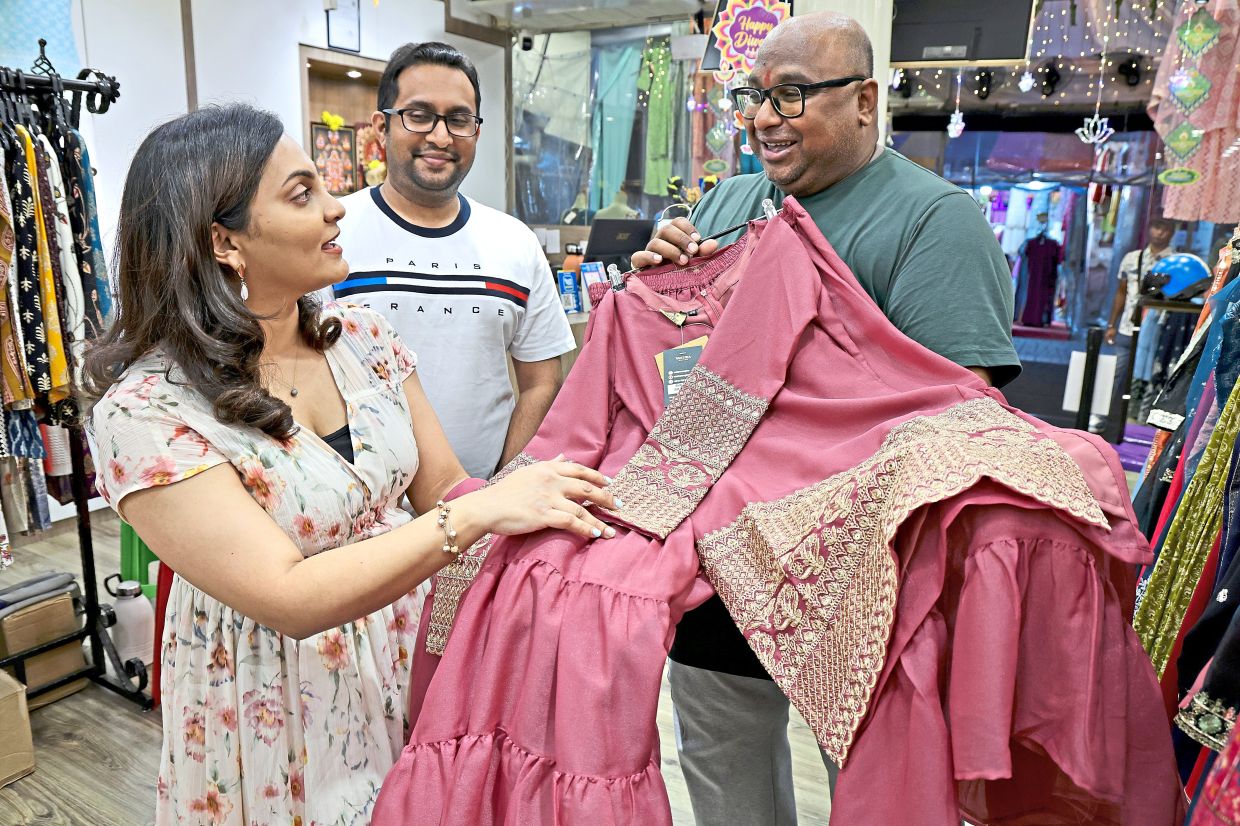
Vastra Empire owner San Shehab Sann See, who was busy attending to last-minute shoppers, said the sharara suit had emerged as a clear favourite this year.
“It is in trend, and both young and old are drawn to the three-piece suit,” he said, describing the outfit of a kurti, wide-legged flared trousers and matching dupatta.
“It is easy-flowing, comfortable and light enough to be worn either on Deepavali morning or for evening visits.”
Whether following new trends or sticking with the tried-and-true, stepping out in new outfits on Deepavali symbolises a fresh start for families celebrating the Festival of Lights.
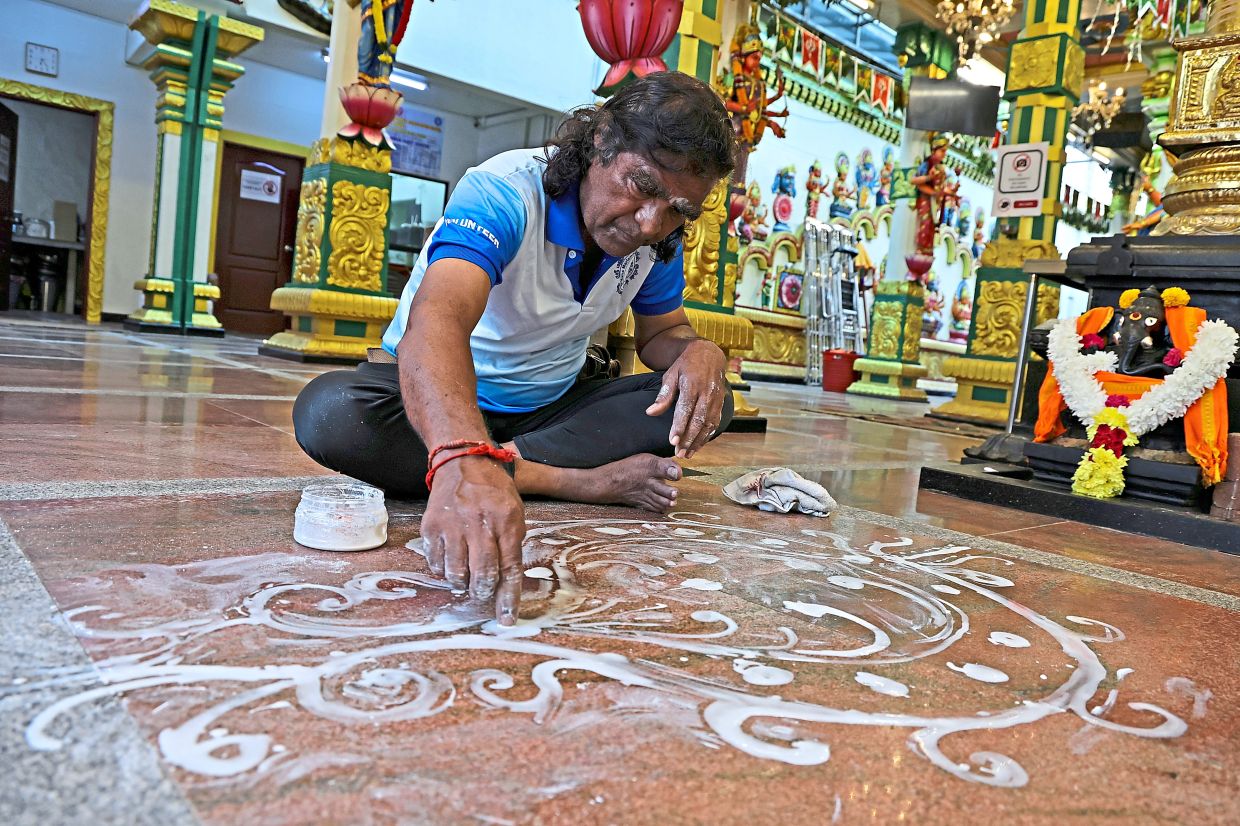


Karunagaran drawing a rice flour kolam on the floor of the Arulmigu Sri Mahamariamman Temple in Queen Street, Penang, for the coming Deepavali festival.
Santhanakumari showing the polystyrene and sticker kolam sold at her shop in Little India for Deepavali.
Sweet treats are a must for Deepavali, and shoppers are spoilt for choice.
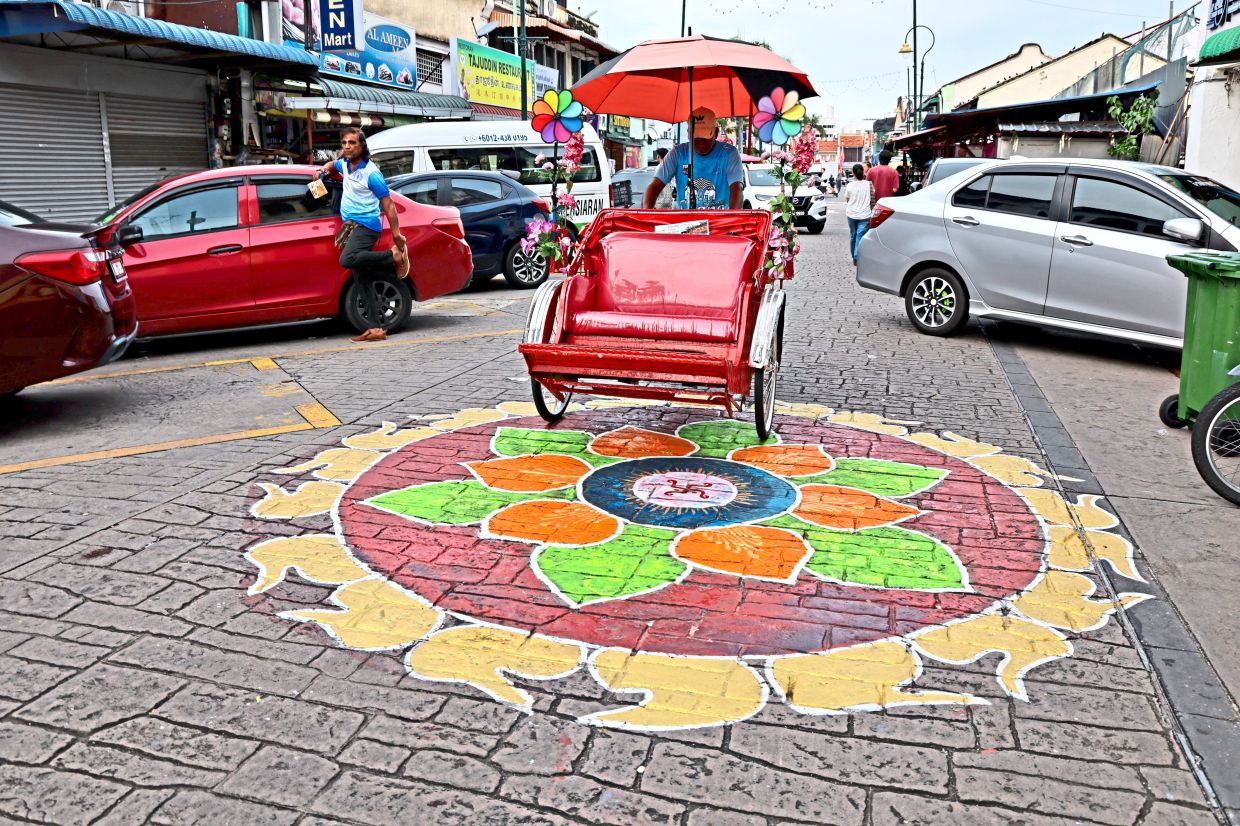
Colourful kolam drawings can be found on the roads at the Little India enclave in Penang.
Uma (right) shopping for Deepavali decorations with her children Lakkesh and Rashitra.
Shopowner San Shehab (right) showing the ‘sharara’ suit to Dr Kavitha and her husband Dr Mahendran. The suit is in trend now and popular with the young and old.
Chandra Segaran and his wife Valarmathi checking out the kolam stickers sold at a store in Little India. They plan to celebrate with their daughter in Kuala Lumpur.
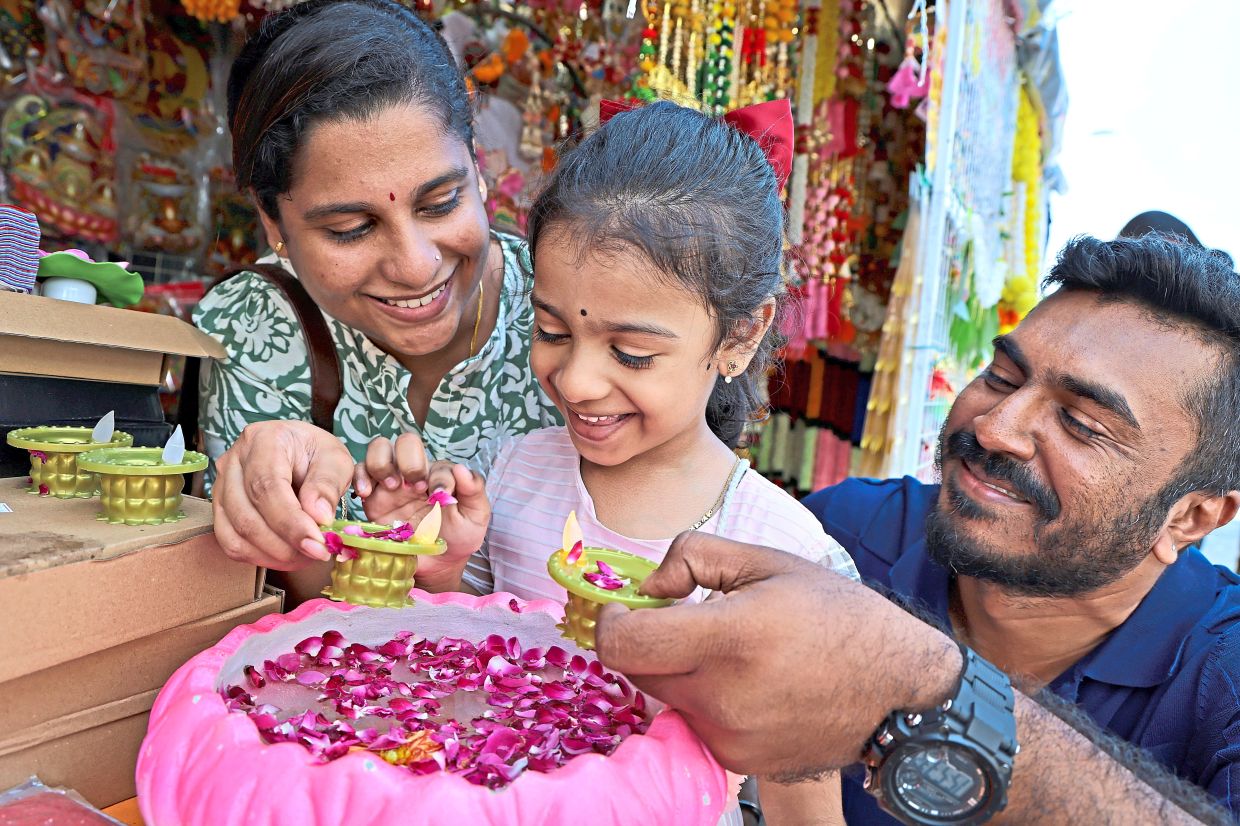
Engineer C. Surendren and his wife P. Legasiri with their daughter visiting Little India, Penang, where they bought 10 water-activated lamps.
With Deepavali just days away, Little India has become a hive of activity as shoppers throng its narrow streets in search of new clothes, festive treats and decorations for the Festival of Lights.