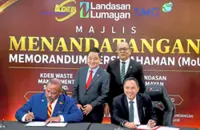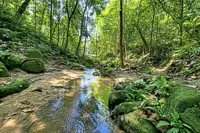
Friends of Rivers (FOR), a community-driven rehabilitation programme under Selangor Water Management Authority (LUAS), will receive RM2.7mil next year for its initiatives.
State infrastructure and agriculture committee chairman Datuk Izham Hashim said the allocation, a hike from this year’s RM700,000, would be used to construct river trails and expand community activation.
“Currently 58 communities are involved in the initiative, but the state believes many more can participate, even by caring for smaller rivers or streams near their homes,” he said.
Speaking at the closing of Selangor Friends of Rivers Workshop 2026 at Selangor International Trade Centre in Shah Alam, he reminded participating communities that activities within river reserves must not compromise its primary role in flood management.
“River reserves serve as secondary channels or floodplain areas, allowing excess water to overflow safely when rivers are full.
“Any planning must therefore ensure that these areas remain capable of accommodating floodwater.”
He also urged those involved in riverbank community gardens to avoid using chemical fertilisers.
“Instead, use compost and other organic alternatives to prevent runoff from contaminating nearby waterways,” he stressed.
Highlighting the importance of the FOR programme, Izham said Selangor had at least 1,025 main rivers and tributaries, more than 140 ponds and lakes, and a 291km coastline stretching from Sabak Bernam to Sepang.
Altogether, the state’s river network spans about 3,950km.
“To put that into perspective, the total distance is roughly equivalent to travelling from Johor to Perlis and back three times,” he said.
“As such, protecting and revitalising this extensive network will require collective action.”
Izham stressed that the public and local communities played an important role in managing the state’s water resources.
“Every effort matters, even something as simple as picking up rubbish.
“When hundreds or thousands of people take small actions together, they can create a real and lasting improvement in our rivers,” he said.
At a press conference after the event, Izham acknowledged that enforcement responsibilities among Drainage and Irrigation Department, LUAS and local authorities needed to be better coordinated to tackle illegal dumping and pollution along riverbanks.
“We are looking at ways to better align agency responsibilities to prevent ‘no man’s land’ situations, in which a problem falls between jurisdictions and is left unresolved.
“The aim is for enforcement and cleanup measures to be carried out in an integrated manner.
“However, given the length of Selangor’s river network, it is not always possible to catch offenders in the act,” he noted.
He said tracing pollution to its source remained a major challenge, citing the more than 8,000 industrial premises in the Langat River Basin and over 6,000 in the Selangor River Basin.
“Investigators must trace the source of pollutants across extensive drainage and waterway networks.
“We cannot assume that only factories located beside the river are responsible for pollution.
“The cause may come from a factory that is located from as far as 3km from a waterway.”
He said the LUAS Elite Water Squad (SKEAL) had played a key role in monitoring, patrolling, detecting and responding early to pollution incidents.
“There has been a significant decline in emergency cases, from 80 in 2024 to 38 in 2026, with no Code Red cases recorded to date,” Izham said.
The one-day river workshop aimed to deepen FOR communities’ understanding of their roles and raise awareness of guidelines governing activities near rivers and water resources.
Participants also received certificates of appreciation in recognition of their commitment, efforts and continued contributions to river protection and restoration activities.
Present at the event were LUAS chief assistant director Haslina Amer, planning and development division senior assistant director Nor Zamri Sondor and legal and enforcement division senior assistant director Haizam Irwan Toha.