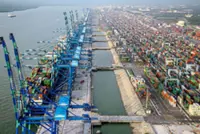
Port of Tanjung Pelepas (PTP) in Johor is the first maritime hub in Malaysia to commission and operate a fleet of electric prime movers (e-PMs) as part of its efforts to reduce carbon emissions.
Transport Minister Anthony Loke said the introduction of the e-PMs reaffirmed the port’s pioneering spirit, setting another national benchmark for the maritime industry.
“Ports around the world are accelerating their transition towards electrification, and I am pleased to see Malaysian ports, with PTP at the forefront, keeping pace with global developments.
“What makes this achievement even more meaningful is that these e-PMs are manufactured locally by Terberg Tractors Malaysia (TTM) in Pasir Gudang, showcasing the strength of Malaysian talent and manufacturing capabilities,” he said in a statement.
Loke said last year, PTP also recorded another historic milestone as the first container terminal in Malaysia to surpass 14 million twenty-foot equivalent units (TEUs) in a single year.
“It was also recognised by Alphaliner this year as the world’s fastest-growing port, with a growth rate of 14.5%.
“I look forward to seeing PTP continue strengthening its position as Malaysia’s leading transhipment hub, while further establishing itself as one of the region’s most resilient and high-performing container terminals,” he said.
Meanwhile, PTP chief executive officer Mark Hardiman said the port conducted a proof of concept between 2023 and 2024, which found that an e-PM generated significantly less carbon dioxide.
“The study demonstrated that an e-PM generates 4,000kgs of carbon dioxide equivalent per month compared to 7,600 for conventional units.
“This represents a 48% reduction in emissions, alongside a 57% reduction in monthly operational costs per unit,” he said.
Hardiman added that PTP has established a comprehensive decarbonisation pathway to reduce carbon emissions by 45% by 2030 as it moves towards its net-zero emissions target by 2050.
“Between 2011 and 2023, we progressively electrified our rubber-tyred gantry crane (RTG) fleet in phases, while expanding the fleet over time, with 245 e-RTGs now in operation,” he said.
“The introduction of e-PMs marks another important step in this ongoing transition towards lower-carbon port operations.”
He said the new electric vehicles formed an integral part of PTP’s long-term expansion programme, which would increase the port’s handling capacity to 16.3 million TEUs annually by 2029.
TTM chief executive officer Boo Wei Ching said the commissioning also demonstrated the capabilities of Malaysian engineering and manufacturing in supporting world-class port operations.
“Beyond supplying the equipment, our teams worked closely with PTP throughout the testing, commissioning and operational readiness process to ensure every unit performs reliably in a demanding environment.
“We look forward to supporting PTP as the remaining units are progressively commissioned in the months ahead,” he said.
The first 21 e-PMs, supplied by TTM, entered service on Aug 11 to support container movement within the terminal, while another 31 units are expected to be delivered in batches by the end of September.