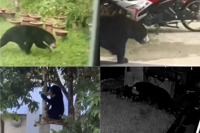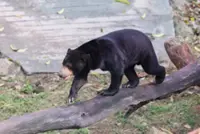
SUN bear conservationists in Sabah are testing a soft release method to increase survival of the endangered species.
Tenom and Pitang were selected as trailblazers for the programme involving a phased reintroduction to their natural habitat.
“This process takes time and depends on each bear.
“We take them to the forest, then back to the centre and repeat the process until they are independent enough to live on their own in the wild,” Bornean Sun Bear Conservation Centre (BSBCC) environmental education officer Mohd Haniff Mohd Busrah said during a briefing at Tabin Wildlife Reserve (TWR), Bernama reported.
BSBCC currently has 43 rescued sun bears, the majority previously illegally kept as pets or were found in oil palm plantations.
So far, 13 bears were hard- released, but three didn’t survive due to factors like competition among bears in the wild, food scarcity, disease and injury.
“When they become too accustomed to humans, restoring their wild nature is very challenging.
“Some no longer exhibit natural behaviour, so they remain at the centre,” he said.
In the soft release, the bears are fitted with a GPS collar (costing around RM10,000 each) to enable monitoring and evaluation of the programme’s effectiveness.
Mohd Haniff said 15 bears were rescued between 2018 and 2026, with an upward trend in rescues this year with four bears so far.
Tabin Sun Bear Project (TSBP) by BSBCC and supported by a RM50,000 grant from Malaysian Palm Oil Green Conservation Foundation (MPOGCF) is focused on scientific research, field monitoring and human-wildlife conflict management.
TWR, under Sabah Forestry Department and Sabah Wildlife Department (SWD), is about twice the size of Singapore and is suitable for wildlife conservation as it is far from human habitation.
It is equipped with BSBCC facilities for rehabilitation programmes, monitoring and research, in addition to having logistical uniqueness such as natural landing areas in the volcanic mud zone to facilitate access to the interior.
Meanwhile, MPOGCF conservation and sustainability executive Nur Fatin Amirah Ahmad Amri said support for TSBP was part of efforts to promote sustainable wildlife conservation.
Plantation companies work in cooperation with SWD and BSBCC to report the sighting of bears, she said, while part of the grant was utilised for the GPS collars.
She said Tenom, who has been at Tabin for almost two years, was showing positive adaptation to the forest environment.