
Locals highlight urban challenges in rapidly developing area in JB
KNOWN for its vibrant food scene and thriving commercial areas, the Johor Jaya constituency has evolved into one of Johor Baru’s most established residential and business hubs.
The Johor Jaya state seat was first contested in 2004 following a redelineation exercise in 2003.
The constituency was carved out of parts of the Tiram state seat and the former Pasir Gudang state seat, which was redesignated as a parliamentary constituency during the exercise.

Residents acknowledge the constituency’s rapid development over the years but believe more can be done to address issues such as parking, environmental management and community facilities.
Businesswoman Annie Chia, 43, said environmental concerns especially rubbish disposal and dengue should be given greater attention in the Johor Jaya constituency.
“Cleanliness in some areas has deteriorated, with dengue cases becoming more common.

“I believe poor waste management is one of the contributing factors which needs to be addressed,” said Chia, a Johor Jaya resident of more than 40 years, who is active in a local community committee.
She added that clogged drains and flash floods remained recurring issues in some areas despite complaints to the authorities.
“When drains are blocked, water cannot flow properly and flooding, in some areas, happen after a short downpour.
“Despite repair works carried out from time to time, the problems still recurs,” she said.
Chia said parking shortages in commercial areas was a growing concern.
Germaine Yong, 52, agreed.

She said limited parking in some of the constituency’s busier commercial areas was especially challenging on weekends.
“Parking can be a problem in popular areas such as around Jalan Dedap, especially on Saturdays and Sundays.
“When parking bays are full, some motorists park along the road, which contributes to traffic congestion,” said Yong, who helps her husband run a shop selling school uniforms in Johor Jaya.
Yong, who has lived in Johor Jaya for over 30 years, said the area was well maintained and had continued to improve over the years.
“There have been improvements over the years, especially in terms of roads and other basic facilities,” she said.

“I hope the constituency continues to see development and attract more visitors to further boost the local economy.”
Retired army serviceman S. Balakrishnan, 66, said the constituency was one of the most developed areas in the state.
“I have lived here for 40 years and have seen a lot of progress and improvements,” he said.
Balakrishnan said he hoped the elected assemblyman would continue maintaining the constituency, with a focus on infrastructure matters.
“Most of the roads, drains and public facilities are generally well maintained and issues are often addressed quickly.
“I hope the next assemblyman will continue this effort and ensure that the Johor Jaya constituency remains a comfortable place for residents to work and live in,” he said.
Retiree Khalid Abu Bakar, 64, said community leaders and residents should be given easier access to development allocations to address issues affecting their neighbourhoods.
“Many of the facilities and buildings in our residential areas are old and in need of repairs and upgrades.
“As community leaders, we often apply for allocations to carry out improvement works, but the process can be difficult and it takes a long time,” said Khalid, who is active in local community organisations.
He hoped the next assemblyman would prioritise community development and strengthen support for grassroots initiatives.
“I hope the next elected rep makes it easier for community groups to get aid to carry out programmes and improvements for residents,” he said.
The Johor Jaya seat is a Chinese-majority constituency with 45.4% Chinese voters, 39% Malays, 7.9% Indians and the remaining 3.7% comprising other communities, including Sabahans and Sarawakians.
In the previous state election, Pakatan Harapan’s Liow Cai Tung won the seat in a four-cornered contest against Barisan Nasional’s Chan San San, Perikatan Nasional’s Ker Ching Sheng and Parti Warisan’s Victor Chen.
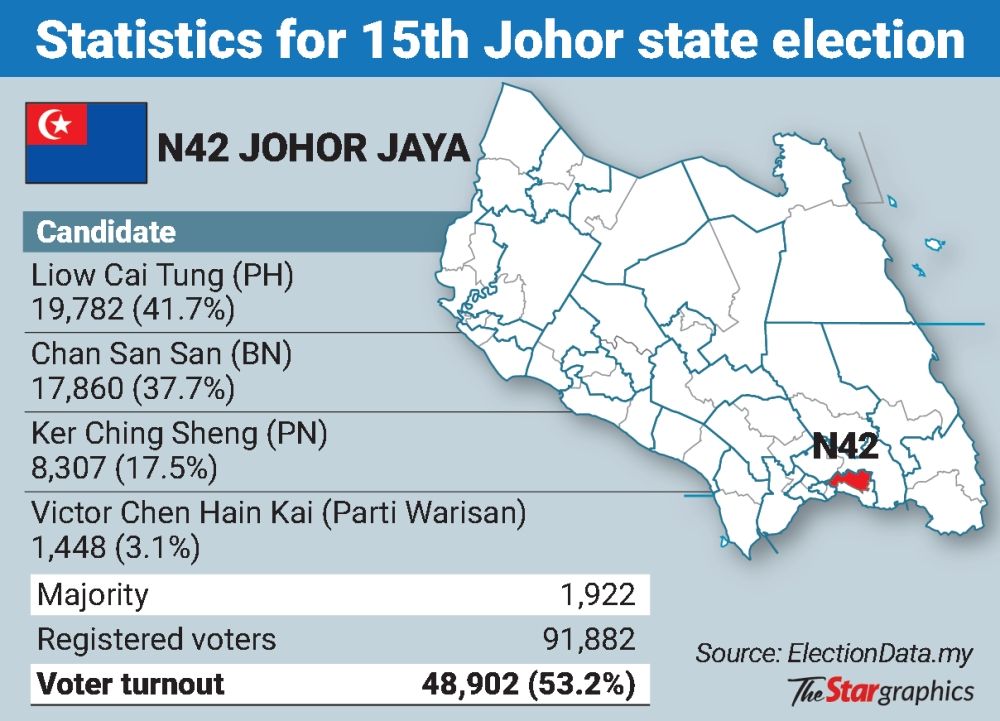
A total 48,902 voters, or 53.2% of 91,882 registered voters, cast their ballots during the election.
Caretaker Johor Mentri Besar Datuk Onn Hafiz Ghazi announced the dissolution of the Johor state legislative assembly on June 1, paving the way for the state’s 16th election.
On June 12, the Election Commission set July 11 as polling day for Johor.
Nomination day is on June 27 and early voting on July 7.
Johor last held a state election on March 12, 2022, when Barisan Nasional secured a two-thirds majority after winning 40 of the 56 seats.
Pakatan Harapan won 12 seats, Perikatan Nasional secured three seats while Muda won one seat.