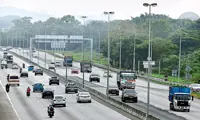
As the annual Hari Raya Aidilfitri balik kampung exodus gathers momentum, many Malaysians are hitting the road with more than just kuih raya and luggage in tow.
They are also relying on increasingly sophisticated driver-assistance technologies such as adaptive cruise control (ACC) and lane-keep assist (LKA) to navigate the long journey home.
While common in newer vehicles and designed to make trips safer and less tiring, road safety experts warned that these systems could introduce a subtler risk – overconfidence.
The ACC automatically adjusts a vehicle’s speed to maintain a safe distance from the car ahead by accelerating or slowing down using sensors such as radar or cameras, while LKA helps keep the vehicle centred within its lane by detecting road markings and providing gentle steering corrections or warnings if the car begins to drift.
Universiti Putra Malaysia Road Safety Research Centre head Assoc Prof Dr Law Teik Hua said prolonged reliance on driver-assistance systems could reduce active monitoring and increase reaction times, a phenomenon known as automation complacency.
“This phenomenon occurs when drivers assume the system will handle hazards.
“When unexpected events arise, such as sudden obstacles or sensor failure, drivers may take longer to re-engage,” he told Bernama.
According to the Society of Automotive Engineers International, vehicles equipped with ACC and lane centering technology are classified as Level 2.
This means the system can control steering and speed simultaneously but requires the driver to continuously monitor the environment and be ready to intervene.
In controlled conditions, these systems, along with other advanced driver assistance systems (ADAS), can enhance safety performance.
Festive travel, however, is rarely controlled, Law noted.
“A festive exodus typically brings dense congestion, abrupt braking, aggressive lane cutting and motorcycles filtering between vehicles,” he said.
“Drivers must understand that these (ACC and LKA) are Level 2 assistance systems.
“The human driver remains fully responsible,” Law stressed. International research echoes this caution.
A report by the Insurance Institute for Highway Safety (IIHS) found that partial automation features were best understood as convenience technologies rather than standalone safety systems.
The study warned that reliance on partial automation could contribute to driver overconfidence and disengagement, with empirical work suggesting that some motorists might take greater risks because they felt the system would handle driving tasks.
Fatigue further complicates matters.
Extended highway journeys, often undertaken at night during festive periods, create monotony.
Law said that although semi-autonomous features reduced physical workload, cognitive workload remained.
“When drivers are tired and at the same time confident about the semi-autonomous car, they may react slowly to an emergency,” he said, adding that motorists should ensure they were well-rested before long journeys.
Malaysia’s tropical weather also tests system reliability.
Heavy rain can interfere with radar and camera sensors, reducing object and lane recognition, experts highlighted.
Sun glare might affect camera-based systems, while worn or poorly maintained road markings, particularly on secondary roads and in construction zones, could impair lane-keeping performance, they said.
Law noted that driving culture presents another layer of unpredictability, with frequent lane changes, short following distances and motorcycle filtering triggering sudden braking responses from ACC when vehicles cut in, potentially surprising trailing motorists and increasing rear-end risk.
He advised motorists to treat assisted-driving features strictly as support tools.
“Drivers should disengage ACC and LKA during heavy rain, floods, sharp curves or complex urban traffic.
“Both hands must remain on the steering wheel, safe following distances should be maintained, especially in wet conditions, and sensors should be kept clean to ensure proper detection.
“Technology can assist, but it cannot replace responsibility,” he added.
As families travel home to celebrate, advanced systems may ease fatigue.
But safe arrivals would still depend on something far more fundamental than automation: alert, attentive human minds behind the wheel, the experts reiterated.