
‘Rubbish from Thaipusam, CNY and Ramadan in a row will push overburdened system to the brink’.
The waste crisis in Kuala Lumpur shows little sign of easing, with rubbish volumes expected to spike by about 30% through Thaipusam, Chinese New Year and Ramadan.
Conditions at the city’s waste transfer station near Middle Ring Road 2 (MRR2) remain strained.
StarMetro had reported last week on recurring equipment failure at the facility.
Since then, the transfer station has been operating at 50% capacity, with mounting backlogs and pressure on rubbish collectors.
Sources familiar with operations at Kuala Lumpur City Hall (DBKL) and Solid Waste and Public Cleansing Management Corporation (SWCorp) said there was growing concern that the rubbish surge over the public holidays could overwhelm an already stretched system.
They added that several waste compactors and hoppers at the transfer station were not working, while others faced recurring maintenance problems.
“The festive period is always challenging; but with current operational constraints, the spike in waste volume is a real concern,” a City Hall source said.
The source added that any prolonged disruption could have a knock-on effect on collection schedules across Kuala Lumpur.
The transfer station has four compactors – three of which operate at any given time while one undergoes maintenance.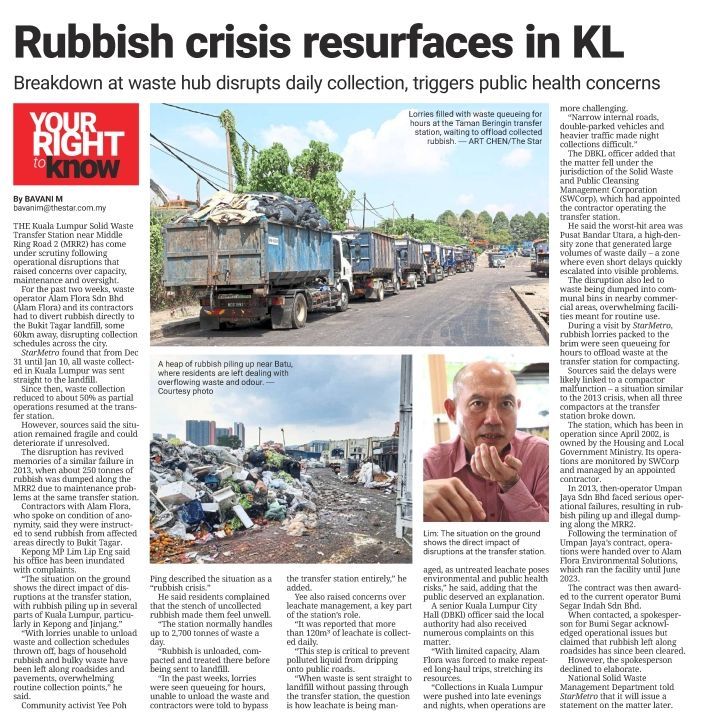
The station handles up to 2,700 tonnes of waste daily, where rubbish is unloaded, compacted and treated before landfill disposal.
“Hoppers receive waste from rubbish lorries, direct it into compactors to be compressed, before being transferred to larger vehicles for disposal at the landfill,” said a SWCorp source.
“When hoppers are down, lorries are forced to unload waste onto the ground and this causes a pile up and delays.”
Breakdowns involving hoppers and compactors from December last year have pushed the system beyond its limit, forcing drivers to split their daily runs between the transfer station and Selangor’s Bukit Tagar landfill about 60km away.
While partial operations at the transfer station later resumed, capacity remains at 50% which is considered fragile.
A driver who spoke on condition of anonymity said he used to make four collection trips a day to the transfer station.
He now does two long-haul runs to Bukit Tagar – waiting two to three hours each time to offload waste.
At the height of the crisis two weeks ago, waiting times stretched to four hours, he said.
“I am exhausted. The waiting is the biggest problem,’’ he said.
Sources warn that unless underlying maintenance failures are urgently resolved, the system risks collapsing during the festive period and through to Ramadan.
According to experts, waste volumes rise by about 30% during these periods, driven by bulky household and commercial waste.
Save Kuala Lumpur coalition chairman Datuk M. Ali said the city was heading towards a preventable disaster.
He said the situation reflected poor maintenance, weak contingency planning and years of neglect, and warned that failure at a critical facility like the transfer station could disrupt the entire waste management chain.
“The agencies must clarify what is happening and assure residents that the crisis will not recur,” he said.
Kuala Lumpur Residents Action for Sustainable Development Association (KLRA+SD) honorary secretary Joshua Low said the rubbish crisis had affected areas such as Kepong and Jinjang, and residents worried things could worsen during the festive period.
“The last thing residents need while preparing for Chinese New Year is rubbish piling up,” he added.
A similar failure occurred at the same transfer station in 2013, when malfunctions forced large-scale dumping along the MRR2.
Over 250 tonnes of waste were left along the highway after all compactors failed.
The transfer station, which has been operating since April 2002, belongs to Housing and Local Government Ministry.
It is managed by an appointed contractor and monitored by SWCorp.
The current operator Bumi Segar Indah Sdn Bhd has acknowledged operational issues, while National Solid Waste Management Department has yet to issue a statement.
Meanwhile, Setiawangsa MP Nik Nazmi Nik Ahmad urged notices be issued to contractors failing to meet standards.
The former Natural Resources and Environmental Sustainability minister said authorities had legal and policy powers to act against a non-performing contractor.
“There are legal procedures involving SWCorp-related agencies, from issuing notices to terminating contracts for non-compliance,” he said.