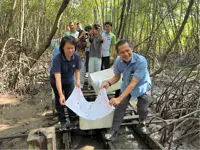
They learn about wetland ecosystems while planting seedlings
GETTING about 260 volunteers to plant 6,490 mangrove tree seedlings is almost like mobilising a small army.
At the edge of the mangrove forest beside Sungai Burung, Balik Pulau in Penang, volunteers were equipped with tall rubber boots and gloves before they stepped off the boardwalk, into the mangrove forest.
They were placed in groups of eight to 10, with each group led by an experienced hiker or outdoorsman.
The leader carried a walkie-talkie so that as the teams spread out deeper into the forest, they remained in contact.
A drone pilot hovered above, documenting the planting from the air for records and future reference.
While volunteers dug holes in the mud to plant the seedlings, Penang Island City Council (MBPP) Landscape Department readied a support crew of more than 10 members.
They helped carry seedlings along the boardwalk and collected the thousands of black polybags that had to be removed before planting.
M. Jeyakumaaran, 49, one of the organisers and a Trip 4 Trees campaign participant, arranged for 40 plywood planks measuring 0.6m by 2.4m each.
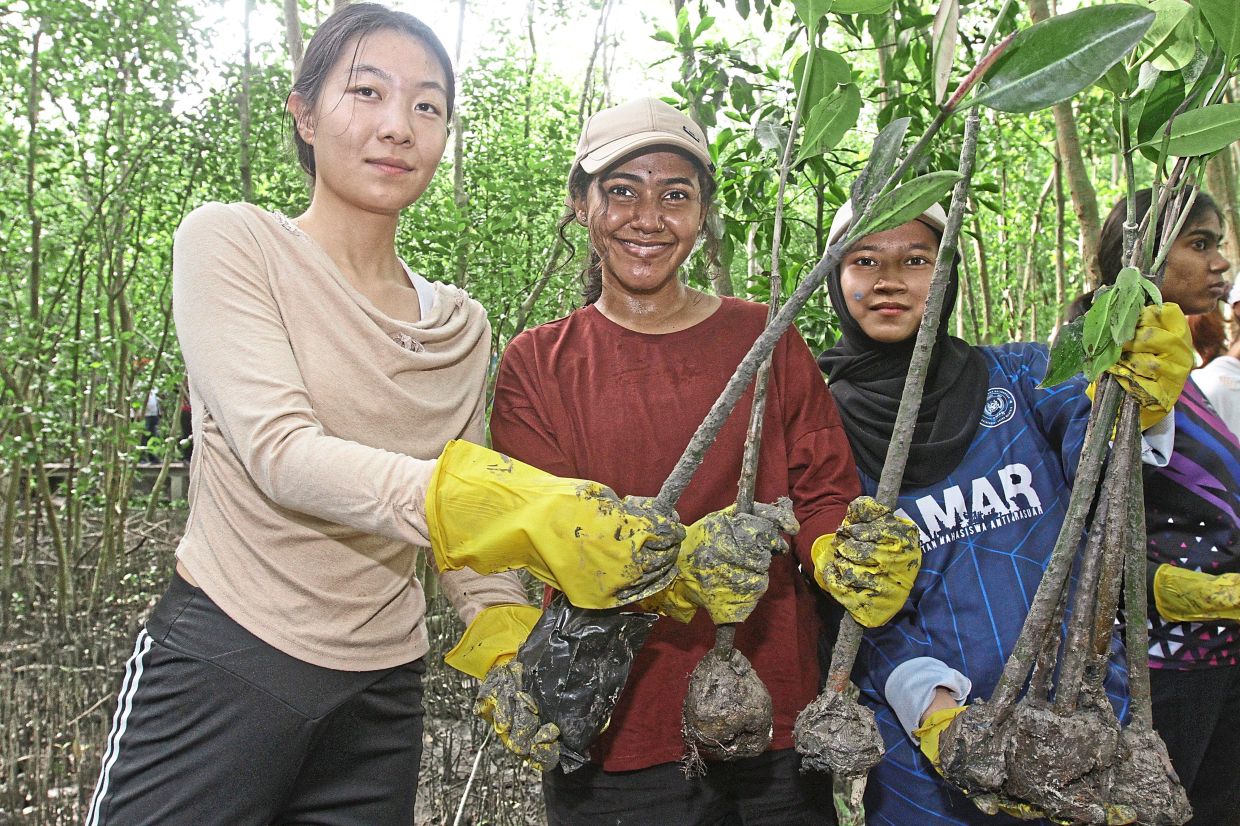
“If you want to go deeper into the mangrove forest to find bare patches for planting, the planks are necessary,” he said.
He explained that in softer sections of the forest floor, volunteers could sink into the mud, making it difficult to move or pull their feet free.
“By laying the planks over those areas, they can move safely and get the work done.”
Jeyakumaaran thanked MBPP for its assistance and for sponsoring the mangrove seedlings together with the state Forestry Department.
Programme manager Paraamjit Singh, 37, said the turnout was significantly boosted by Universiti Sains Malaysia’s (USM) Centre of Global Sustainability Studies, which mobilised more than 180 students to take part.
Among them was Zhang Xinyue, 20, a final-year communication undergraduate from Henan, China, who said moving around the muddy terrain was initially exhausting.
“But it was fun to work together and get all the seedlings planted,” she said.
Alya Mohd Razula, 22, a final-year mathematical sciences undergraduate, said the experience gave her a deeper appreciation of mangrove ecosystems.
“Seeing so many crabs everywhere up close made me realise how important mangroves are to marine ecology.”
Architecture undergraduate K. Kavishene, 22, said she initially thought the task would be straightforward.
“With about 260 volunteers, I thought each person just needed to plant around 25 seedlings.
“It takes only a minute to plant one seedling, but walking slowly to avoid slipping, finding bare patches and carrying seedlings back from the boardwalk makes it much harder,” she added.
Paraamjit said the Balik Pulau mission was the start of the Trip 4 Trees campaign, which aimed to distribute 100,000 tree seedlings globally through community replanting efforts.
He said the campaign would culminate in an overland journey from Malaysia to the United Kingdom next year, covering about 27,000km across 18 countries in three classic Volkswagen vehicles driven by Jeyakumaaran, participants Muhammad Syahmi Abdullah, 54, and Muhammad Danish Vijay, 48.
The trio will propagate mangrove and native tree seedlings along the route.
“While the journey will help spread the message internationally, events like this are the heart of the campaign,” he said.
“This is where people understand, through experience, why mangrove forests matter.”