Ting: State’s budget next year includes initiatives aimed at strengthening wildlife protection.
Johor Budget 2026 has been praised for its comprehensive measures aimed at accelerating the journey towards developed state status by 2030.
Johor health and environment committee chairman Ling Tian Soon highlighted initiatives aimed at strengthening environmental monitoring and wildlife protection.

He noted that the allocation for mobile seismic microzonation equipment, which would allow Johor to study soil conditions and build resilience in tremor-prone areas, was a first for the state.
“This initiative ensures we are prepared for any eventuality.
“The mobile equipment will enable Malaysian Meteorological Department (MetMalaysia) to conduct detailed studies on soil types and building durability, particularly in Segamat.”
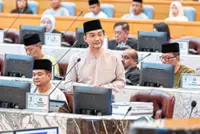
He said this when met after the tabling of Johor Budget 2026 by Mentri Besar Datuk Onn Hafiz Ghazi during the state assembly sitting held at Bangunan Sultan Ismail in Kota Iskandar.
Ling also emphasised the government’s commitment to wildlife conservation, specifically tigers in Endau-Rompin National Park.
“Plans are underway to establish conservation areas in the park to protect these big cats and strengthen habitat preservation, giving these efforts international recognition for conservation standards,” he said.
State education and information committee chairman Aznan Tamin welcomed the formation of a council on artificial intelligence (AI) aimed at developing the state into a regional AI hub.
“The council will bring together government agencies and AI experts to ensure Johor’s AI development progresses rapidly and remains ahead of other states.
“It will also coordinate projects across agencies and facilitate expertise sharing, creating a robust AI ecosystem,” said Aznan.
State unity, culture and heritage committee chairman K. Raven Kumar praised the budget’s inclusivity, noting its focus on diverse groups.
“This budget demonstrates the state government’s resilience and efficiency in ensuring the welfare of all Johoreans.”
State housing and local government committee chairman Datuk Mohd Jafni Md Shukor highlighted the strong focus on housing and urban development.
“A total of 8,915 affordable homes are set to be completed by 2026.
“Initiatives such as Perumahan Kasih Johor and subsidies for People’s Housing Project (PPR) and Government Rental Houses (RSK) residents aim to improve living standards and dignity for low-income families.
“The state is also expanding housing programmes on wakaf land, providing direct assistance, including rental support, for 20,000 recipients, first-home purchase aid and relocation support, demonstrating an inclusive approach to urban housing.”
Mohd Jafni underscored investments in digital governance and public services, with initiatives such as Johor Integrated Complaints Centre and JohorPay facilitating enhanced service delivery and accessibility.
“Digital access improvements are also planned under the Maju Johor Premium WiFi initiative at hospitals, bus terminals and public housing complexes, aligning with the state’s smart city vision.
“Infrastructure upgrades under the Johor Smart City plan include closed-circuit TV installation, landscape enhancements and pedestrian-friendly improvements to make urban areas safer and more liveable,” he said.
Mohd Jafni said the budget balanced technology, environmental stewardship, youth development and housing, demonstrating a commitment to sustainable growth and social welfare.
“It is a roadmap for action, ensuring Johoreans enjoy inclusive and continuous progress across all aspects of life,” he added.
Meanwhile, state balancing force chief Andrew Chen Kah Eng (PH-Stulang) said the budget would help grow Johor’s economy adding that the various initiatives would help improve the people’s well-being.
During the tabling of Johor Budget 2026, Onn Hafiz said the Johor government projected RM2.55bil in revenue next year, with an expected surplus of RM4.46mil.
He added that the state recorded RM218bil in investments over the past 3½ years, creating more than 64,000 job opportunities.
Onn Hafiz said the state’s unemployment rate remained among the lowest in the country, at 2.3%, while its gross domestic product grew by 6.4%, the highest in Malaysia.
“The value of agricultural sales in Johor has also reached RM27.2bil, the highest in the nation,” he said.
“We are also seeing positive growth across multiple fronts, including zakat collection, local council revenues and profits from state-owned government-linked companies.”