
I am midway through dinner at a hotel in Bali, Indonesia when my 12-year-old son lets out a piercing scream from somewhere beyond the restaurant.
“Mummy, it’s too dark and scary!” he cries, reappearing moments later, slightly breathless.
On most evenings, I might wave him off with a chuckle. But this time, I feel a flicker of embarrassment as conversations pause and a few curious glances turn our way.
This, after all, is no ordinary evening.
It is Nyepi, the island’s Day of Silence, where for 24 hours once a year, everything comes to a complete standstill. There is no traffic on the roads. No lights, no noise, no cooking and no music.
Even local television and radio stations go dark/silent, and Bali’s I Gusti Ngurah Rai Airport – which typically handles over 400 flights a day – closes.
At Hoshinoya Bali, where we are staying, the public areas fall dark after sunset, lit only by candles the staff tend to one by one. The relentless drizzle repeatedly snuffs them out, giving the Japanese-owned resort a dreamlike atmosphere.
The Balinese take Nyepi very seriously. Jeffrey Chan, a Bali-based expatriate of two years, only fully grasped its intensity last year when he stepped out of the house, wholly unprepared for what awaited him.
“It was like the world had come to a standstill,” he recalls. “Everything was eerily quiet.”
Instinctively, he reached for his phone and was soon informed by his Airbnb host that it was Nyepi.
“The first thing I did was check my fridge. There was only one cup of instant noodles,” he says, adding that the single cup barely sustained him and he was starving and miserable by nightfall.
Chan, it turns out, is not alone.
A social experiment
Every year, tourists arrive in Bali with flights booked months in advance, itineraries neatly planned, only to realise – often too late – that their trip coincides with Nyepi. It is the one day on the island that does not bend to tourism, and the one detail most guidebooks and AI fail to impress upon you.
I would soon find myself in the same position. After booking a return flight for my family that is timed with the school holidays, I discovered, days later, that it fell on this important occasion.
Having never heard of it, I did what most people would do: I turned to Google. The answers, as they appeared, were not particularly reassuring. My two rambunctious boys, aged 10 and 12, confined to the hotel for 24 hours, and expected to keep their voices to a minimum?
I had to suppress a laugh.
It would make for an interesting social experiment, if anything.
We arrive at the hotel on a balmy evening, two days before Nyepi, but not without repeatedly briefing the boys on what to expect, and more importantly, how to behave, long before we even board the plane.
We visited the striking new Saka Museum – named by Time as one of the world’s greatest places in 2024 – and came away with a deep appreciation of what a collective pause can do for an island.
During Nyepi, Bali’s carbon emissions are estimated to fall by almost 54,000 tonnes, an environmental impact said to be comparable to taking about 11,700 cars off the road for a year, or planting roughly 900,000 trees that would absorb a similar amount of carbon over a decade.
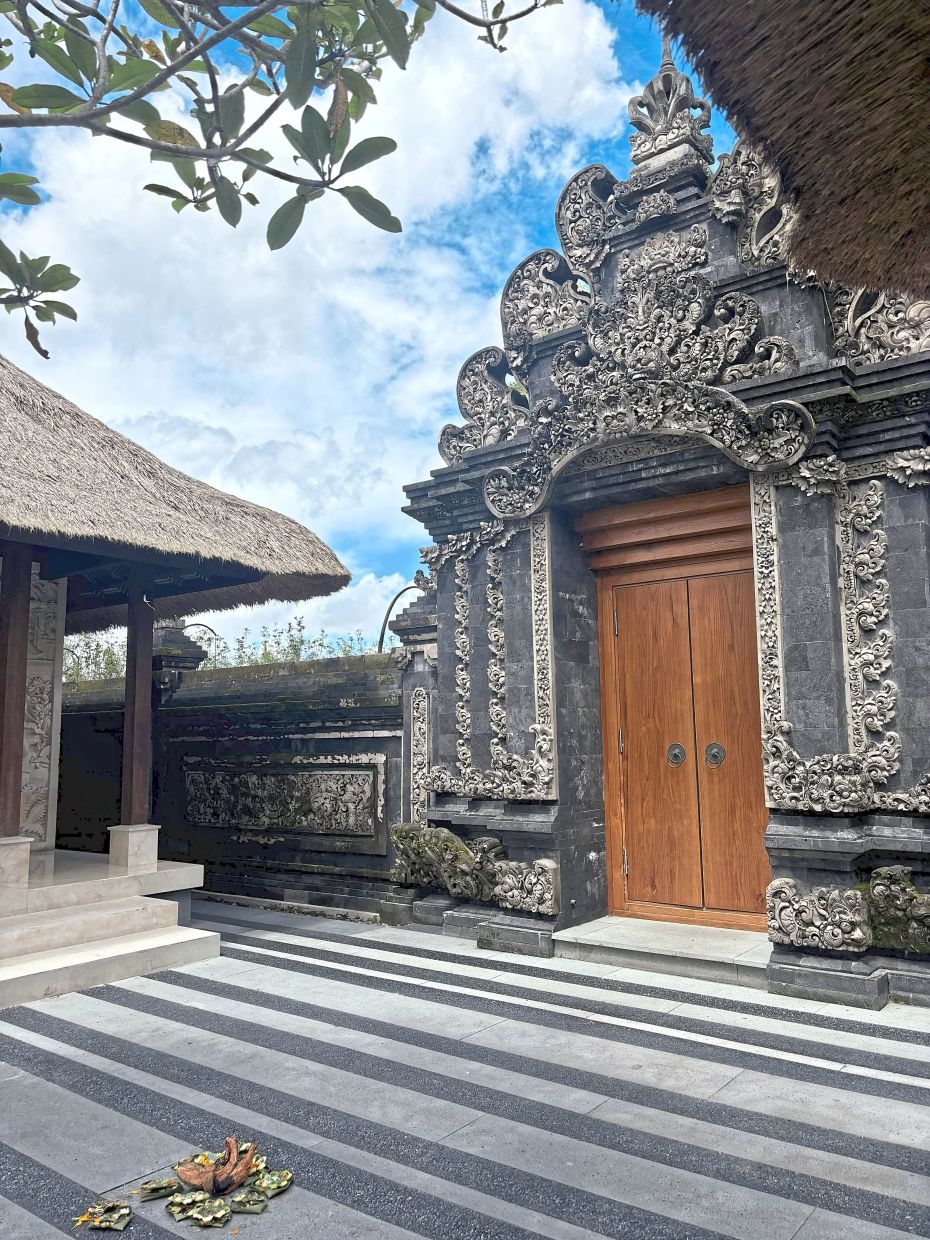
Hoshinoya Bali was designed by Rie Azuma of Azuma Architect & Associates, who spent time visiting Hindu temples and traditional homes, while also studying local craftsmanship across Indonesia. It is nestled within a dense jungle some 30 minutes from central Ubud, yet feels worlds away.
Elevated walkways weave through the grounds, while the sacred waters of the Pakerisan River rushes below, lending it an almost cinematic sense of seclusion. Facilities are deliberately pared back – a small library, a stunning spa and a single restaurant serving refined Japanese.
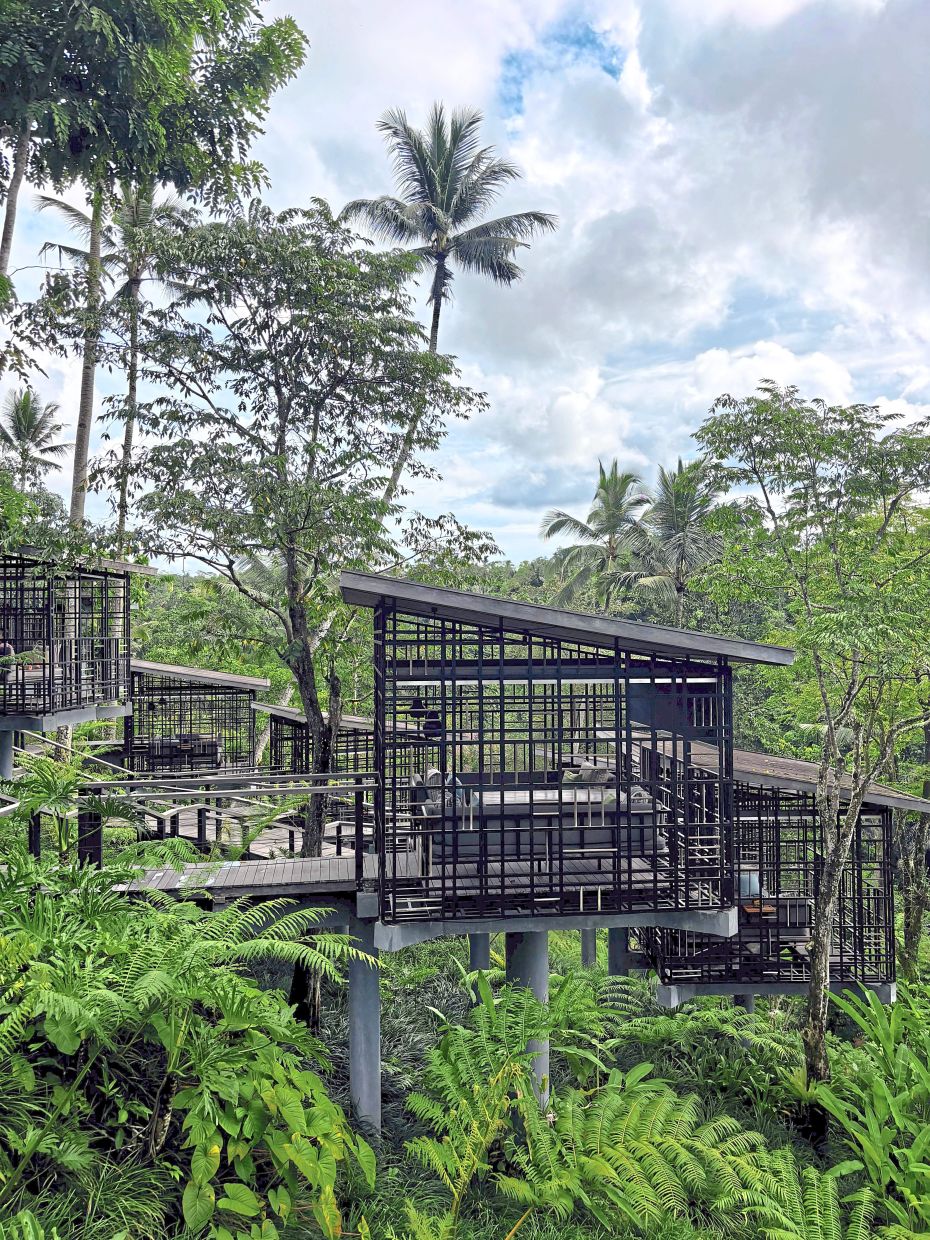
The two-storey wooden villas are spacious and elegant, blending beautiful Balinese architecture with a restrained Japanese aesthetic. There are no televisions, and the long, central pool that bisects the villas closes at 8pm.
With so few distractions, it feels like the ideal setting for a festival devoted to silence.
Devices, distractions
Waking up to the stillness of Nyepi morning feels surreal, since we’re still buzzing from the cacophony of the Pengerupukan ceremony the night before (held to get rid of any and all negative energy).
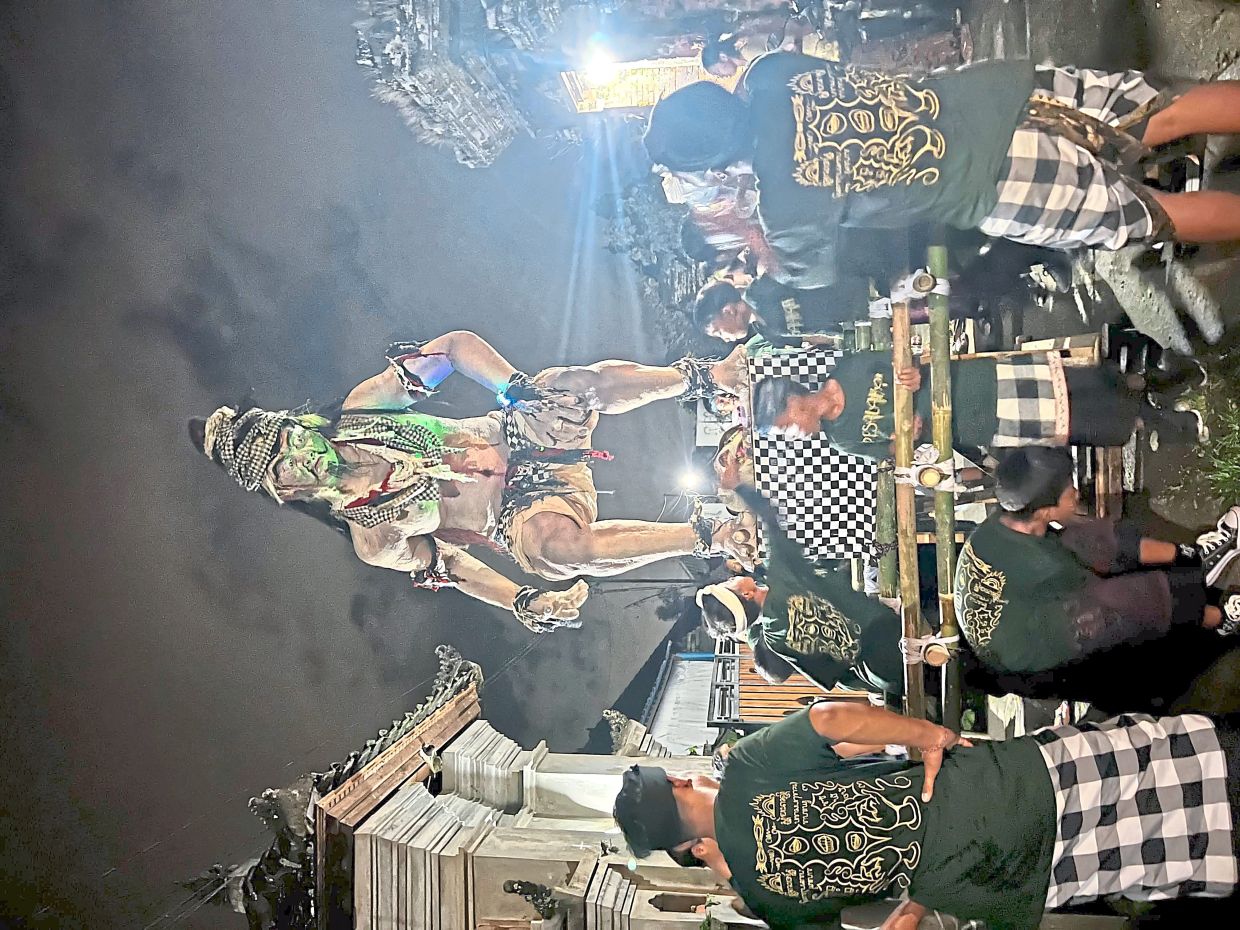
In Pengembungan, the neighbouring village, locals parade towering ogoh-ogoh effigies – fearsome figures crafted from bamboo and steel – through the streets, accompanied by drums, fireworks and a deliberate crescendo of noise.
Seated in one of the resort’s gazebos suspended above the rainforest and amid the chorus of birdsong, we feast on gindara teriyaki and nasi goreng for breakfast. The views are picture-perfect; our voices, deliberately subdued.
While my husband remains tethered to his laptop for remote work, I make a quiet vow to stay offline, reaching for my phone only when necessary – to send a message or capture a moment.
The pull, however, proves stronger than I expect and, throughout the day, I catch myself automatically reaching for the device several times, scrolling through social media for a few seconds before catching myself and putting it away.
It’s a habit too deeply ingrained to undo in just a few hours.
By midday, a lull settles over the resort. From where we sit in one of the pavilions, learning to make canang sari, which are pretty Balinese offerings of flowers central to daily prayer, we notice that the resort’s gates have been shut, barring anyone from entering or leaving.
Only the staff are permitted to step out once their duties are done, and even then, only with a special permit.
Out of sight, but never quite out of mind, are the pecalang, traditional patrol guards tasked with ensuring the rules of Nyepi are observed, quietly making their rounds.
To my mild amusement, a staff member offers reassurance.
“Don’t worry. At most, they’ll give you a light scolding ... maybe ask you to do 20 push-ups,” he says, deadpan.
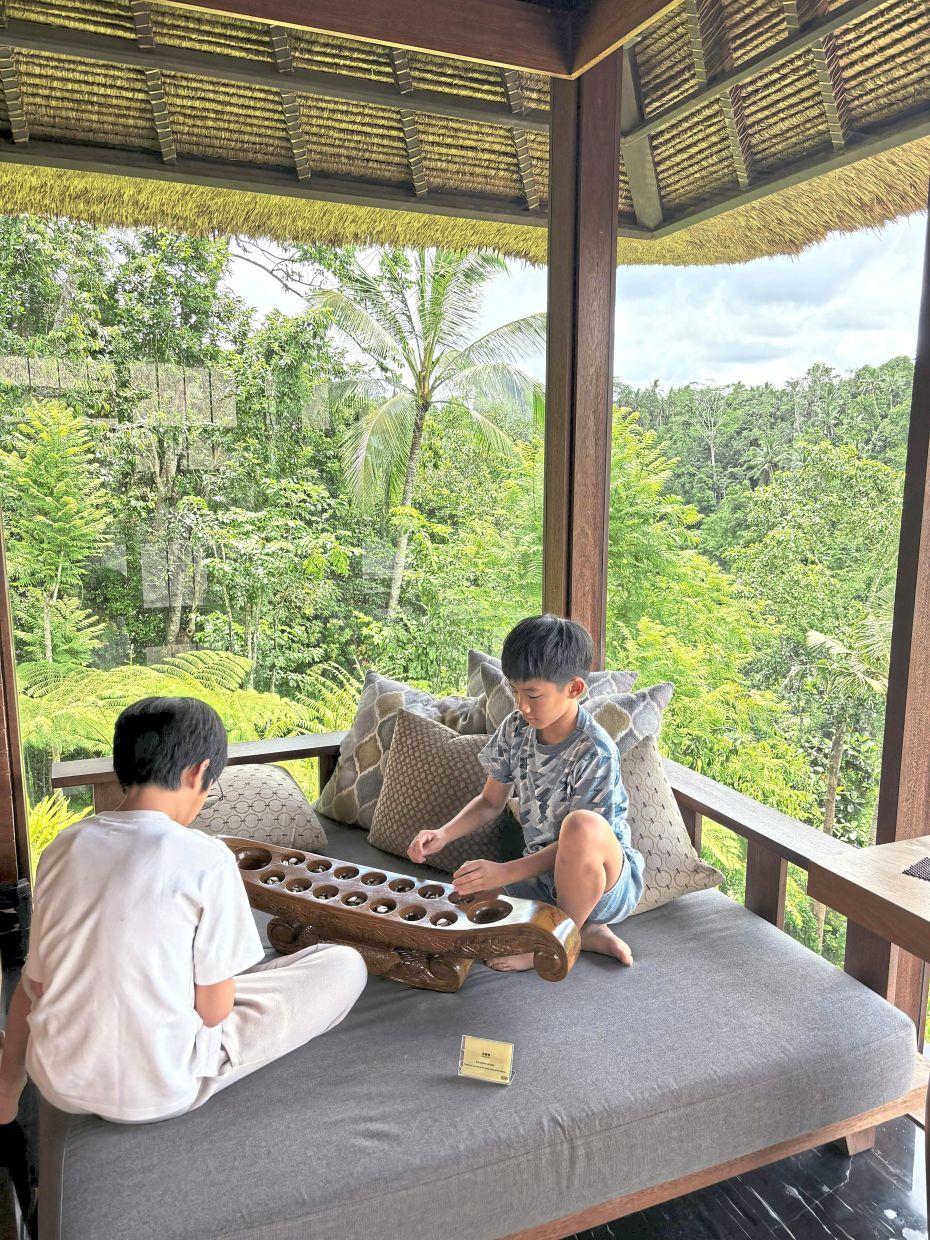
The boys hold up well at first, with chess and congkak in the library providing enough to occupy them for an hour or two. But discipline begins to fray once we reach the pool, where they soon descend into roughhousing.
After a while, I stop urging them to keep quiet, deciding it is better to let them expend their energy before evening falls.
As the day progresses, I take a funicular down to the spa, where a limited menu is more than compensated for by floor-to-ceiling windows framing lush greenery.
As the therapist kneads my back with warm oil infused with spices, something begins to shift. The usual restlessness that defines my holidays – the need to see, to do, to maximise – begins to dissolve.
In its place is an unfamiliar kind of peace, a sense that there is nowhere to be, nothing to chase, except this moment itself.
While guests in homeshare properties or short-term rentals may have to cook quietly behind closed doors, kitchens at hotel restaurants are, thankfully, allowed to operate as usual.
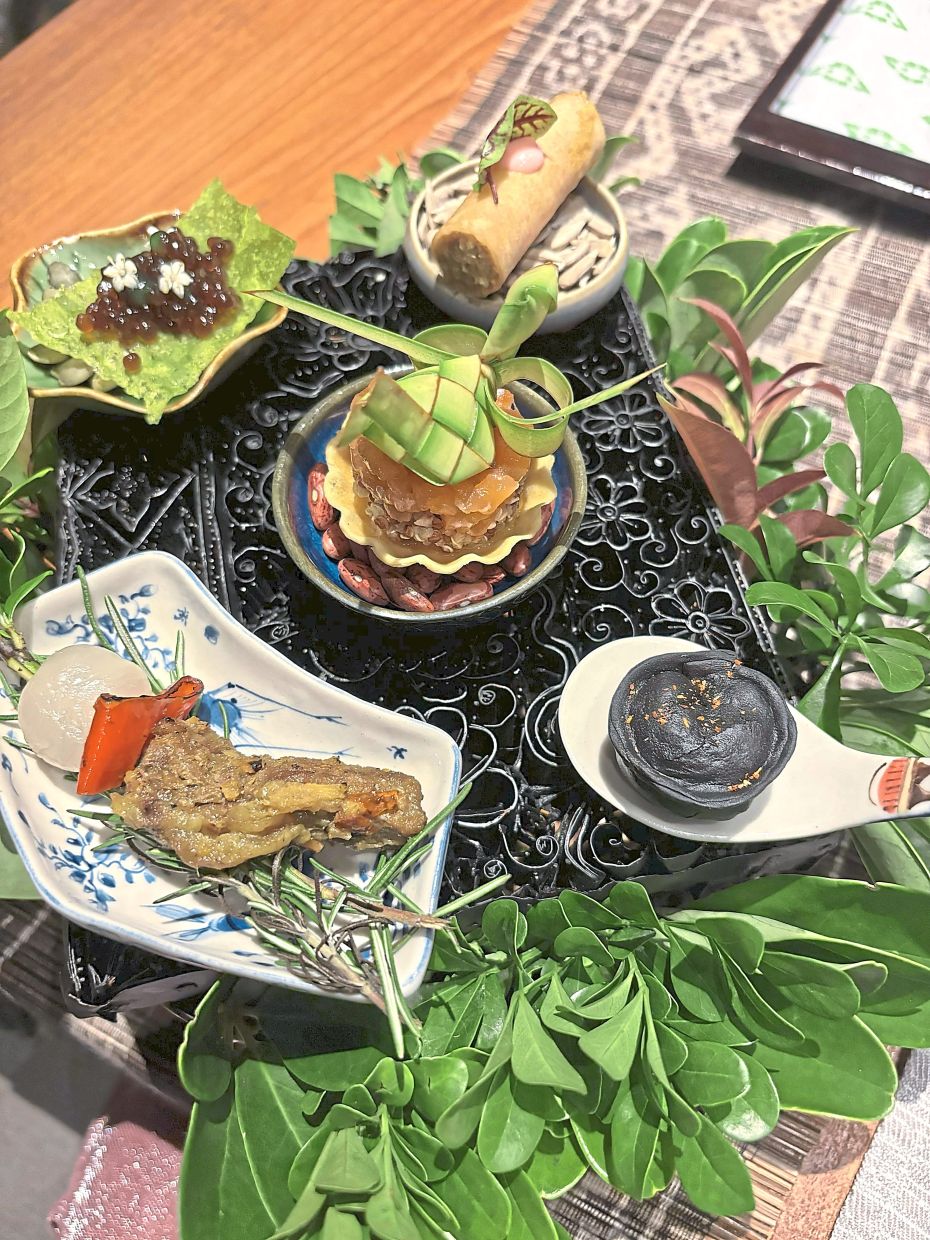
Our eight-course dinner is a refined interplay of Balinese and Italian, presented in the spirit of Japanese kaiseki. From duck confit risotto to the scallop gazpacho, and even the vegetables, each dish is artfully composed, balancing visual elegance with depth of flavour.
We’re about to tuck into the beef tenderloin, which is ceremoniously wrapped in banana leaves, then unveiled and carved tableside, when our 12-year-old comes running.
After the little incident – which, surprisingly, draws neither a scolding nor an order to perform push-ups – we step outside, using torches from our phones to light the way.
Several Balinese have told me stargazing is one of their favourite rituals during Nyepi.
With the island plunged into darkness, the sky clears of light pollution, revealing constellations and, on a good night, even the Milky Way.
The weather is not entirely on our side as clouds drift in, obscuring parts of the sky, but what remains is still spectacular, prompting audible gasps from other guests who choose to linger outdoors.
The only other time we have seen a sky quite like this is in Munduk, Bali’s quieter, less-touristed highlands.
Mindful escape
Later, we gather for a light stretching session led by two of the hotel’s staff. The movements are followed by a series of breathing exercises that gently bring the evening to a close.
At the end, the instructor glances at her watch and quips, “Only nine hours left till the end of Nyepi.”
My kids whoop and cheer, before retreating to our room to spend the rest of the night playing Roblox on our phones.
Feeling a palpable sense of sadness, my mind drifts to our Balinese driver, Argus, who had remarked that Nyepi is no longer what it once was since the Internet.
“It used to be something I looked forward to every year,” he said.
“It was a chance for families to slow down and spend time together. Now, my 10 and 16-year-old kids are just constantly on their phones, on YouTube,” he continued.
Just as I begin to wonder if Nyepi has been too much for my kids – as it seemed to be for the insensitive Swiss tourist who made headlines on March 20 after recording himself insulting the festival – I catch one of them animatedly recounting the experience to his friends when we return home.
He loved it.
His brother, however, much preferred the spectacle of Pengerupukan to the silence of Nyepi.
In a world where wellness is increasingly commoditised – packaged into expensive retreats and longevity centres that are often out of reach for the average person – Nyepi feels almost radical in its simplicity.
It is not the kind of family getaway we had planned, but it may well be the most meaningful one we have had.
And we are already planning our return next year, but this time we’ll be locking our gadgets away in the hotel safe.
Travel notes
How to get there: Ubud is located roughly 35km to 40km from Bali’s Ngurah Rai International Airport, with the journey typically taking between 1.5 and 2.5 hours depending on traffic conditions, which can often be congested.
Travellers can choose from several options, including pre-arranged private transfers, airport taxis, or ehailing services. For a smoother arrival, many hotels in Ubud also offer pick-up services for a fee.
Direct flights to Bali from Kuala Lumpur are available on Malaysia Airlines, AirAsia and Batik Air; if you’re flying from other hubs around the country, expect a transit.
Where to stay: Many accommodations offer special two-night Nyepi packages, allowing guests to check in the day before and depart the day after, as no arrivals or departures are permitted on Nyepi itself.
Smaller, more intimate resorts strike a thoughtful balance between privacy and convenience. Some provide on-site dining and cultural programmes, such as canang sari or batik making, while a few also arrange guided walks to nearby villages, where guests can witness – or even participate in – an authentic ogoh-ogoh procession.
For those who prefer a more structured experience, larger resorts such as W Bali Seminyak or Anantara Ubud offer curated Nyepi stays. On the eve of Nyepi, some of these resorts may organise their own small-scale ogoh-ogoh procession.
Nyepi survival guide: Choosing the right accommodation is especially important during Nyepi. Private villas and homeshare properties, while appealing for their space and privacy, can prove less convenient as there are no on-site dining options, and guests are expected to remain indoors with limited access to food unless prepared in advance.
Hotels, on the other hand, are generally better equipped for the occasion, although beaches – even those directly in front of hotels – are strictly off-limits.
On the eve of Nyepi, shops and roads start to shut from about 3pm as the island prepares for the Pengerupukan festival. Traffic typically thins out by midday, offering a rare opportunity for a quiet, crowd-free exploration. That said, visitors should plan ahead to ensure they return to their hotel before closures begin.
Stock up on essentials and medication the day before, but avoid over-preparing if you’re staying in a hotel.
Nyepi can be challenging for younger travellers. Pack low-tech entertainment – books, board games, cards – if screens or kids clubs are not an option.