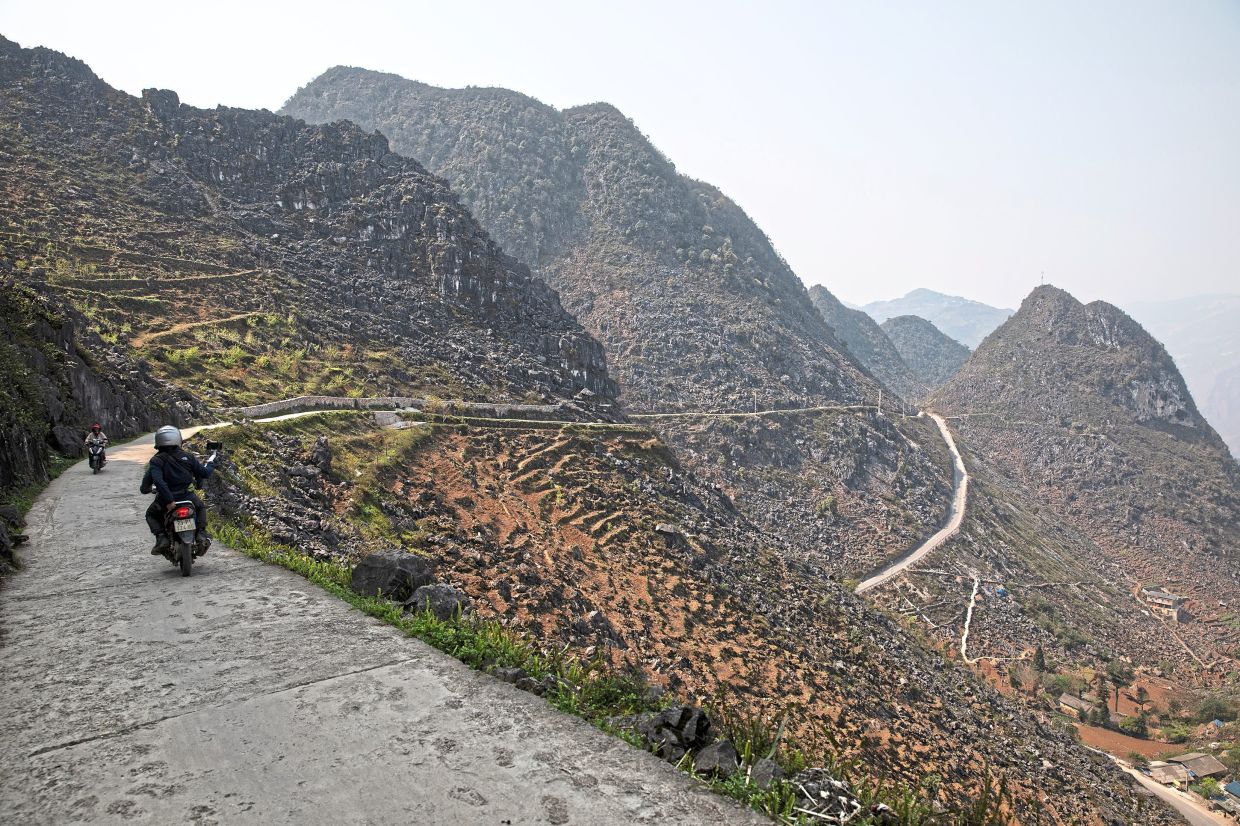
Dozens of honking motorbikes jockeyed for space as they zigzagged up Quan Ba Pass in Ha Giang, Vietnam. I clutched and throttled between low gears on my Honda XR while keeping one eye on the narrow road and the other on my guide, who was riding his own motorcycle about 5km ahead.
Suddenly, the land along our right side dropped away, revealing a sweeping view of rolling hills, terraced farmland and layers of mountains lurking in the midday haze. I quickly understood why locals call this stretch of road Heaven’s Gate.
I was beginning a two-wheeled journey on the Ha Giang Loop, a roughly 370km circular network of roads in the highlands of northern Vietnam. This route, nicknamed Happiness Road for its desired effect on the region, has been attracting adventure seekers for about a decade, and I was eager to see why.
From Heaven’s Gate, our four-day trip in late March last year would take us veering through switchbacks squeezed between rugged rock formations, soaring along cliff-side paths and coasting through verdant valleys. We would ride about 95km per day – stopping frequently to stretch our legs at places like open-air cafes, textile workshops and French colonial ruins – before settling into local hostels known as homestays each evening. These are in villages inhabited by ethnic groups like the Hmong, Tay and Dao.
The Ha Giang Loop is not for the faint of heart. The slim roads dip, climb and curve through the mountainous landscape, often along pulse-quickening drop-offs and through villages teeming with rural life.
I learned the hard way that a driver’s license from the United States is not valid here; most tourists need an approved Vietnamese license to drive legally.
On my first day, a police officer at a checkpoint waved me down and thumbed through my documents. I paid a fine of VND3mil (RM463), and thankfully, the receipt he provided me gave me a pass the next and only other time an officer pulled me over.
Most travellers on the loop choose to ride on the back of a motorbike with a local guide driving – a setup known as an easy rider. Not only does this avoid the whole driver’s license issue, the arrangement is actually cheaper and gives riders, with or without motorcycle experience, the freedom to focus on the views rather than the road.
But being an avid motorcycle rider, I couldn’t pass up the opportunity to navigate these roads myself, so I splurged for a guided, self-riding private tour from Bong Backpacker Hostel in Ha Giang City. The popular tour-operating hostel is one of many that have popped up in Ha Giang, about a six-hour bus ride north of Hanoi, Vietnam’s capital, near the border with China.
Easy ride
We wound down the curves of Quan Ba Pass and reached a popular stop, where we climbed to an outlook over the colourful and compact town of Tam Son and a pair of hills called Fairy Bosom.
Those hills, limestone karst formations shaped over centuries, are a signature of the Dong Van Karst Plateau. According to Hmong legend, a fairy who fell in love with a mortal but had to leave their child behind on Earth created the twin hills, which made the land fertile.
As we hit the road again, each turn burst into different kinds of panoramas. Some placed us between the folds of rugged mountains, darkened by shadows, save for the glimmer of light on the road. Others had us coasting through stepped rice and corn fields.
We arrived at our first homestay, in the district of Yen Minh. Across a dozen or so tables, travellers shared plates of rice, chicken, vegetables and tofu. Guides surrounded the tables and poured a clear liquid into shot glasses. My guide popped up next to me with his own glass and a smile. This was “happy water”, another guide explained, a traditional homemade alcohol. And with it came a shouted toast, which we echoed in unison, one line at a time:
Mot, Hai, Ba, Zo!
Hai, Ba, Zo!
Hai, Ba, Zo, Zo, Zo!
Hai, Ba, Uong!
The words – variations of “one, two, three, drink!” – roared in my mind as I went to bed in my private room. Luckily, it was farthest from the dining area, which transformed into a boisterous karaoke scene.
Gliding above it all
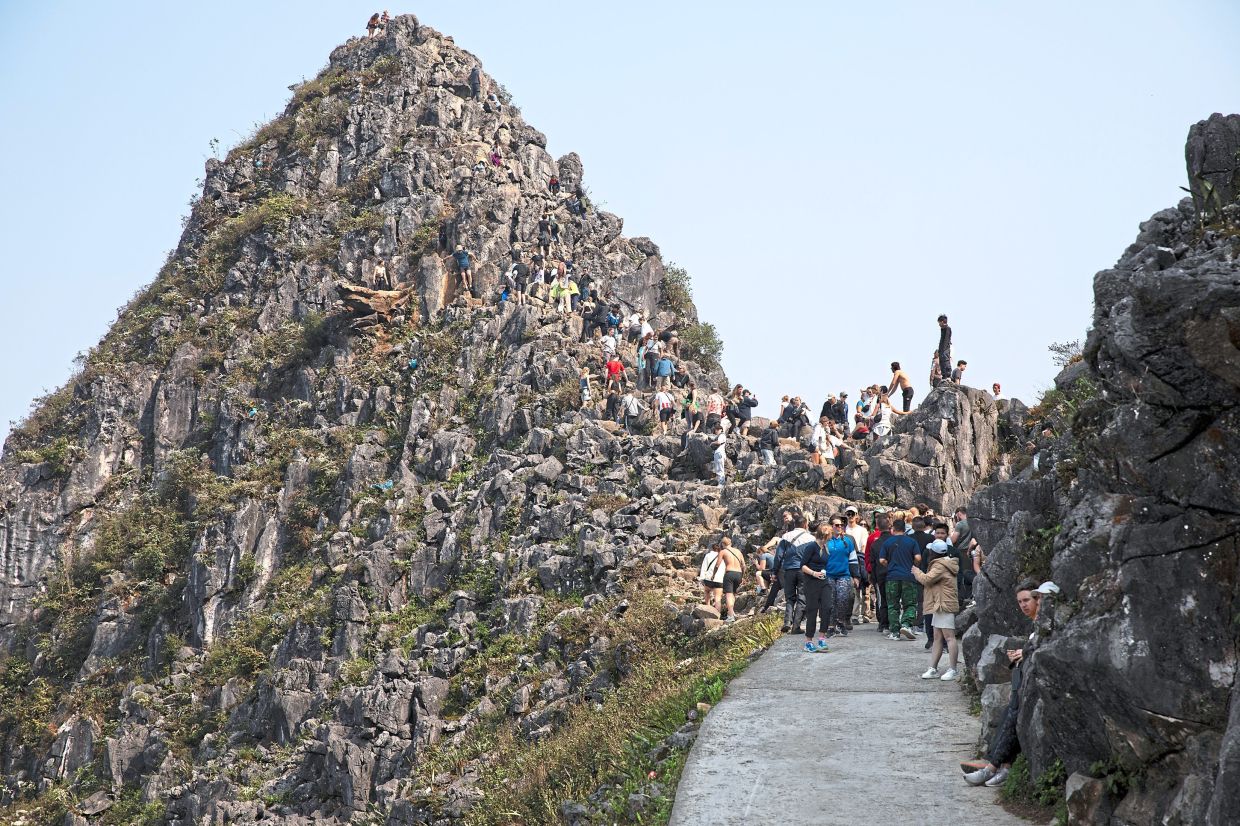
Tham Ma Pass weaves up the hill like a serpent, fattening up high and slimming as its slithers out of the valley from which it ascended. It was only up from there.
If the first day felt as if we were riding within the tight world of farmland and villages, the second day felt as if we were gliding above it all.
We moved at a comfortable pace. At this higher elevation, wind swept through the trees, carrying a mixed scent of pine and smoke, which wafted across much of the land from controlled fires that farmers use to burn brush.
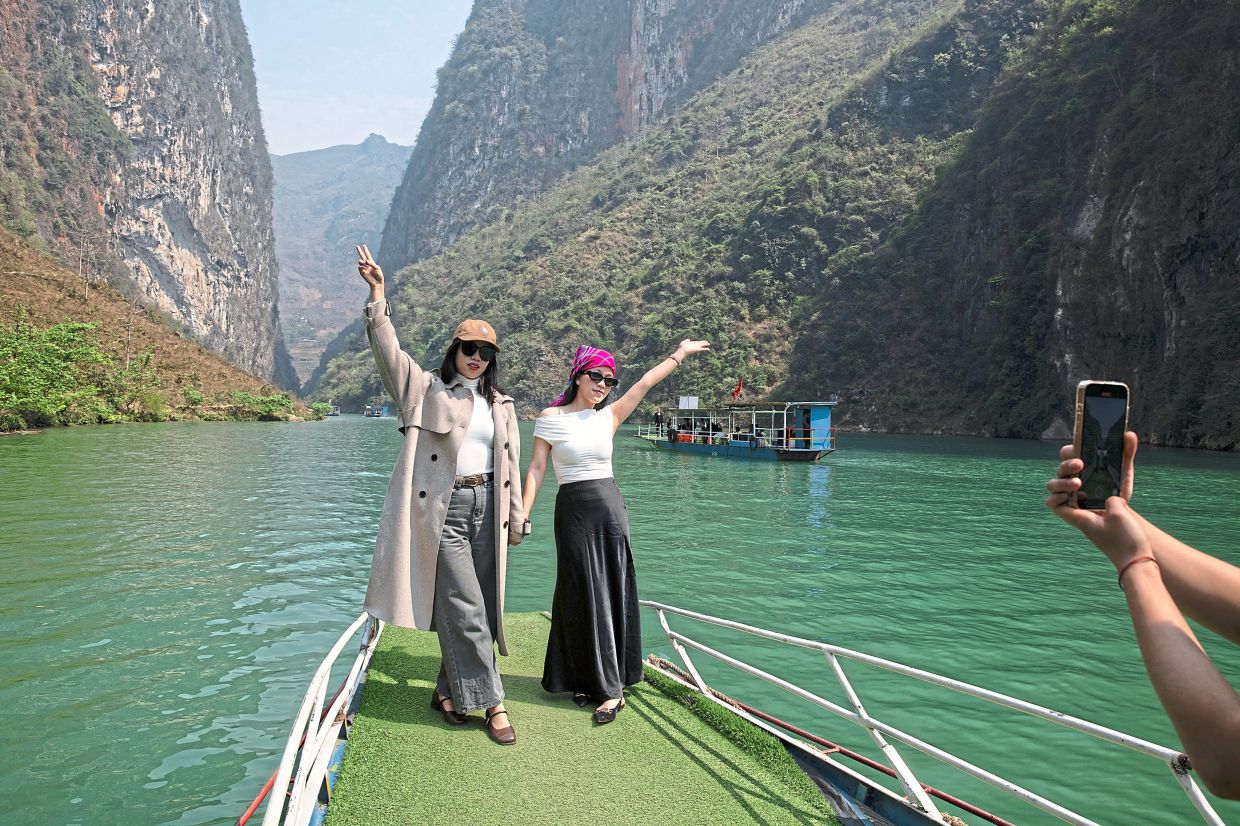
This road had stretches straight and wide enough to pick up speed and pass others. We wove around tourists seated behind their guides, some clutching the rear fender, some taking selfies, others extending their arms like wings to embrace the wind.
“On the first day, my easy rider tapped me and told me to let go and hold out my arms,” said Maddi Moran, a 24-year-old recent college graduate from California. After that, she spent much of the ride “closing my eyes, holding my arms out wide, feeling the curves of the road winding back and forth”, she said. “It’s the closest I’ve felt to flying without leaving the ground.”
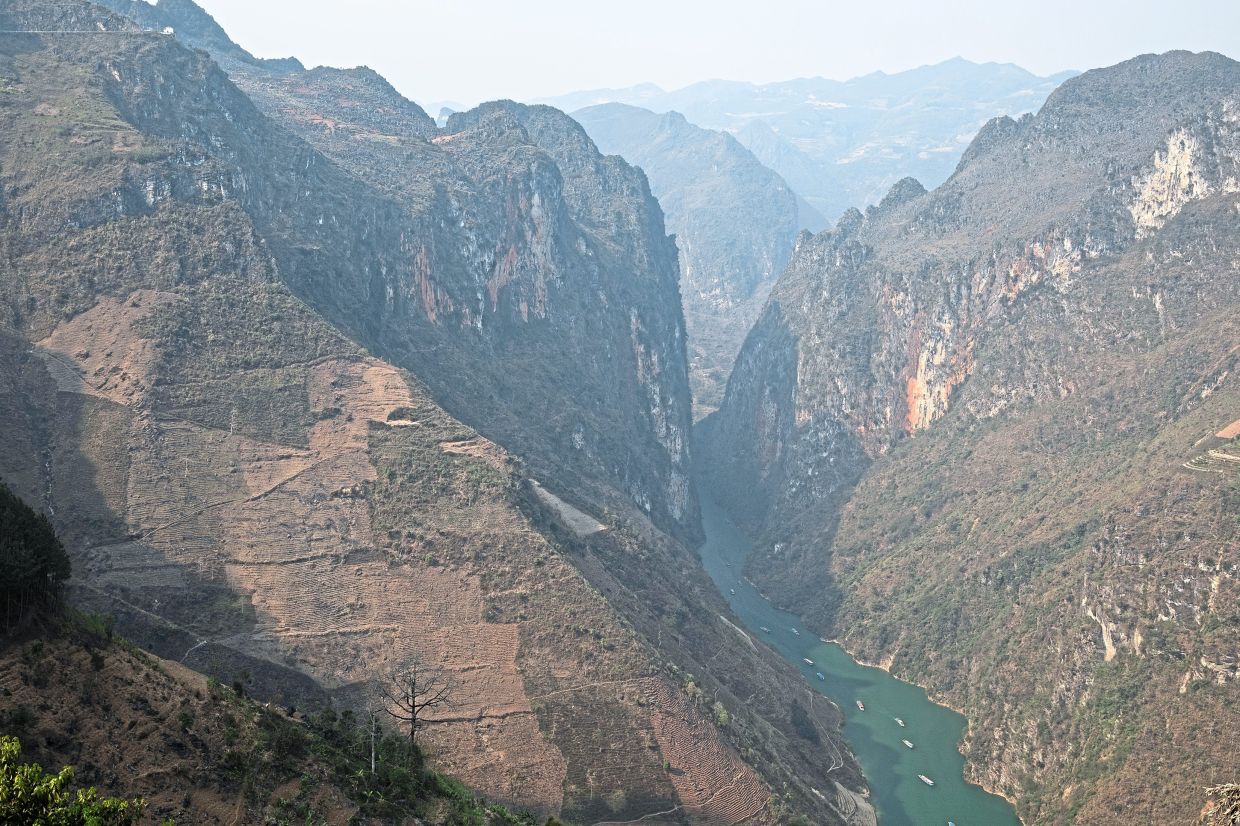
After riding along Ma Pi Leng Pass – much of it over 1,500m above sea level – we made our descent to Meo Vac Clay House, our homestay for the evening.
More bumps
I knew I would need to brace for a bumpy ride when I saw the machinery and road workers on the third day. As we made the long coast down, I stood with my knees bent to absorb the shocks, bucking along as if I had swapped my bike for a bull at a rodeo.
The construction of the loop began in 1959 and, over the next roughly six years, men carved the route into the sides of the mountains. Ho Chi Minh, then North Vietnam’s president, began calling it Happiness Road, reflecting what he thought it might bring to villagers in the remote region.
My body was beginning to feel the saddle time when we arrived at our final homestay in the town of Du Gia. As my guide and I shot pool and I sipped a cold Bia Ha Noi beer, I thought I would turn in early. Then I heard the roar of those familiar words: “Mot, Hai, Ba, Zo!”
I knew I would not be seeing my bed anytime soon.
On our last day, as we began our final descent, I found myself slipping into the unique state of Zen that one gets from travelling by motorcycle.
Riding requires a total focus on the present moment. The hum of the engine drowns out your thoughts, and the vibrations keep you acutely aware of your movement.
You feel the temperature and humidity change as you dip or rise; you can smell the earth, the road itself or food cooking nearby; and your eyes constantly scan your surroundings.
I trailed my guide down the last pass and we entered the bustling streets of Ha Giang City once again, turned onto a paved promenade along the Lo River and reached Bong Backpacker Hostel’s back entrance.
I pulled in the clutch, shifted down, kicked out the stand and turned the key for the last time. I was sweaty, bruised and thoroughly exhausted, yet I felt rejuvenated. – DEREK M. NORMAN/©2026 The New York Times Company
This article originally appeared in The New York Times.