
Welcomed by the gentle morning breeze and a harmonious chorus of birdsong, we were instantly drawn to the peaceful charm of Pantai Serdang in Selangor.
Surrounded by mangroves and mudflats, this coastal paradise serves as a stopover for more than 10 species of migratory shorebirds, escaping the cold climates of the northern hemisphere.
Unlike forest birds that are best seen in the early morning or late afternoon, shorebirds follow the patterns of tide. “When the tide comes in, it brings the birds closer to shore, so it’s easier to watch them,” explained our guide, Afiq Abdul Rahman.
Timing is everything in birding, and if you are hoping to observe shorebirds up close, checking the local tide schedule (a quick Google search will do) can make all the difference. The right gear – a pair of binoculars, a birding guide and a pair of walking shoes – is all you need.
And, of course, patience is essential.
Before we set out, we were warned that these waders can be difficult to spot due to their pale, sandy colour. “Their natural camouflage allows them to blend seamlessly with the surroundings,” Afiq, 34, said. This disguise helps keep them safe from predators.
Beginner’s luck
Being a group of first-time birders, we thought we were already out of luck that morning when we noticed the grey skies and thick clouds – there wasn’t a single bird in sight.
We thought we’d have to wait for hours, but then, layers of melodic calls and chirps filled the air, and the landscape came to life.
Afiq then gestured toward the distant shoreline, where a small group of birders and photographers had gathered. Still unsure of what we were looking for, we quickly raised our binoculars. Some of us fumbled with the focus, but eventually, we got the hang of it.
Just then, a flock of storks came into view. “Oh, look! Their butts are pink,” one of us exclaimed. Afiq identified them as painted storks. These little moments – of naming a bird and seeing it from such a close distance – made the experience even more thrilling.
As we continued our journey, we came across more seasoned birders who were silently observing the landscape for any sign of avian life. We were impressed by their heavy camera gear. Among the birders we met was Ashwin Kalai Chelvan from Malaysia’s Wild Bird Club, who, at the time, was heading to India for a birding expedition.
“Joining a bird club is one of the best ways to connect and learn,” Afiq advised. “You pick up faster when you are around others who share your passion.”

A test of patience
A flash of turquoise caught my eye, drawing my attention to the treetops. It was a collared kingfisher, perched calmly on a branch.
Nearby, a common sandpiper was preening its feathers on a rock. Its greenish-brown upper body and pale belly made it a little hard to spot against the boulder. Both birds were unfazed by our presence.
A little beyond the shoreline, a striated heron stood frozen on a lone branch jutting out of the water. Its gaze fixed below, patiently waiting to catch its next “meal”.
If you’ve watched the animated film Migration, where a family of mallards embarks on an adventure to Jamaica, you may remember Erin, the heron who has a taste for ducklings. While there is some truth in that portrayal, Afiq clarified that, in reality, herons are more interested in fish and crab.
What really stole the scene for us, though, was a strange-looking stork, more commonly known as the lesser adjutant. Locals call it “burung botak kecil” (small bald bird), and once you see it, you will know why.
With its bare neck and patchy, fuzzy head, it looked like it was having a bad hair day. The lesser adjutant belongs to the same stork family as the greater adjutant and the marabou stork, which share its distinctive, somewhat scruffy appearance.

Just when we thought we had seen it all, the sky erupted with movement. We stood in awe as hundreds of starlings put on a show in a mesmerising, swirling murmuration.
“It confuses predators and protects the flock,” Afiq explained. One of the upsides of going with someone experienced is that you get to ask questions and learn about all these interesting facts.
We started feeling the first sprinkles of rain, but our birding adventure was far from over, as there was more to see. Just then, a black-capped kingfisher appeared. Its vivid blue wings and crimson bill stood out against the gray morning.
It might get mistaken as the more familiar white-throated kingfisher at first, but as Afiq pointed out, this one is a winter migrant from East Asia. “They prefer mangroves and coastal wetlands.”
We were peering through our lenses, trying to take in every last glimpse before it vanished from view. Keeping these little birds in frame can be tricky, especially for anyone who is still learning to keep up with their quick movements.
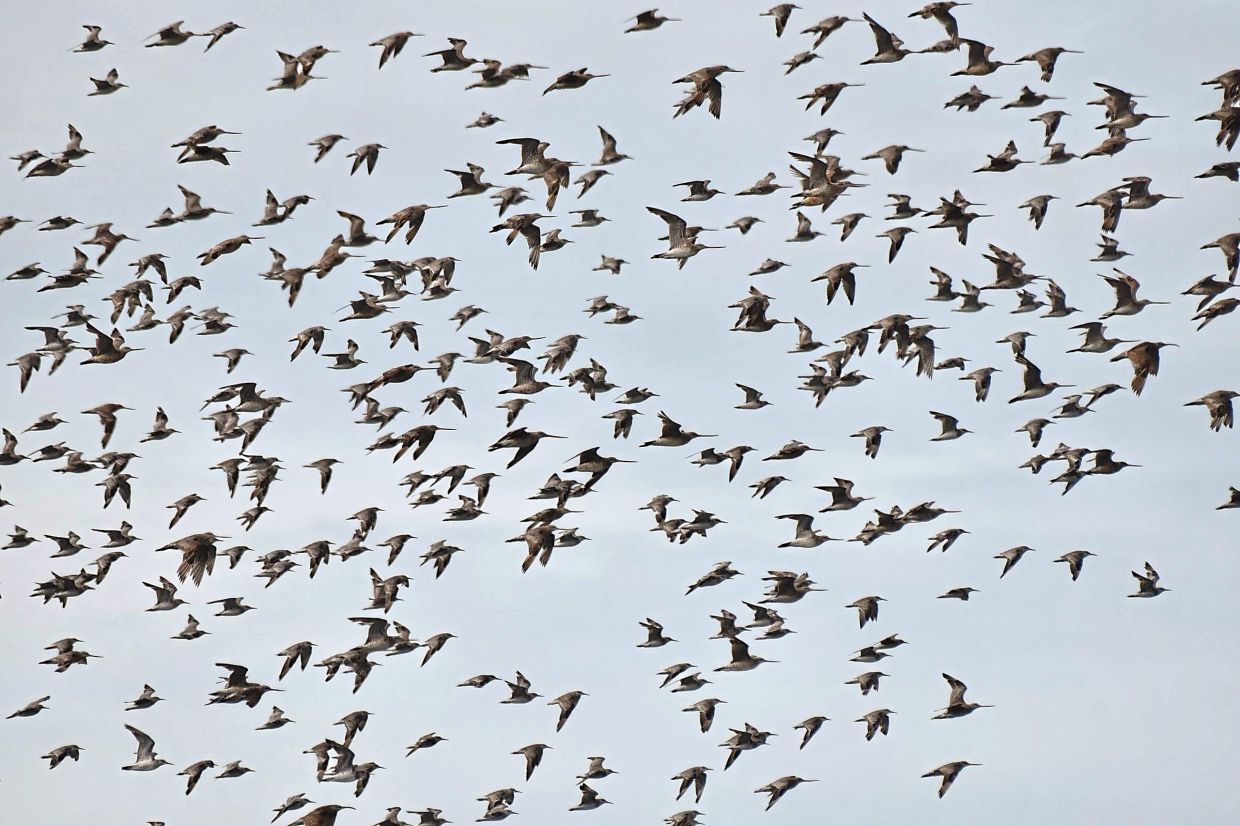
Soon, these seasonal migrants were joined by even more visitors, as we spotted the common redshank, Tibetan sand plover and Eurasian curlew.
The redshank stood out with its orange-red legs, while the sand plover was small and quick, moving delicately along the shore. And the curlew, on the other hand, had a distinctive long, curved bill – which it uses to dig into the mud to find shellfish and worms.
Some of these birds travel from as far as Siberia (Russia) and Alaska (United States), flying thousands of kilometres each year just to spend the colder months in tropical regions.
Along their route, they make pit stops – especially at places like Pantai Serdang – to rest and refuel, before continuing their journey southwards (towards Australasia).
Depending on the species, the timing of their arrival varies, said Afiq.
“They head back north to breed by April.”
Birding, we discovered, gave us the chance to escape from the city buzz and to reconnect with nature.
It’s worth doing some homework before you go: Reading up on the types of birds you might spot gives you a clearer idea of what to expect once you are out in the field.
Just as we were leaving, a group of wild otters emerged from the water, a perfect send-off to wrap up the day.
You don’t need to venture far to enjoy birdwatching. There are plenty of great spots within Malaysia for birding. One such example is Fraser’s Hill in Pahang, a fantastic destination for avian activity, especially for forest species.
Other places like the Putrajaya Wetlands, Panti Bird Sanctuary in Johor, Kuala Rompin in Pahang and the Kinabalu Park in Sabah also offer a rich birdlife and scenic trails.
And if you don’t have the time to go out of town or state, then just head to your nearest park or trekking site and start your birding journey from there.