In 2025, when the Metropolitan Museum Of Art devoted its fashion mega-show to the Black dandy and how Black men’s style had shaped our wardrobes, it became a de facto, if perhaps unintentional, act of protest at a moment when overt diversity efforts were being scrutinised by the Trump administration.
Now the museum is quietly wading into the culture wars again.
This week, Costume Art opens in the new Conde M Nast Galleries. It is a clear statement about the enduring relationship between art and fashion.
The show is composed of mirrored pairs: generally one piece of art from "Impressionism" or "Ancient Greece" or "Arms And Armour", to one garment – and proof positive that clothing, or the clothed body, is the single thread linking all 17 departments in the museum.
So far, so typical for a costume exhibition.
But sprinkled among the usual sylphlike mannequins in the exhibition are nine new forms of the sort that usually aren’t seen in the fashion departments of any museum.
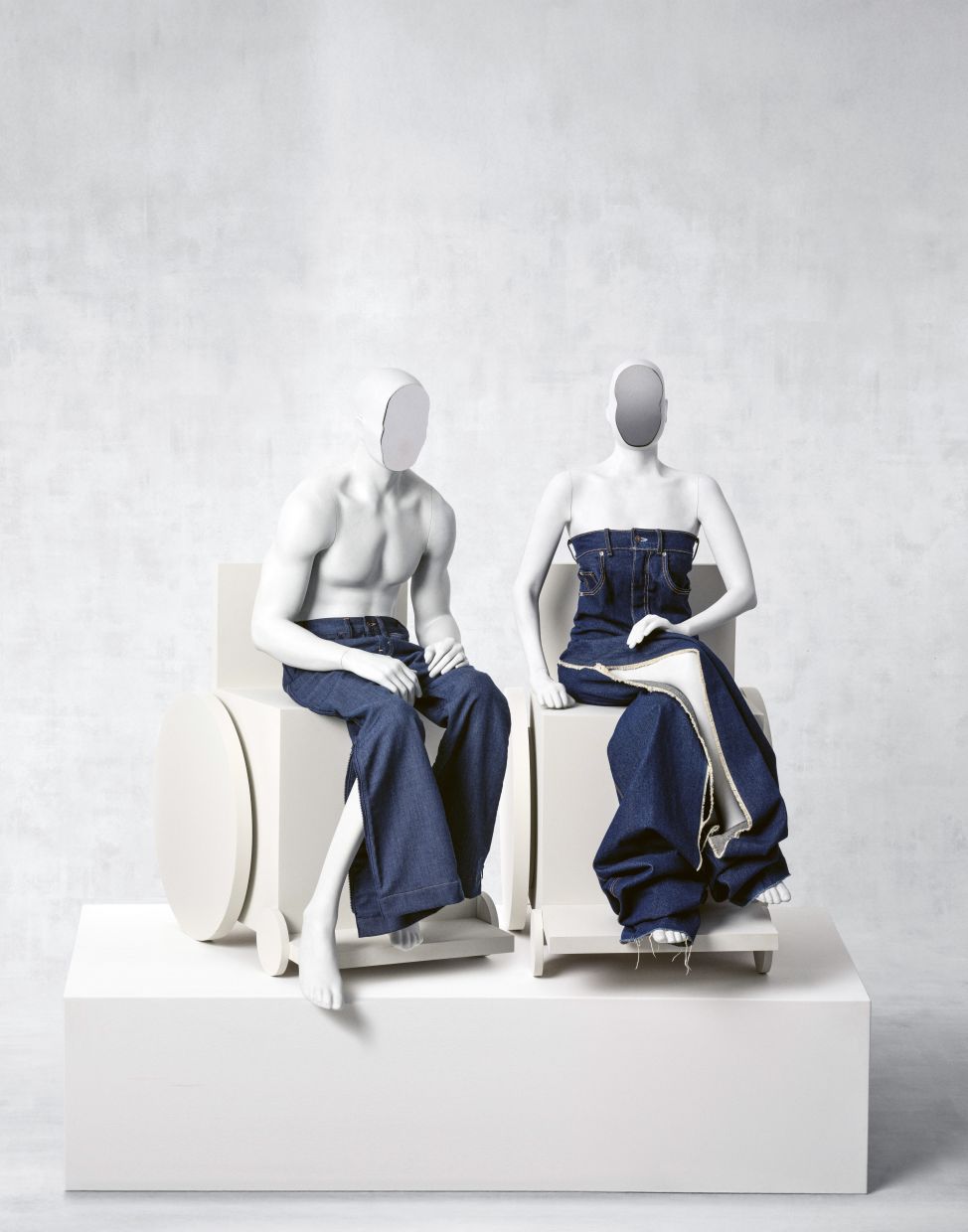
And atop each body, rather than the usual abstract face, there’s an oval of polished steel so that visitors’ own faces will be reflected back at them, as if they are the person inside all these differently shaped bodies.
“It’s a pretty obvious statement about self-reflection and seeing ourselves in other people’s experiences,” said Aimee Mullins, a model and actress who lost her lower legs as a baby and who posed for one of the mannequins.
Artist Michaela Stark, who is known for binding her own flesh so that it spills over, confronting those who see it with their own idea of what is considered beautiful – and who also posed for a Met mannequin – put it more bluntly: “It institutionalises the idea that bodies are different.”
Indeed, said Aariana Rose Philip, a Black trans model and another Met mannequin model, “it’s going to show people that the Costume Institute and the Met are making a commitment to inclusivity and diversity, even in times where sociopolitically, it’s being clamped down on.”
The mannequins were the brainchild of Andrew Bolton, the curator in charge of the Costume Institute, who has made it part of his mission to expand the holdings of the department to include significantly more designers of colour and ones outside the classic European couture tradition – and to augment the forms on which the clothes are shown.
Read more: How the Met Gala turns fashion into art while igniting debate on diversity
His mannequin expansion began with the 2023 show, Women Dressing Women, which included a representation of Philip as well as one of Sinead Burke, an activist and the founder of the Tilting The Lens consultancy who was born with achondroplasia, a form of dwarfism.
That form, which was borrowed from the National Museum Of Scotland, was a smoothed-out, generic version of Burke’s body.
For Costume Art, her mannequin was remade in a more physically accurate way.
Otherwise, the difference between then and now is in number, emphasis and the fact that the new mannequins were conceived as permanent holdings of the department, intended to be used in future shows.
Besides Philip, Burke, Mullins and Stark, the mannequin models included Jade O’Belle, the curve model and artist; Charlie Reynolds, a curve model; Antwan Tolliver, the model and founder of the streetwear label Freedom Is Fly, who became paraplegic as a victim of gun violence; Sonia Vera, the model and swimwear designer who was paralysed as an adult; and Yseult, the singer-songwriter and curve model.
All made their way to a studio in Brooklyn, where they stripped down to their underwear (or, in the case of Stark, a corset and nothing else) and stood patiently as 175 cameras snapped hundreds of images of every part of their bodies in various poses.
The images were then “digitally sculpted”, according to the show catalogue, into files that were 3D printed and hand-finished.
Bolton said that by adding these forms to the more classical mannequin collection, they are "trying to complete the picture”.
He is hoping to add to the variety of mannequins every year, building a population of forms for the department that echoes the variety of forms in the world outside – and in other parts of the Met.
That may not sound like a big deal, but it is a real change in policy for the department, and one that has the potential to resonate outward.
In the same way that for decades Asian and African dress was treated as textile rather than fashion, and held in those curatorial departments instead of in the Costume Institute, different bodies have always been represented in the museum – but in painting and sculpture, not clothing.
Instead, the fashion department, like all fashion departments, has followed the lead of designers and the runway, depicting the ideal form beneath clothes as a thin, attenuated body.
Every year, as visitors admire the garments on display, that custom reinforces the idea that fashion belongs to a specific kind of elite, one defined not just financially, but physically.
For many of the models involved, seeing the new forms is also a deeply emotional experience.
This despite the fact that, as Burke pointed out, they are in the minority. Even in the Costume Institute exhibition, they make up only 19 of the 191 mannequins in the show.
“My life’s work in the fashion industry has been wanting disability to be more recognised and more accepted, rather than hidden away,” Philip said.
“So to have an opportunity to be a part of art history, to be able to go to my favorite museum and see myself, was a deeply surreal feeling. I cried so many happy tears.”
Read more: Fashion is art! Met Gala red carpet stuns with bold style statements
Even so, the mannequin models are already bumping up against the limits of their inclusion.
“I literally can’t go to the Met Gala,” Philip said of the much-ogled party that is the biggest, starriest cultural fundraiser of the year. Or, at least, she can’t make a traditional Met Gala entrance.
“The stairs that everybody sees, that all the celebrities climb, are completely inaccessible,” she said.
That is an issue the museum is trying to address.
There has always been a photo-op area on the sidewalk in front of the stairs, allowing guests who cannot walk up the steps to strike a pose before they go in via a side door.
This year, that space has been expanded, and photographers are largely based in that area rather than higher up on the steps.
But, Philip said, “it’s not the same”.
Stark agreed that the images that come out of the gala matter, especially now.
“Who’s on that red carpet and what their bodies are like is a political statement,” she said.
To really inspire change, she said, the party needs at least some “fabulous fat women wearing fabulous gowns”.
“If it is watered down to an Ozempic-fuelled event of skinny girls wearing paintings on the red carpet, that’s an active denial of what this exhibition is really about,” she said. – ©2026 The New York Times Company
This article originally appeared in The New York Times.