Thai pearl farmer still loves his job despite tsunami and Covid-19 setbacks


By AGENCY
Ung and his wife Nuanpit in their shop in Ao Yon in the south of Phuket. Nuanpit has been designing and making exquisite gems from the pearls for customers from all over the world for several years. Photos: Carola Frentzen/dpa

While you may not see them on your approach, the livestock of the pearl farm lies in long, neat rows on the sandy bed of the shallow warm sea that surrounds Thailand's largest island Phuket.

These workhorses may do their work at a glacial pace, slowly forming pearls in colours that range from white and cream to silver and champagne, but the harvest easily makes up for that.

Plastic buoys bobbing on the water mark the location of the molluscs, the only other clue to their existence being a small boat in which all kinds of equipment, buckets, nets and ropes are piled up.

This simple craft belongs to Kriangsak Ung, who uses it to tend to his approximately 10,000 shellfish "to check if they are well and then, later in the year, to bring them in and harvest the pearls", the 70-year-old says.

For 46 years, this delicately built man has worked as a pearl farmer on Phuket, and despite many reversals of fortune over that time, he still loves his job.

The bay of Ao Yon, where Ung grows pearls at his farm located in the sea not far from the beach.


Ung breeds two species of pearl oysters: Pinctada Maxima, the largest of the approximately six species of oysters used for pearl farming, and Pteria penguin, commonly known as the penguin's wing oyster.

A pearl emerges after about two years, though in the case of particularly large specimens, it may take as long as four years, says Ung. "A young, happy oyster we can use up to three times."

Ung's gaze proudly wanders from his workshop to the adjoining jewellery shop where his wife Nuanpit has been designing and making necklaces, pendants, bracelets and earrings from the pearls for several years.

With smaller ear studs selling for as little as 500 baht (RM62), Nuanpit caters for every budget. The largest pearl in the shop, which boasts a diameter of 16.2mm, costs 120,000 baht (RM14,974).

Pearls are probably the oldest form of jewellery on earth and got their first known mention in the Chinese Shujing or Book of Documents: "In 2206BC, King Yu received pearls from the Huai River as tribute," it says.

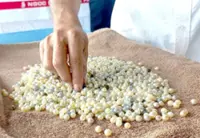
Pearls cultivated from Ung's farm. The thickest pearl in the shop has a diameter of 16.2mm.

Pearls come in for praise in the Old Testament, the Koran and the Talmud for their purity, which is actually quite ironic given that they emerge from worms or parasites that manage to infiltrate the shells of molluscs only to be coated with mother-of-pearl as part of the shellfish's defence mechanism.

Japanese pearl farming pioneer Kokichi Mikimoto succeeded in cultivating pearls for the first time in 1893, though it took him many more years to develop his technique to the point where the results were perfectly round.

The principle has remained more or less the same ever since: the farmer places a tiny piece of material, often a bead or sometimes, to jump-start the process, a tiny piece of pearl, into the shells, and then simply waits.

Ung uses tweezers to insert round pieces of shell into an oyster in his workshop. The shells then coat the intruder with mother-of-pearl.
Almost all genuine pearls available on the market today are cultured – and thus usually somewhat more affordable than the far rarer natural variety.

To get flawless pearls, Ung uses circular pieces of conch shell. He sits at a small table in the workshop with all kinds of fine equipment beside him, and fixes one of the shellfish in a holder in front of him.

With an experienced hand and tweezers, Ung inserts the foreign body into the shell. Behind him, tanks are lined up. Baby mussels grow here, the next generation.

Ung is a self-made pearl farmer. "The technique is not difficult, it’s simple and pretty 'low tech' – all you really need for pearl farming is time."

But there have been setbacks too. Foremost among them was the tsunami of Dec 26, 2004, which devastated Phuket.

"It was a Sunday," Ung recalls. The shop was closed, he was upstairs with his wife and four children in their first floor flat. "We were lucky. But the water came over and over again and destroyed everything. All that was left was the house itself."

All their oysters were lost. "We had to start all over again."After a lot of hard work, things eventually got back on track. That's to say, until the coronavirus came along.

The shells of the two species of mussels that Ung breeds – Pinctada Maxima and the black Pteria penguin – which are also sold as decoration.

"These are hard times again. And the business had just picked up."

Ung's smile gives way to worry lines. "We have almost no income since Covid started."Still, he opens the shop every morning. But only rarely do tourists make it to Ao Yon these days.

Since July, fully vaccinated people have been allowed to return to Phuket without needing to quarantine. But tourist numbers are strictly capped and the bureaucracy and strict rules are onerous.

Despite these challenges, Ung has never considered giving up. So what does he love so much about his work? He thinks for a moment.

"I love that I can be outside, in close contact with nature," he says eventually, adding that he also values the solitude his job brings, something he found especially important in the early days.

"Before I moved into this house, I lived in a remote place, a hut on stilts, right above the sea," he said, smiling happily.Ung's work has even been appreciated by the revered Thai royal family.

Nuanpit proudly points to a golden plaque and a photo of Ung being honoured on National Agriculture Day in 1995 by the then Crown Prince and now King Maha Vajiralongkorn.

The sun slowly begins to set over the bay, marking the passing of yet another day in which no customers have made it to Ao Yon.

But the next morning Ung will open the shop again, lay out the jewellery and hope that it will be a different story. After all, someone like him doesn't just give up after almost 50 years of pearl farming. – dpa

Shop authentic pearls without breaking the bank by using Shopee Voucher Code Shopee Voucher Code

Get 20% OFF The Star Digital Access

Monthly Plan

RM 13.90/month

RM 11.12/month

Billed as RM 11.12 for the 1st month, RM 13.90 thereafter.

Best Value

Annual Plan

RM 12.33/month

RM 9.87/month

Billed as RM 118.40 for the 1st year, RM 148 thereafter.

Follow us on our official WhatsApp channel for breaking news alerts and key updates!
pearl farmer , pearls , Thailand

Next In People

Bespoke milliner makes World Cup-themed cowboy hats in Texas, US
South Korean pianist recreates himself as a one-handed performer after paralyzing stroke
Entrepreneur and father Ma Han Pin is redefining what success looks like
Malaysian veteran photographer and her son share work and family ties at The Star
A living dilemma: Syrians in Germany split over staying or returning to homeland
Entrepreneur and mother of four Nadia Nasimuddin on redefining wellness and bodycare
She's only 10, but she's taking college courses in the US
Iban woman leads Malaysia's parasitology and tropical medicine society
What keeps this Malaysian vendor delivering The Star for decades
Couple goals: Married medics face war side by side in Ukraine

Others Also Read