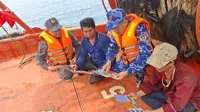
HANOI: What began as a routine getaway soon turned into an unexpected journey of discovery for Dinh Lan Anh, a tourist from Hanoii, when she witnessed the intricate art of pearl harvesting and refinement on Phu Quoc, Vietnam’s famed “Pearl Island” in An Giang Province.
Following instructions, Anh boarded a boat at 7am from Rạch Vẹm pier, 25km north of the Duong Dong, now part of the Phu QuocSpecial Administrative Zone. After a 15-minute ride across the sea, she arrived at an oyster farm.
Guided along rows of floating buoys, the boat stopped at points where crew members and visitors leaned over the deck to pull up ropes bearing cages of Pinctada maxima oysters, cultivated for five years. One by one, the cages were stacked on the deck.
By 8am, the boat returned to the processing area, where dozens of workers were already in motion – some swiftly opening oysters, others feeding trays of oyster flesh into machines with limewater to extract pearls, while colleagues inspected, measured and sorted the glistening gems.
At 4.30pm, after a bustling day filled with gasps and excitement, Anh sat back to enjoy the view of the turquoise sea and white sand, savouring dishes made from oyster meat and fresh Phu Quoc seafood.
The next morning, she proudly wore a necklace, a pair of earrings and a ring crafted from pearls she had personally harvested and selected.
“This is the first time I’ve ever experienced pearl harvesting firsthand," Anh said. "I always thought pearls were collected one by one. Who would have imagined witnessing hundreds of kilograms harvested in a single day? This jewellery set is truly special and the memory is unforgettable.”
She is one of many domestic and international visitors eager to join the pearl harvesting experience tour offered by Ngoc Hien Pearl Co. Ltd.
Founded in 1994, the company currently operates a 1,000-hectare pearl farming estate in Rach Vem, located in the Special Administrative Zone, An Giang Province.
Farm manager Hoang Van Thanh has been involved in every stage of pearl cultivation since 1997, making him both passionate and highly experienced.
“The waters of Rach Vem are salty, clean, warm, calm and rich in nutrients, providing ideal conditions for pearl oyster farming," said Thanh. "Oysters don’t need to be fed; they naturally consume algae, which also helps purify the seawater. However, they are very delicate, so the cages must be cleaned weekly to keep them healthy, disease-free and growing well.”
When the oysters are young, workers use brushes to scrub mud from the cages and remove organisms such as barnacles (Balanus) and oysters (Ostrea) from the shells. Once the oysters reach five centimetres or more, high-pressure water jets are used to clean the cages.
Dead oysters and harmful predators are also removed, with some of the most dangerous being crabs and thorny snails (L. caudata), which feed on juvenile oysters and drastically reduce survival rates.
“Regular monitoring of oyster growth is essential to adjust cage density and spacing, ensuring optimal conditions for healthy development,” Thanh said.
Pinctada maxima oysters are a rare and precious species, the largest in the marine oyster family Pteriidae. Their shells can reach up to 30cm in length, are nearly round and flattened on both sides. When cultured, they produce large, round pearls over 10mm in diameter, and can grow up to 20mm if cultivated for six to seven years.
These pearls are golden or silvery in colour and hold exceptionally high economic value. However, the survival rate of the oysters is only around 60 to 70 per cent.
The Ngoc Hien Pearl Company spent 10 years successfully researching the technique of implanting nuclei into the oyster’s internal organs. In addition to the rare Pinctada maxima species, the company also cultivates other pearl oyster varieties such as Akoya, Tahiti, and Mabe. All pearl farming and harvesting processes are strictly inspected by Vinacontrol Group.
“The entire life cycle of the oysters — whether three or five years — is closely monitored. Each pearl has a traceability tag and a clear origin profile stating ‘Cultured pearl from Phu Quoc, Vietnam',” said Bui Duy Chinh, chairman of the Board of Directors of Vinacontrol Group.
Thanks to ideal natural conditions and advanced human techniques, the company harvests two pearl crops annually, each yielding around 300,000 to 320,000 pearls, totalling 600,000 to 700,000 pearls per year.
In exceptional years, the harvest reaches 700 to 800 kilograms. On average, the company collects 100kg of Pinctada maxima pearls (cultured over five years) and 200 to 300kg of Akoya, Tahiti, and Mabe pearls (cultured over three years). About 70 per cent of the pearls are exported to Japan.
“The value of a pearl is determined by its shape, colour and thickness. The rounder the pearl, the more valuable it is, the thicker it is, the more lustrous it becomes,” said Ho Phi Thuy, director of Ngoc Hien Pearl Co. Ltd.
“The largest pearl we ever harvested was over 10 years ago, with a diameter of 21mm, sold to Japan for VND1.2 billion (nearly US$45,500). Such exceptional pearls are rare — sometimes we raise a million oysters and get none, but other times, just 100 oysters yield several pearls.”
Known as the 'Pearl King of Vietnam', with an annual revenue of nearly VND100 billion (nearly US$3.8 million), Thủy has been recognised as one of the 63 outstanding farmers in Vietnam in 2025 by the Vietnam Farmers’ Union.
According to experts, the jewellery value of a pearl is defined by a combination of lustre, colour, size, surface blemishes, and symmetry. Among these, lustre is the most important factor in assessing quality. If all other factors are equal, the larger the pearl, the more valuable it is. Large, round pearls are rare and highly prized.
Vietnam’s Nguyen Dynasty once possessed a legendary strand of 23 melo pearls in vivid orange. This treasure eventually ended up in the hands of a Swiss merchant in 1993, four years before the last Emperor Bao Dai passed away in Paris, France.
The largest pearl in the strand weighed 397.52 carats, measuring 37.97mm x 37.58mm, and was purchased by an anonymous buyer for US$7 million.
In 2011, a rare, deep orange 10mm melo pearl from the waters off Phan Thiet was sold to a Japanese buyer for US$65,000.
Since 2007, Vietnam has produced pearls that rival or even surpass those from Japan and China in beauty, thanks to its warmer and less polluted seawater.
Vietnam’s "Strategy for Marine Aquaculture Development to 2030, with a Vision to 2045", clearly states the goal of developing industrial-scale farming of four economically valuable pearl oyster species -- Pinctada martensii, Pinctada margaritifera, Pinctada maxima and Pteria penguin -- in calm coastal areas.
The strategy also emphasises the development of pearl processing and commercialisation industries. By 2030, the target is to harvest 200 tonnes of pearls (sized 7.0–10mm), generating gross revenue of US$3–5 billion, with processed pearl products potentially reaching US$8 billion in value. - Vietnam News/ANN