Global warming extinctions usually have people picturing the last polar bears or other furry critters disappearing, but the crucial and oft-overlooked world of plants is going to be decimated by climate change.
Scientists predict tens of thousands of plant species will disappear by the end of the century.
Between warmer temperatures and shifts in rain and snow patterns, between 7% and 16% of the world's plant species are likely to lose at least 90% of their habitat and go essentially extinct in about 55 to 75 years, according to a study published May 7 in the journal Science.
That equates to roughly 35,000 to 50,000 plant species based on moderate carbon pollution scenarios, and much more if the world's pollution soars, said study co-author Xiaoli Dong, a University of California Davis ecologist.
"The warming rate drives the extinction,” Dong said.
Dong and her colleagues used numerous biology and climate computer models to examine the potential futures of 18% of the world's plant species in detail, seeking to get a good handle on what's in store for all of them.
Scientists have observed this process and even relocated plants to conserve them. But Dong's millions of computer simulations show that even if these species move as fast as possible "it's not going to reduce the extinction rate”.
"It is not because they are not moving fast enough,” Dong said.
It’s because the habitats they depend on will no longer exist.
Climate change, whether by temperature or changes in rainfall, will make areas where plants used to grow no longer liveable for some species, she said.
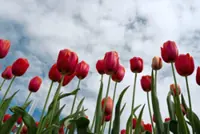
"The perfect condition required by this tulip has become like really small,” Dong said.
This scenario is getting especially bad in the Arctic, the Mediterranean and Australia, the study found. In the Arctic it's because the temperature is warming four times faster than the rest of the globe and in Australia it's driven more by rainfall changes, Dong said.
While Dong’s study looks at future extinction risk, a second study published May 7 in the same journal looked at the current extinction risk of flowering plants, a group with more than 335,000 species, more than most varieties of flora and fauna.
They include odd species such as titan arum, the world’s smelliest plant, and ones humans find useful, such as the orchid that provides vanilla, researchers said.
Evolutionary plant biologist and study lead author Felix Forest applied a 20-year system British biologists developed to prioritise species conservation by saving species that are most unique. The study doesn't look at what's causing the extinction risk, just what would be lost in terms of biological history and distinctiveness.
In the biggest species prioritisation study scientists have undertaken, Forest found that there's more evolutionary history at risk in unusual flowering plants than almost any other groups of flora or fauna, except turtles and tortoises.
Some other species, like different types of rats, have close relatives and a bushy branch, so if one blinks out, others remain to share its evolutionary history. But flowering plants include trees like the Ginkgo biloba, which has no similar species and presents hundreds of millions of years of evolution.
The trouble is that extinction in plants is often overlooked, even by official organisations, when compared with animals, Forest and Dong said.
"We're trying to redress that imbalance between plants and animals, especially vertebrates,” Forest said. "Humans are generally more interested in fluffy furry things and things with two wings than plants. And that's just the way things are.”
The two studies together show that the world cannot wait to take action to save endangered plant species, wrote Chilean biologists Rosa Scherson and Federico Luebert, who weren't part of the studies.
"Maintaining the current conditions that support human life requires urgent action.” – AP