
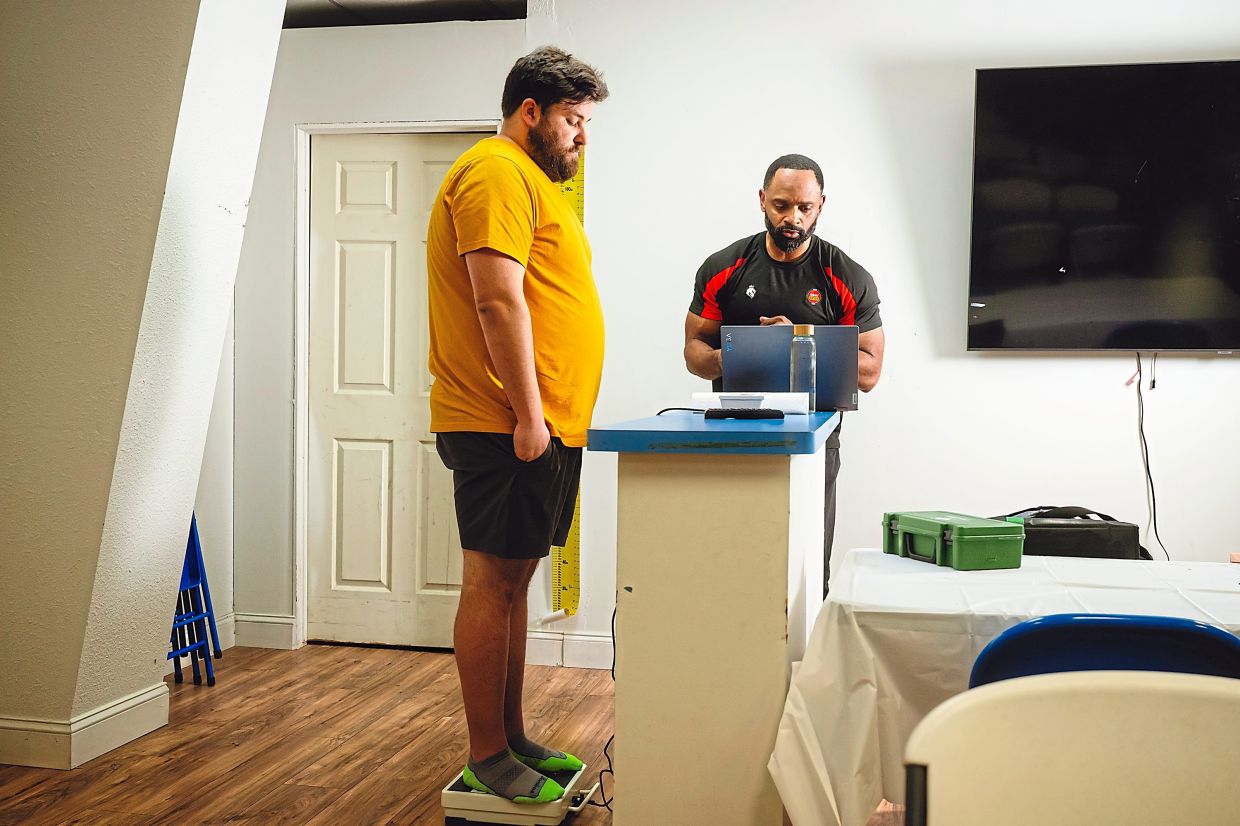
When two men showed up a few months ago at the adult football league in suburban Dallas, Anthony Williams took the men’s measurements – height, weight and waist circumference – and came back with disappointing news.
“I told them, ‘Sorry, you’re not fat enough,’” Williams, one of the league’s coaches, recounted last week as he watched two of the league’s teams, Fat Man United and Totten-Ham and Cheese, battle in an indoor arena an hour’s drive from downtown.
The Man v Fat League is reserved for hefty players, who are lured by competitive football and heavy doses of self-deprecating humor to shed pounds.
Founded in Britain in 2014 as an answer to weight-loss programs that primarily attracted women, Man v Fat expanded to the United States in 2024.
Now it has more than a dozen leagues in New York, New Jersey, Florida and Texas that appeal to men like Joseph Alvarado Delgado, 26, who gained 50 pounds (22.7kg) while working at fast-food restaurants in the Dallas area after high school.
Since he joined, Delgado said, “I’m much more energetic, I sleep a lot better and my wife says I don’t snore as much.”
Williams weighs the players before each match and reviews a log of what they have eaten over the past week. The league standings are based both on matches won and on pounds lost.
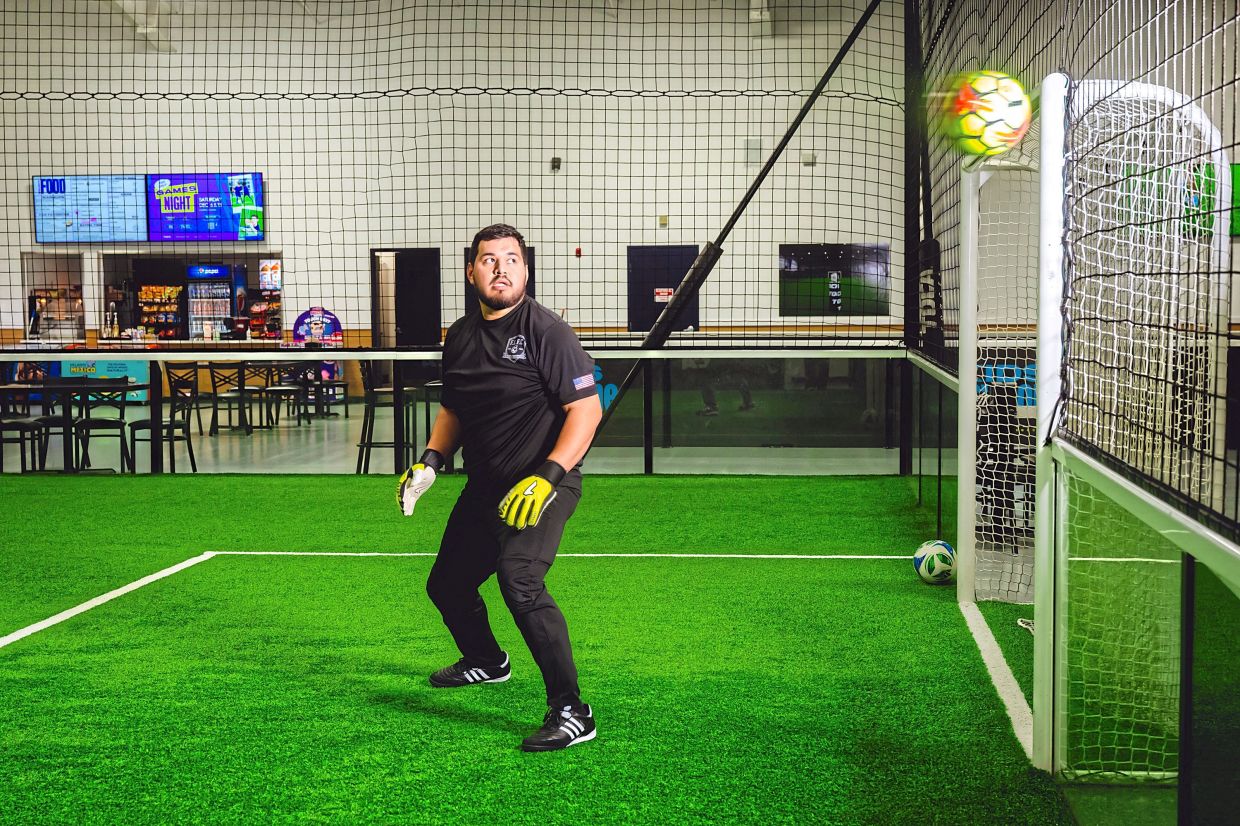
For Delgado, a goalie in Man v Fat, copious portions of macaroni and cheese, burgers, fries, beer and spiced rum – and heartburn – yielded the realisation that he needed to do something. An abdominal scan brought more alarming news. “My liver was inflamed and looked like it belonged to a 40-year-old alcoholic,” Delgado said a doctor told him.
He radically changed his diet, cut back on alcohol and joined the league last summer. This month, when he stepped on the scale before a match, he was down to 280 pounds (127kg) from 330 (149kg) a year ago.
The one downside, he said, is that losing weight can be expensive: A US$500 (RM2,028) pair of ostrich-leather cowboy boots he bought at his previous weight no longer fit. He reckoned that he owns US$1,500 (RM6,084) worth of clothing that is now too big on him.

Lose big
With its cheeky team names and playful ethos – one player had “No Salad” printed in the nameplate on the back of his jersey – Man v Fat might be dismissed as a gag. But participants, who pay US$99 (RM401) a month to play in the league, say they are serious.
Players in Britain collectively have lost 900,000 pounds (408,233kg) – “equal to over 82 elephants,” the league said. To qualify, players must be over 18 and have a body mass index of at least 27.5, which for a man of average height translates to wearing somewhere between a large and an extra large shirt – or bigger.
(That’s just when they join. Players are not kicked out for losing too much weight.)
The competitive aspect – where each pound his teammates lose contributes to the team’s rankings in the league – is a major motivator, Naim Eljaouri, a 37-year-old forward, said as sweat poured down his cheeks, adding, “we have a group chat where we keep each other accountable.”
The weekly matches are played indoors for 28 minutes and can seem like a cross between football and hockey. The ball is allowed to bounce off the wall that encloses the pitch, which is less than half the size of a standard football field. The only time play is stopped is after a goal or a penalty, or when the ball hits the netting above the walls.
“You have no idea how much faster we are now,” said Gustavo Alvarez, a physician who joined the league last spring. “When we started, we were basically just standing and passing the ball.”
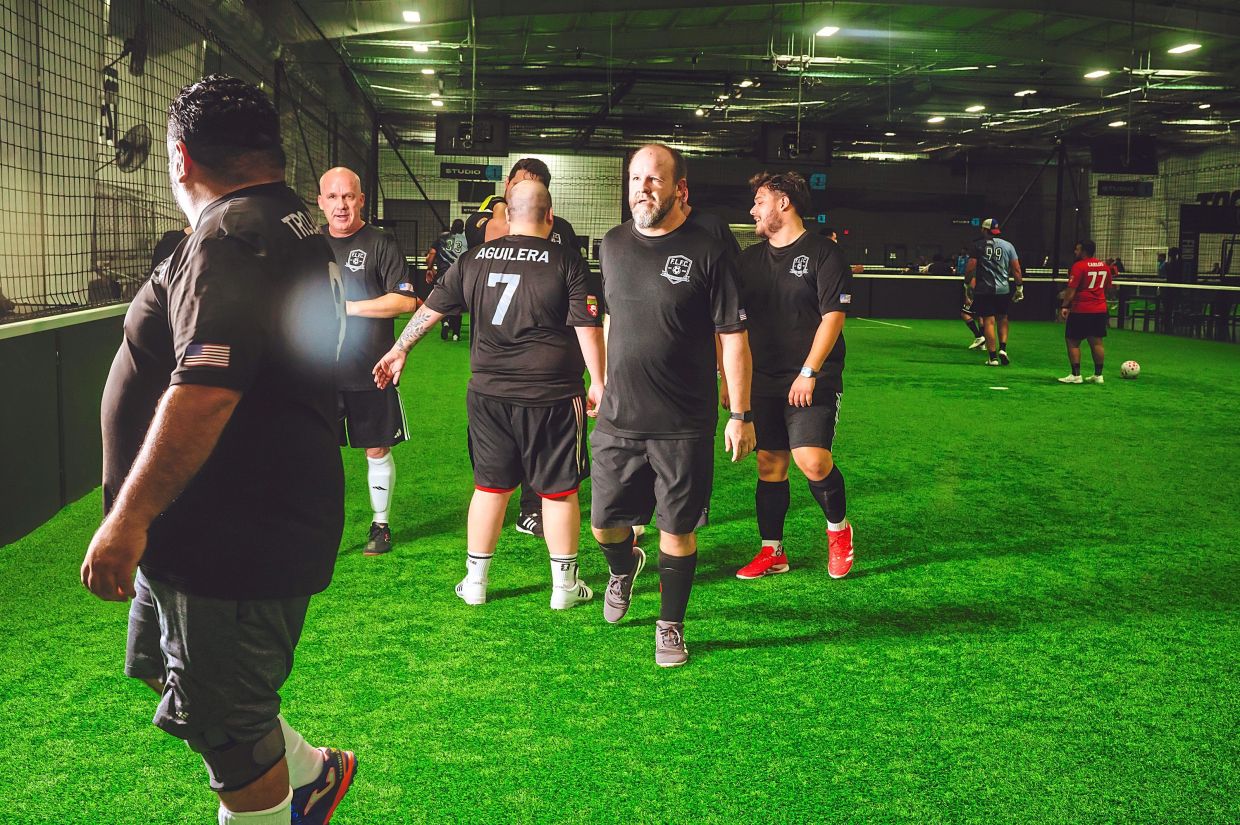
Alvarez plays for Fat Man United. Other team names are also puns of famous football teams, including Fatty Liverpool Football Club (FC in football parlance).
Some team names play off food references: K-FC Dallas and Butterball United.
There’s also OB City, Heart Attack FC and Mission: Slimpossible.
Taking notes
Williams questions the players individually each week about what they ate, an accounting that players say challenges them to eat better.
Delgado said he tries not to disappoint his coach. “If he sees six McDonald’s cheeseburgers on the list, he’s going to look at me sideways.”
Players say the league offers benefits beyond weight loss. At a time when cases of male loneliness are making headlines, teammates forge friendships built around a common purpose.
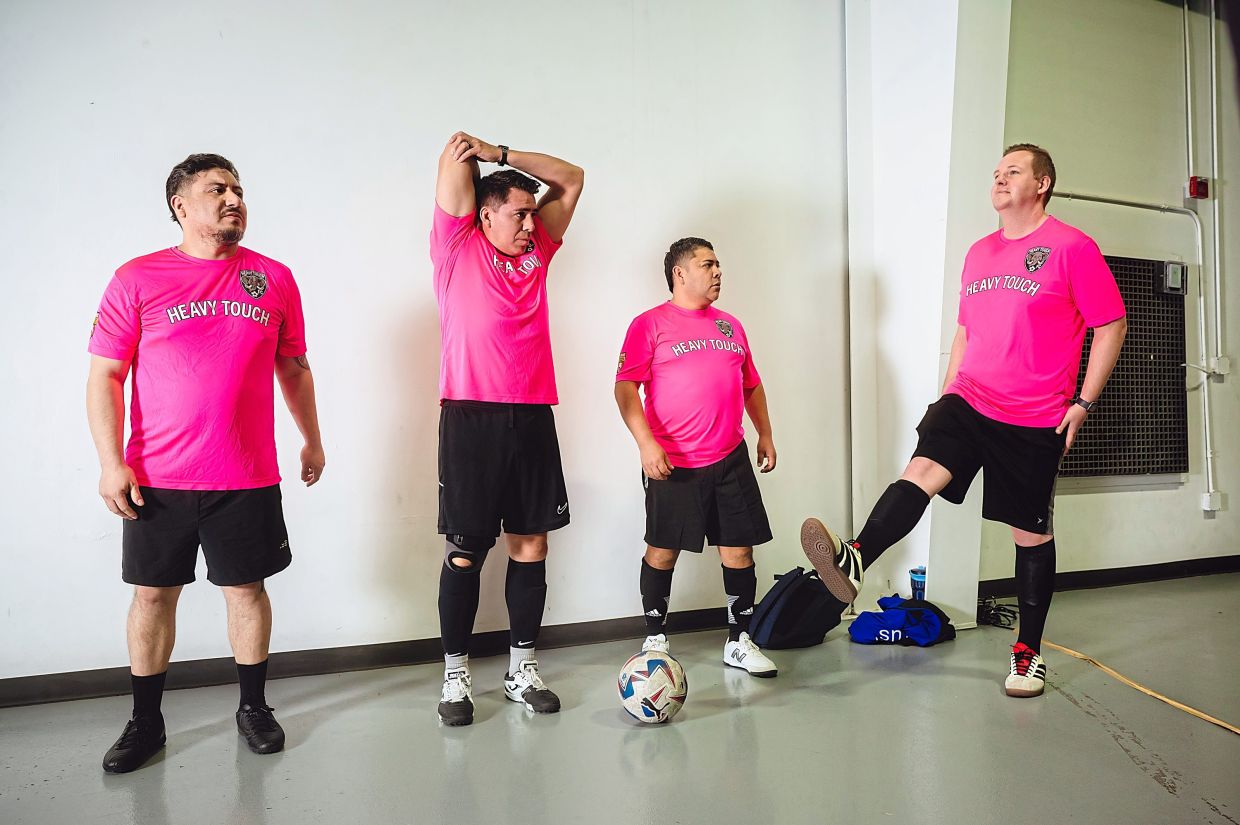
Jarod Zlotkowski, who plays for Fatty Liverpool and manages a sports bar in the Dallas area, said the league allowed him to meet people he might not ordinarily ever cross paths with.
Chris Alsip, a salesperson for a technology company, weighed 429 pounds when he joined. His seven-year-old daughter, who takes football lessons at the same facility, calls her father’s matches “fat guy football.”
Alsip said he thought people were judging him as “lazy, sloppy, unintelligent, low effort” solely on the basis of his weight. Exercising with other heavy people alleviates some of the judging, he said.

During the weigh-ins after the New Year’s break, many players admitted to letting holiday cheer impede their diets. But when Alsip stepped on the scale, he weighed 333 pounds (151kg), eight pounds (3.6kg) lighter than before the holidays and down 96 pounds (43.5kg) from May, his first weigh-in at Man v Fat.
His shoe size has shrunk to 14 from 16, and his waist to 42 inches (106cm) from 52 inches (132cm).
Alsip said he had pharmaceutical assistance: one of the new class of weight-loss and diabetes drugs known as GLP-1s.
Others say they are sticking to diet and exercise alone to shed pounds.
“I want to feel that accomplishment of doing it myself,” said Delgado, who rejected his doctor’s suggestion that he take the drugs. To meet his goal of returning to his high school weight of 230 pounds (104kg) on his 6-foot (182cm) frame, he has replaced Snickers bars with popcorn, and Dr Pepper with water.
Before his wedding in August, he had to have his suit retailored and two insoles slotted into his cowboy boots.
His wife, Stephanie Moreno, joked from the sidelines of a recent match that her husband might shed so many pounds that he could end up flying away.
“He’s my little dust particle,” she said. – ©2026 The New York Times Company