It stood tall, literally, during its heyday. When it was completed in 1930, the four-storey structure was the highest building in Kuala Lumpur.
Today, the Lee Rubber Building is dwarfed by the many skyscrapers around it that have sprung up over the decades.
The Art Deco styled, grey-facade building was designed by British architect Arthur Oakley Coltman of then architecture firm Booty Edwards & Partners (now known as BEP Akitek).
Once said to be the former holiday residence of Kapitan Yap Kwan Seng in the 1930s, the building has since been tenanted by various parties, including a popular bookstore and a lifestyle company.
But not until its recent conversion into a 49-room hotel – located between Central Market and Petaling Street on Jalan Tun H.S. Lee – did the building receive much attention.
Else Kuala Lumpur was officially launched Sept 9, the result of a thoughtful adaptive reuse effort by local design firm Studio Bikin, which worked closely with the hotel’s Singapore-based founders Javier Perez and Justin Chen.

“Else has been a four-year project realised through the challenges of the global pandemic and inspired by the emerging new era of travellers. The result is an urban haven for the globally minded and curious.
“Our design and construction team sensitively balanced a contrast of new and old, with a refined juxtaposition of a beautifully preserved pre-war building and innovative design that invites guests to explore the property on their own and discover intimate pockets to pause and reflect,” said Chen, an architect by training who is leading a regional shared workspace brand.
Indeed, walking around the hotel makes you feel like you have wandered into a huge private bungalow or mansion that houses a mix of contemporary and cultural furnishings and decor pieces, as well as local and foreign artworks.
A surprising find is the old-style granite benches on the fourth floor, which have been a part of the building from the early years, left untouched to give guests a glimpse into the past.
Also preserved is the building facade, with the etched wording “Lee Rubber Building” still intact, although it has been given a fresh coat of grey paint.
“With this being a building of historical significance – it was the tallest building in KL at that time – it was our intention to preserve it, at least on the outside, as much as we could, and also the inherent architectural features inside,” said Farah Azizan, creative director of Studio Bikin, when we met at the hotel recently.
“The original (facade) colour was actually white but when we came across it, it was painted this really awful yellow,” shared Farah. “With blue highlights, which was not very nice,” added Adela Askandar, the design firm’s managing director.
“So we repainted the facade and restored some of the building elevation. We also added three more floors above the original four-storey building.
“But we were also very conscious of the fact that we needed to breathe new life and new energy into it,” said Farah.
The designers added that they were glad for the opportunity to be involved in the project, especially since it’s located in the busy yet historic area of Chinatown.
“There was no place in Chinatown that offered this serenity where you could rest,” said Farah.
“And switch off from the hustle and bustle of the streets, because it can get quite hectic.
“So that contrast was something we were interested to explore with the client,” added Adela.
Curated space
Guests who check in at the reception area, which is on the first floor, will notice a coffee table filled with an array of antiques and cultural curiosities. More of such unique pieces are seen on various shelves, nooks and corners of the hotel.
“Javier’s idea was to reimagine the hotel like a big house, and we had an idea of wanting it to have stuff that was specially curated,” said Farah.
“It has this feel that every piece was personally selected, which it was, by the whole team,” added Adela.
The way they approach the hotel interior, said Farah, is also organic.
“Towards the end, we always view this as something that is constantly growing and evolving, and not finite, so what you see here will change in say, six or nine months’ time.
“If you view it as a home, when you first move in, you have your baseline furniture. Then over time, as you travel, grow and change, you will make some adjustments along the way. Your taste and needs will change, and we see this constantly evolving interior here as well,” explained Farah.
“There is also this strong sense of eclecticism that we inject into the interior because we didn’t want this to be a typical five-star hotel where everything comes from one contracted source.

“These vintage chairs, for example, were shipped in from the US,” said Adela, pointing to the chairs we were sitting on.
There is also furniture custom-made and shipped in from China, she said, adding that most of the rugs in the common areas are by established local designer Omar Khan, while some seen in the rooms are from Turkiye.
Perez, who is involved in the food and beverage business, feels that there is a lot more they can do to enhance the space.
“I feel we haven’t even started to scratch the surface of what are the soft kind of furnishings, what are the odds and ends, that actually belong in this space.
“We have the first layer of art and furniture, but there is so much more.
“When I see this space, personally I see it as very empty, so we will continue to add on and fill it up,” he said.
When asked if there was a general theme or concept that they adhere to, he said there was none.
“Most homes don’t have themes, but they have ‘themes’ of experiences and special moments, things that you like or are drawn to.

“So it’s quite eclectic and organic, and that’s part of our DNA and what makes us unique and stand out,” he said.
Farah explained that they also want to invoke questions about the decor pieces.
“With these curated items, we want people to be curious and ask, ‘Why is it here, where did it come from, who did it belong to’,” said Farah.
“I think that also ties up with the idea of travel. Lots of people bring back objects and things they find during their travels, so what we have here speaks about that as well,” said Adela.
Perez said that, overall, they hope to offer a completely different experience for guests.
“KL is very interesting because when we look at hotels, the majority of travellers that you actually cater to are business travellers, and that’s already a segment on its own.
“So we have to kind of tap into that business segment traveller as well and who is that business traveller that then wants a different experience, and who does not necessarily need to stay in the bigger chain hotels.
“We look at this as a huge guesthouse, rather than a boutique hotel, that caters to someone who is looking for a place to disconnect from work, a place which is very functional but quite experiential,” he said.
Farah hopes that the space also offers elements of surprises for guests.
“(We want it to be) a home away from home, where a certain artwork, furniture or sculptural piece you find triggers some memory or experience that you have had before of a past trip, for example.
“So we want to encourage people to experience that as they go through the building, to find elements of surprises, and at the same time enjoy the full elements of a hotel with modern comforts,” she said.

A thoughtful approach
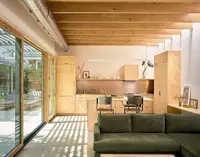
At the core of the interior space at Else Kuala Lumpur is a series of voids positioned along the height of the building.
“This creates interesting views and also staggers how the light falls through the space below.
“It gives it new energy and really opens up the space to bring in light and air into the main common areas.
“That’s quite an important architectural move that we did and a lot of other design decisions revolved around that, basically,” said Adela Askandar from Studio Bikin, the design firm entrusted with the old Lee Rubber Building conversion project.
“In the ways we have approached our projects, we have always been mindful about the few key things we consider in our design that make a project sustainable.
“One is natural light and trying to bring in as much of it as possible. Two is natural ventilation.
“They’re passive but effective ways that we normally use in our projects that, in the long run, benefit the building,” said Farah Azizan, creative director, adding that the hotel corridors are not air conditioned.

Using as much locally made materials and products as possible also helped reduce the carbon footprint.
For example, the terracotta bricks laid on the ground and fourth floors were obtained from a local brickmaker in Johor.
Despite the pandemic, the ladies also tried their best to source locally woven items for the interior.
“For example, the bedheads in the rooms on the first three floors are woven by Bidayuh and Penan weavers from Sarawak,” said Adela.
They further emphasised that the protection of an old building was an act of sustainability in itself.
“The main thing is we are actually preserving an existing structure without demolishing it and revitalising it for a new lease of life for at least another 40 years.
“So that saves you a lot of carbon footprint already. This was constructed in 1930 and it’s pretty solidly built. There is really no reason for you to not be able to revitalise it.
“We also hope that with this hotel, and the rejuvenation of an old cinema with REXKL for example, that other stakeholders would be interested to look into their properties and see what potential they have,” said Adela.
Already a subscriber? Log in
Get 20% OFF The Star Digital Access
Cancel anytime. Ad-free. Unlimited access with perks.