New Norcia is a small town in Western Australia, about 132km north of Perth.
It is set near the banks of the Moore River along the Great Northern Highway.
At first glance, it seems quiet and almost unassuming, but it is a place marked by layers of history, with many heritage buildings that quietly hold its past.
Drawn by what I had read and my own curiosity for places shaped by time, I found myself wanting to see how these stories lived within its old structures.
Two hours north of Perth, I arrived without any real plan, neither tour nor checklist. Somehow, that made everything feel more immediate and real.
Set in the dry open landscape of Wheatbelt, New Norcia feels almost unexpected.
The Spanish-influenced buildings rise out of the parched surroundings in a way that feels slightly out of place, yet strangely fitting.
This town belongs to its own story, separate from everything around it. Founded in 1847 and still run by Roman Catholic Benedictine monks, it is often described as Australia’s only monastic town.
But standing there, that description felt too simple.The town has had many purposes over time – a mission, then a monastery, later a centre of education, and now a place of spiritual retreat.
That sense of evolution lingers in the air, as though each phase has quietly left something behind. What struck me most was the stillness.
There was a serene, almost untouched beauty to it. The kind that does not try to impress, but gently settles into you.
I remember thinking how strange it was that a place with so much history could feel so unknown.
Home to a quiet small community where Benedictine monks move almost unnoticed among the historic buildings located within the monastery.
They gathered to pray daily at Abbey Church which serves as a central place of worship. There is a rhythm to their presence – steady, unhurried. The Monastery Chapel drew me in without effort.
Sitting there as the monks gathered for prayer – part of a tradition that stretches back over 1,500 years. I did not feel the need to understand it fully.
Just being present in that stillness felt enough. There were moments where I did nothing at all – just sat, walked, observed. And strangely, those moments felt the most meaningful. Without realising it, I found myself slowing down to match it.
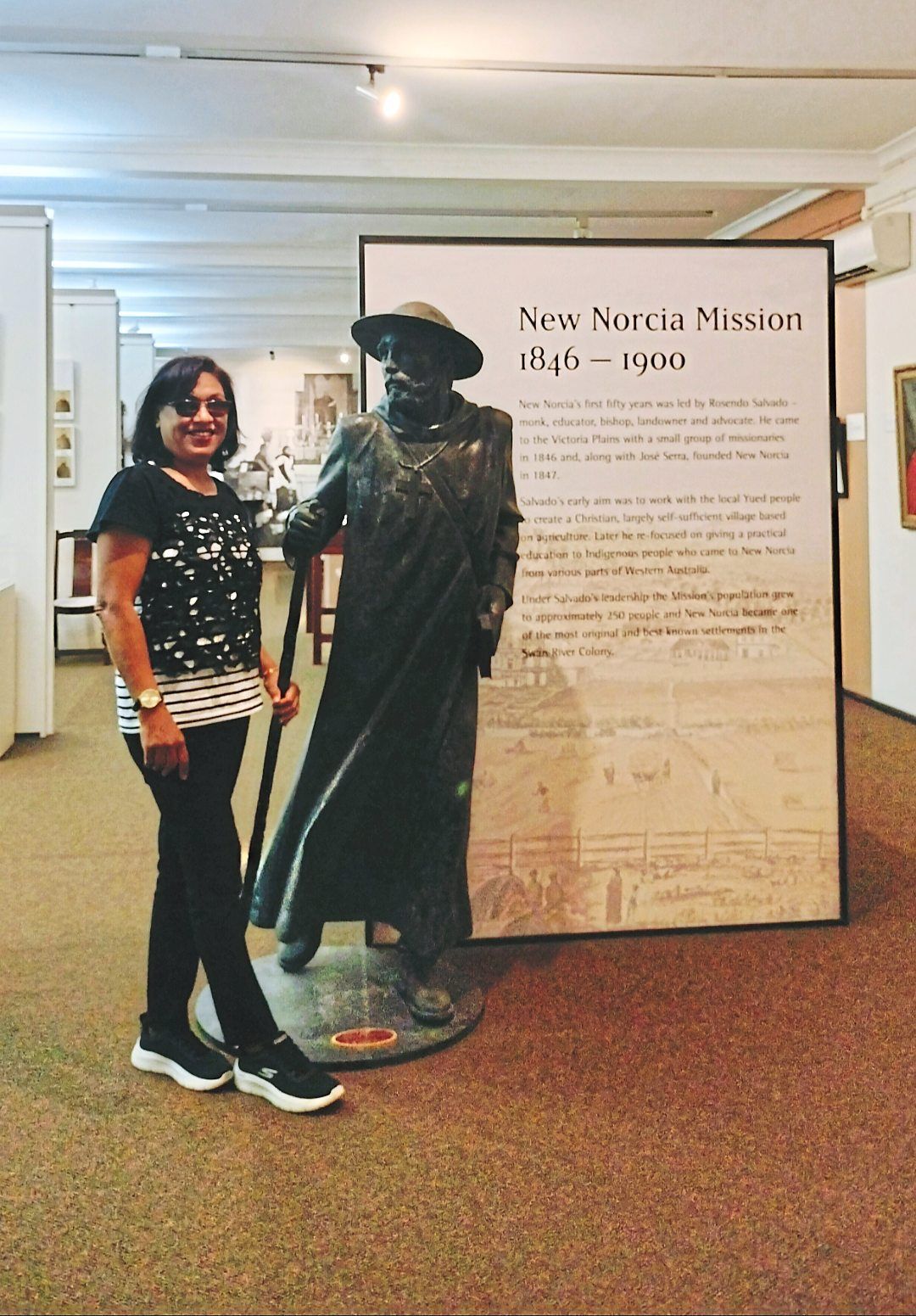
I stepped into the New Norcia Museum & Art Gallery, where the story of the town and its history spoke of its quiet evolution yet somehow remained rooted in its original purpose. It serves as the visitor centre, the starting point for understanding everything around you.
Objects, furniture, personal items and artworks are arranged in a way that slowly tells the story of New Norcia – not in one straight line, but in layers.
The ground floor reflects the earlier years, while upstairs holds church-related artefacts and exhibitions that trace the town’s different phases.
What stayed with me was the quiet richness of the collection. The art gallery houses one of the most significant collections of religious art in Australia, with European works – particularly Spanish and Italian – sitting alongside contemporary Australian pieces.
Some of the older works date back centuries, carefully preserved and restored, carrying with them a sense of time that feels almost tangible.
There were also smaller, more intimate details – delicate botanical drawings, textiles, and everyday objects – the kind you might overlook at first, but which slowly build a fuller picture of life here.
It didn’t feel overwhelming. Instead, it drew me in gently, the kind of place where you don’t notice how long you’ve been inside.
When I stepped back out, the town felt different. The buildings I had been casually walking past earlier now seemed more connected, as if I had been given pieces of their meaning. Later, I found my way to the New Norcia Bakery, where monastery products, soap, olive oil and wine are sold.
Bread are still made using a wood-fired oven that has been in use for over a century. The smell of freshly baked bread and biscotti lingered in the warm air, grounding the experience in something tangible and familiar.
The building features neo-classical architecture and was first used to accommodate parents visiting students at the town’s colleges – St Gertrude’s College for girls and St Ildephonsus’ College for boys.
By the late 20 th century, it evolved into a public hotel and represented a welcoming staycation for visitors to take in the serenity of the bushland setting.
New Norcia is not just a destination. It is a place of purpose, history, and stillness. You do not experience it all at once. It reveals itself slowly and only if you allow yourself the time to notice.
It was a simple stop, but it felt like a continuation of everything else – tradition carried quietly forward by experiencing the magnificent architecture, cultural and historic heritage. Long after I left, what stayed with me was not just what I had seen, but how the place had made me feel quieter, more aware and somehow gently altered by the experience. It was as if New Norcia was simply continuing to exist in its own time, and I was just passing through it.