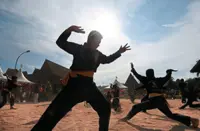
Law student Gurkiran Kaur, 22, is proud to be one of the few Malaysian women skilled in gatka, an ancient martial art form that’s still practiced among the Sikh community.
Gurkiran spends much of her free time trying to master the art of gatka, a martial art system that combines spiritual, mental and physical training and uses various shastars (weapons) such as bamboo sticks, axes and kirpan (a sword or knife).“I spend about one or two hours practising different gatka self-defence techniques. What’s interesting about gatka is that it relies on feet movement as well as body and arm strength. Gatka, just like other martial arts, is a good all-body workout which helps build both my upper and lower body strength.
“As a girl, it is important to learn the art of self-defence so I can protect myself without having to rely on others for help ” says Gurkiran who lives in Subang Jaya.

Gurkiran also wants to learn gatka because it is a part of her culture and heritage.
“Not many Sikh youths are keen to learn gatka. They prefer to sign up for martial arts that are deemed trendier like muay thai, karate or mixed martial arts.“I chose gatka over the other forms of martial arts because it’s a part of my religion and culture. I want to continue to learn this martial art as it can help me to increase my spirituality as well as my knowledge of self defense, ” explains Gurkiran.
Gatka – based on the Indian martial art shastar vidyaa (the science and art of weapons) – is an ancient north-western Indian martial art developed by Sikh priest Baba Budha Ji in the 17th century.
The knowledge was passed to Guru Hargobind, credited with the initial militarisation of the Sikhs. Centuries ago, Sikhs in Punjab relied on shastar vidya and gatka to protect themselves against Moghul invaders.
Gatka was brought to Malaya in the 19th century by Sikhs who immigrated here to serve in the police and paramilitary forces.This ancient art form is less known among Malaysians, compared to other traditional martial arts like silat, silambam, and wushu, practised among the Malay, Indian, and Chinese communities respectively. Perhaps this is because the Sikh community is relatively small and the martial art is practiced exclusively by the people of the Sikh faith.
Gurkiran has been learning gatka since she was in primary school. Her passion for the martial arts was further fueled when she continued her secondary education at a boarding school in Amritsar, Punjab. There, gatka was part of the school’s extra curricular activities, and Gurkiran could sharpen her skills.
“While gatka isn’t popular in Malaysia, it is widely practised by both girls and boys in many northern Indian states. Several academies in Punjab offer a diploma in gatka too. Gatka has also been included in India’s National School Games, ” says Gurkiran, who completed her O-Levels in Amritsar before returning to Malaysia in 2016.
Gurkiran and her siblings, fresh graduate Jeewat Kaur, 25, and student Mahabir Singh, 17, are among 20 members of the Pertubuhan Ajaran Baba Buddha Ji Akhada Selangor dan Kuala Lumpur (Akhada). It is one of the few Sikh societies in Kuala Lumpur that teaches shastar vidya and gatka.

Gatka displays are usually a big part of the community’s cultural and religious celebrations. Before the pandemic, Gurkiran and her fellow gatka practitioners would sometimes put up gatka performances to mark Vaisakhi, the Sikh New Year which falls on Wednesday. But because of the pandemic and the distancing requirements to stay safe, there will not be any performances this year.
Preserving an ancient art form
Akhada president Kashminder Singh, 30, and instructors Darshan Singh, 40, and Jaswinderpal Singh, 35, put students through rigorous three-hour training sessions every fortnight. The sessions combine fighting skills with spiritual practice, which are both important elements of this martial art form.
Students look sharp in their blue outfits, which are incidentally the colour of the uniforms worn by Sikh warriors. Female students wear a salwar kameez, while male students wear a knee-length shirt – known as chola – and kachhehra (knee-length shorts).

Across their chest, is a gatra, which is a strap to hold the kirpan. Instead of a belt, a shawl is tied around their waist for them to tuck a weapon or two in. The khanda – the emblem of Sikhism, which represents one’s belief in God – is mounted on their turbans, which are worn by all students.
“Students start with warm-ups, followed by a set of ardas (prayer) before they begin their physical training. This is followed by penthra (coordinated leg-and-arm movements).
“Weapons like ktaar (dagger), axe, dhaal (buckler shield), aara (steel whip), and flail are used in our training.
“There’s also the vadda chakkar, a circular nylon net with weights at the end of each spoke, ” said Kashminder, a gatka practitioner of 12 years. He learned this ancient martial art from his seniors, who studied under gatka instructors from Mumbai, India.

Because of the dangers involved when sparring using knives, axes and swords, students have to train with total concentration, discipline and restraint. Students are also reminded that the techniques learnt should never be misused.
The basis of their training is learning to focus on the fundamentals of weapon handling as well as developing tactical training skills.
“Beginner students are trained to spar using sticks. They are then evaluated and once they successfully complete level one of their training, they will learn to handle more dangerous weapons.”
While injuries and bruises are a part and parcel of training, Kashminder says that safeguards are in place to prevent serious injuries. These include using proper protective gear, having thorough training under supervision in techniques before students can start to spar.
Also, the weapons – purchased online from Punjab – are blunt.
“Safety comes first, and we constantly remind students these weapons must never be misused. We drill into students that gatka is part of our Sikh heritage. It’s not about violence.
“Gatka teaches students patience and self-respect, the essence of Sikhism.
“It places emphasis on the three golden rules of our religion – to remember God constantly, be humble and live an honest life, and be charitable, ” Kashminder explains, adding a medical box is always at hand during each training session just in case.
At the core of gatka training is a five-step movement: Pursue the opponent, aim for his flank, deflect incoming blows, take a commanding position and attack.
Gatka combines speed and rhythm in a controlled manner. The dhol – a percussion instrument – is played as the students train and spar to enable them to keep to the tempo as they move in dance-like, flowing movements.
More than a skill
For Kashminder, gatka is part of his identity as a Sikh. It has helped him better understand his religion, increase his spiritual awareness and build physical strength.
“Never in my wildest dreams did I expect that I’d be handling swords and other weapons, just like how my forefathers did. I love gatka because it keeps me fit and agile, and because it’s part of my heritage, ” says Kashminder, a taekwondo 1st dan black belt holder.
Over the years, Kashminder and his students have forged a close bond and now, they regard each other as family.

“Currently, there are only three instructors at the Akhada. Many of our seniors have left due to family and work commitments, ” Kashminder explains.
Gurkiran and Kashminder hope to encourage more people in their community to become practitioners of this ancient art form.
“I hope more youngsters will learn gatka as it is a self-defense art passed down from the warriors of the olden days. After the interstate travel ban is lifted, we are planning to visit Sikh temples across Malaysia to bring awareness of this martial art.
“We hope to organise seminars and train more youth from different states so that they can spread the knowledge and practice of gatka to the Sikh communities there. Hopefully this will enable more Sikhs the opportunity to preserve our culture for generations to come, ” concludes Kashminder.
Already a subscriber? Log in
Get 20% OFF The Star Digital Access
Cancel anytime. Ad-free. Unlimited access with perks.