Every Tuesday and Friday evening, Chamkaur Singh, 68, rides his kapcai to a few fruit stalls along Jalan Ipoh and at Bandar Baru Sentul in Sentul, Kuala Lumpur.
But the grandfather of two is not there to buy the freshest mangoes or sliced guava.
For the past one year, Chamkaur has been visiting fruit sellers around his neighbourhood to collect fruit waste, which is then channelled to Gurdwara Sahib Sentul (GSS) Sikh temple’s organic compost project.
Collecting rotten items isn’t a fancy job but Chamkaur is happy to do it because he knows that his actions have a positive impact on the community.
“Prior to this, the fruit sellers would throw the waste into the dustbin and it would end up in a landfill. But these items can instead be used to make organic compost and feed our gardens. On average, I collect between 10kg and 15kg of fruit wastes a week from the fruit sellers, ” says Chamkaur, who drops off the waste at a compost pile located in the temple grounds on Wednesday and Saturday mornings.
Chamkaur is part of over 10 volunteers who are involved in GSS’s composting project, which started late last year. The sexagenarian is among a growing number of individuals who understand how composting can improve soil structure and provide many nutrients to keep plants happy.
Compost is disintegrated organic matter where microbes and fungi assist in the breaking-down process. Compost is a safer alternative to chemical fertilisers because it improves the overall condition of the soil after being used for several months. It has natural microbes which keep plants healthier. Needless to say, composting is an environmentally friendly and sustainable activity.

Since joining the project, Chamkaur’s knowledge on composting has grown by leaps and bounds.“Before this, I never knew of such a thing called composting. We never knew that fruit peel, egg shells and non-meat food residue can be composted and you can get organic fertilisers.
“The good thing is, composting is inexpensive. And the end results are amazing where kitchen waste can be transformed into nutrient-rich food for plants, ” explains Chamkaur, a manager at a music school in Sentul.
Reducing landfill waste
It was real estate negotiator and avid gardener Jespal Singh, 50, who initiated the project at GSS last November. Jespal, a GSS temple devotee, mooted the idea after becoming more conscious about food wastage at the temple.
“Sikh temples offer langar (communal meals) for lunch and functions each day. Before the conditional movement control order, the GSS would cook food to feed between 100 and 300 devotees. That’s a lot of food with a fair share of food waste and vegetable scraps daily.
“Before the project, food waste from GSS would end up in garbage bags, and eventually in the landfill. That has added to the greenhouse effect. The temple community then decided to reduce our carbon footprint and start a sustainable project that could benefit everyone, ” says Jespal, who learnt about composting by attending a series of courses as well as doing online research.

At landfills, food scraps and food waste decompose and release methane, a greenhouse gas 28 times more potent than carbon dioxide. According to the United Nations Food and Agriculture Organisation, 30% of food is wasted globally across the supply chain, contributing 8% of total global greenhouse gas emissions.
Since the MCO and conditional MCO, there has been little or no cooking at the GSS temple. But Chamkaur continues to collect fruit scraps from fruit sellers while other volunteers bring their non-meat-based food waste from their homes for composting.
“These families have embarked on the journey of reducing the amount of organic waste that ends up at landfills. I hope more Sikh communities will collectively start composting projects at gurdwaras, ” says Chamkaur.
Universiti Putra Malaysia’s Department of Plant Protection head Assoc Prof Dr Norida Mazlan says home composting is beneficial because it contains essential microbes, reduces the cost of buying fertilisers and retains soil moisture.
“Kitchen waste such as onion peel, unused vegetables, tea bags, coffee powders and eggshell can be reused for composting. But most often, these items end up in our landfill.”
According to the Solid Waste and Public Cleansing Management Corporation, the household sector accounts for 44.5% of the food waste generated in Malaysia each day. That amounts to almost 16,690 tonnes per day.
Composting isn’t difficult, and anyone can do it at home, explains Dr Norida.
Jespal adds that the best part is there’s hardly any cost involved.
“Composting can easily be done, even for those living in condominiums. A simpler method is to have a bokashi (fermented organic matter) composting bin, where bokashi powder is sprinkled onto kitchen food waste, which can then be turned into a nutrient-rich soil conditioner.
“Organic compost has lower nitrogen, phosphorus and potassium (or NPK, the primary nutrients needed by plants) content. But in the long run, it’s more of a soil conditioner, and over time, the condition of the soil improves. Organic compost helps lessen the pollution that goes into our water table, rivers and drains, ” he says.
A community effort
At a far corner on the temple grounds, there are several compost piles, all of which are at different phases of the composting process.

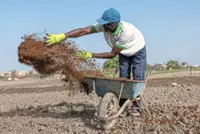
Twice a week, Jespal and the volunteers rake up dried leaves from the temple grounds and layer it with food waste.
“We add a starter as a catalyst to help with the decomposition. What’s important is the brown-leaves-to-food-waste ratio, moisture level and aeration. The compost needs to be turned on a regular basis, say twice to three times a week. That’s when you aerate the compost because the process of composting is an aerobic process, ” explains Jespal, who has two children.
Chamkaur has also roped in his son and son-in-law to help with the project.
“It’s a friendly project where over 10 volunteers come together to create compost for the community. A handful of us are retirees and this activity keeps us busy. We always look forward to meeting each other at the temple.”
The average composting period is two to three months. When ready, the compost is given out to the community to use in their gardens.
Since the start of the project, the GSS temple has produced over two tonnes of mature compost from two tonnes of garden waste and approximately seven tonnes of food waste.
“So far, the response from our community has been positive. It’s a long process but we have to take little steps to reach our goal of reducing carbon footprint and reducing waste that ends up in the landfill, ” says Jespal.
He is pleased the compost project has garnered some attention among children too.

One of his biggest supporters is Gurjoth Singh Kang, nine, who collects vegetable scraps from home for the project.
“I help Mummy cut the vegetable skin and put it in a separate recycle bag. My father comes to the temple regularly to dump it in the compost pile.
“Kids should take part in this environmentally friendly composting activity because they can learn more about it and start doing it at home as a little project.”
Jespal chips in: “We have the next generation of leaders coming in. We have to teach and motivate them to show that this is the way to go. Our forefathers left the earth to us and we are leaving it to the next generation. Do we want to leave it with so much pollution or do we want to take little steps where we can help reduce carbon footprint?”
Chamkaur plans to continue collecting the fruit waste for as long as he can.
“In the past, I never knew the fruit sellers. Now all of us are friends. They are happy to pass their scraps to me as they know it’s for a good cause.
“When I go there, they say to me, ‘Uncle you can eat free fruits’. I’m so happy to collect the fruit peels because it keeps me active and moving about,” says Chamkaur.

Already a subscriber? Log in
Get 20% OFF The Star Digital Access
Cancel anytime. Ad-free. Unlimited access with perks.
Moving towards zero waste


The temple's compost project teaches the young and old about the benefits of composting. Photos: The Star/Azman Ghani
Man on a mission: Chamkaur goes around on his kapchai to collect fruit peel for the Sikh temple's compost project every week.
Collecting fruit scraps isn’t an easy job but Chamkaur (right) doesn’t mind doing it as part of the Sikh temple’s compost project.
Rotting foodstuff has a slight stench so Gian Singh (right) helps to tie a cotton cloth across Chamkaur's face.
In a year, over two tonnes of compost have been made using food scraps and vegetable peel.
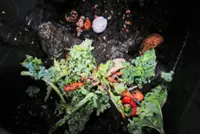
Fruit peels and vegetable scraps can be reused to make compost.
Jespal (right) is pleased that the compost project has garnered interest among children like Gurjoth.
Volunteer Gian Singh, 76, slips on his gumboots before participating in the aerating process of the temple's composting project.
Jespal mooted the composting project to reduce food waste at the temple.
Follow these simple steps to make compost.