A hunter carrying a bow and arrow is accompanied by 13 dogs, each wearing a collar with the leash attached to the hunter’s waist.The scene is a common one but this picture is 9,000 years old and carved into the sandstone mountains in Shuwaymis, Saudi Arabia.
Shuwaymis and Jubbah are famous for their ancient rock art. Archaeologists have found more than 1,400 carvings showing some 7,000 animals and humans.
There are now 156 at Shuwaymis and 193 at Jubbah showing hunting dogs, many of them wearing collars and leashes.
Hands-free dog leashes look great and it seems a good way to keep your dogs close to you as you run and carry kit but such leashes can only work if the dogs are well-trained.
If they are not, you’re pulled over. It suggests that ancient Arab hunter-gatherers must have been good dog trainers too.
Hands-free leashes aren’t common today, although you might see runners use them. Thankfully, we have a selection of options now.
“Rex and Rosie were tiny, too small for collars and leashes, when they came to us,” Alison Murugesu, a freelance writer in Kuala Lumpur remembers.
The two dogs were part of a family dumped on the street in Taman Melawati, Ulu Klang, Selangor. While many dumped animals end up homeless or euthanised, Rex and Rosie lucked out and found a happy home.
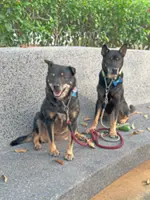
As they have the striking dark fur of German shepherds and dobermans, their mum nicknamed them the Dobermutts.“
The Dobermutts must have been about three months old when they were big enough to go out and about,” Murugesu recalls.
Little chasers
Being small, active and happy, the pups were far from angelic. “They wanted to chase things,” Murugesu giggles. “We were worried that the standard collar and leash wasn’t good for them. When they yanked, it must have hurt their necks.”
The pups grew quickly and very soon became a real handful. “Rex weighs 17kg and Rosie weighs 16kg,” Murugesu muses. “Walking the two together is a lot. We got them harnesses that distributed the pull away from their necks but even then they were too strong for us.”
Thinking it over, Murugesu called in a retired policeman K9 trainer for help and training.
“He started with a choke chains,” Murugesu says. “I was there to watch though, to make sure it wasn’t painful. He worked with them – and us – teaching them how to walk with us, and not pull, and how to listen.”
The dogs learned all the basic commands: stop, sit, stay, come back, cross (for roads) and of course the old favourite: dead dog.
With training, walks were safe and lots of fun. It also helped that a variety of leashes came on to the market.
Aside from harnesses of all shapes and sizes, there was also the martingale collar.
Martingale collars are said to have evolved in the late 1800s when dogs like whippets and salukis were popular coach dogs. As these slim fast running dogs have narrow heads, they slip out of traditional collars and leashes rather easily.
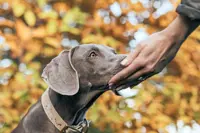
The martingale collar consists of two loops: one that is fitted to the dog’s neck so it sits snugly, and a wider looser outside loop. The leash is clipped to the smaller loop.
When the dog walks, the loop is loose but if the dog pulls, the collar tightens. It’s designed not to choke, just to signal to the dog that it’s going too fast.In addition to the careful fitting, martingale collars tend to be wide, adding to the comfortable fit.
Proper fit and comfort
Murugesu is a huge fan. “We use nothing else,” she says. “We had them fitted properly and now we just slide it over. They don’t accidentally slip out and as it tightens just a bit, they know when they need to slow down.”
Today the Dobermutts are pampered house dogs who have their favourite spot on the sofa and go swimming in the sea when they go on a break at Port Dixon.
Their walks are structured for balance too. “We have two walks a day, morning and evening,” Murugesu explains. “We go out for 30 minutes where we sniff and check things out for 10 minutes, exploring as we go, then we walk 10 minutes without stopping so it’s exercise. Finally, we slow down for 10 minutes and sniff around again.”
The structure manages two things: enrichment and exercise.
Dogs need to sniff around because this is how they catch up on the neighbourhood news: what dog, cat or human passed by, what interesting new plant or person turned up, and so on. It’s like a coffee shop gossip for dogs.
The sniffing is to exercise the doggy mind and the fast walk is to exercise the doggy body. By scheduling the physical exercise in the middle, Murugesu ensures her pets warm up and cool down properly.
While the martingale collar is now standard in the Dobermutt household, when Rosie had a sore throat recently, her mum brought out her old harness.
“When she was younger, she used it daily and was fine but now she goes all stiff,” she giggles. “And she gave me this look, saying ‘what is this I have on me?’ It was clear she didn’t like it so I took it off again.”
Thankfully, the sore throat was temporary. “I think she chewed too enthusiastically on her yak chews and scraped her throat,” Murugesu smiles.
And while the perfect leash keeps those enthusiastic pulls in check, there’s no stopping the happy Dobermutts inhaling their treats in joyful gulps.