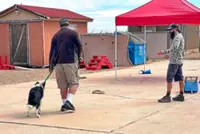
Dogs are living longer, and it’s now not uncommon for them to get beyond 20 years old. That brings with it some unfamiliar health challenges. But by giving them a good diet and the right amount of exercise, you can help them stay fitter and happier.
Dogs get old, and as they do, they become susceptible to many of the problems that can afflict older people: ailments increase, hearing and sight deteriorate, and movements become stiffer.
Owners should therefore keep a close eye on their pets, and the first question that arises is: When does a dog become old?
A formula that’s often quoted is that a dog’s age times seven equals human age. But experts say that’s far too simplistic, because the size of the animal is also significant.
“A Great Dane is almost Methuselah at the age of seven, but for West Highland or Jack Russell terrier, it’s the prime of life, ” explains Barbara Braus from the Hofheim Veterinary Clinic, adding that these smaller breeds can easily live to 16 to 17 years of age.
Veterinarian Thomas Steidl says that it’s now not uncommon to see dogs living beyond 20 years old.
“In recent decades, dog life expectancy has increased enormously, ” he says, mainly because the animals are better cared for.
According to Steidl, typical diseases include arthritis, circulatory problems and tumours. Dementia is also becoming increasingly common in our four-legged friends. “The animals become forgetful and suddenly nocturnal and forget their house training, ” he says.
Ageing is of course a gradual process, but there comes a point where an owner will notice that their dog doesn’t play so much, doesn’t want to walk so much, and needs more time for rest and sleeping.

The eyes of older dogs often get cloudy, but that isn’t necessarily anything to worry about. “The lens tissue becomes denser and therefore appears cloudy from a certain angle. But the dogs can still see well, ” explains Braus.
A look at the claws is also important. They can become too long and grow inwards.
Another problem in old age is becoming overweight. “This can often be remedied by a change in diet in conjunction with moderate and regular exercise, ” says veterinarian Ronald Lindner. He recommends a calorie-reduced feed for older dogs, and the right amount of exercise. If you have a small dog, let it run around and avoid carrying it around too much.
However, the exercise must be adapted to the dog’s physical condition. Short sprints and jumping about at ball games, for example, are not suitable for older dogs who often suffer from joint problems. Regular walks where the dog determines the speed are better.
If something hurts an animal, it should definitely be treated. “No old dog needs to be in pain, ” says Steidl. “Inflammation-inhibiting medicines can help a lot with conditions like arthritis.”
Otherwise your beloved pet could fall victim to a vicious circle where the animal moves less and less because of the pain, and their joints become ever stiffer, and the risk of obesity increases. – dpa/Sabine Maurer

Already a subscriber? Log in
Get 20% OFF The Star Digital Access
Cancel anytime. Ad-free. Unlimited access with perks.