
It's heartening to note that more individuals, especially women and seniors, understand the importance and benefits of strength training.
We know that strength or resistance training helps increase muscle mass and bone density, improve joint health, boost metabolism, burn calories at rest, and contribute to better coordination and balance.
Beginners will usually start with body weight exercises (that don’t require any equipment) before moving on to resistance bands and/or free weights and machines.
But some who have access to gyms, prefer starting with free weights straight away.
Several readers in this category have asked me which one gives the best results: free weights or machines?
Well, there is really no one-size-fits-all approach and they are both equally effective – it really boils down to your personal preferences, specific goals and the kind of equipment you have access to.
Here are some pros and cons to help you decide which to choose.
Free weights
For the uninformed, free weights refer to any kind of training equipment that isn’t attached to something.
The most common ones are dumbbells, barbells, weighted ankle/wrist cuffs, medicine balls and kettlebells.
Even a bottle of water can be used as a free weight.
The pros:
- Using them is simple to learn and applicable for all levels of fitness.
- You can do multiple exercise variations to strengthen different body parts using the same set of dumbbells.
- Free weights activate more synergistic stabilising muscles while you are training so you end up with better balance.
- You can strengthen the joints for functional movements used in your everyday setting.
For example, if you are lifting something overhead (like swinging your three-year-old up in the air) or carrying a heavy bag, it’s much easier to train for these movements with free weights instead of machines.
- They allow for a full range of movement instead of being locked in a restricted motion or pattern, making them suitable for all body types and sizes.
- You can use free weights to perform compound exercises, i.e. strengthen multiple muscle groups simultaneously.
- It’s easier on the wallet as it’s less expensive than purchasing gym memberships and machines.
The cons:
- It takes time to learn proper form and the different types of hand grips.
- There are no instructions on how to use dumbbells or barbells unless you educate yourself, learn from someone or hire a personal trainer.
- For heavier weights, you need a spotter or training partner to check your form.
- There is a higher risk of injuries.
One study on injuries sustained at fitness facilities noted that more than half occurred while strength-training with free weights.
These were often due to overestimating strength (and piling on weight too quickly), using poor form, failing to correctly execute a repetition and dropping the weight on a body part.
Weight machines
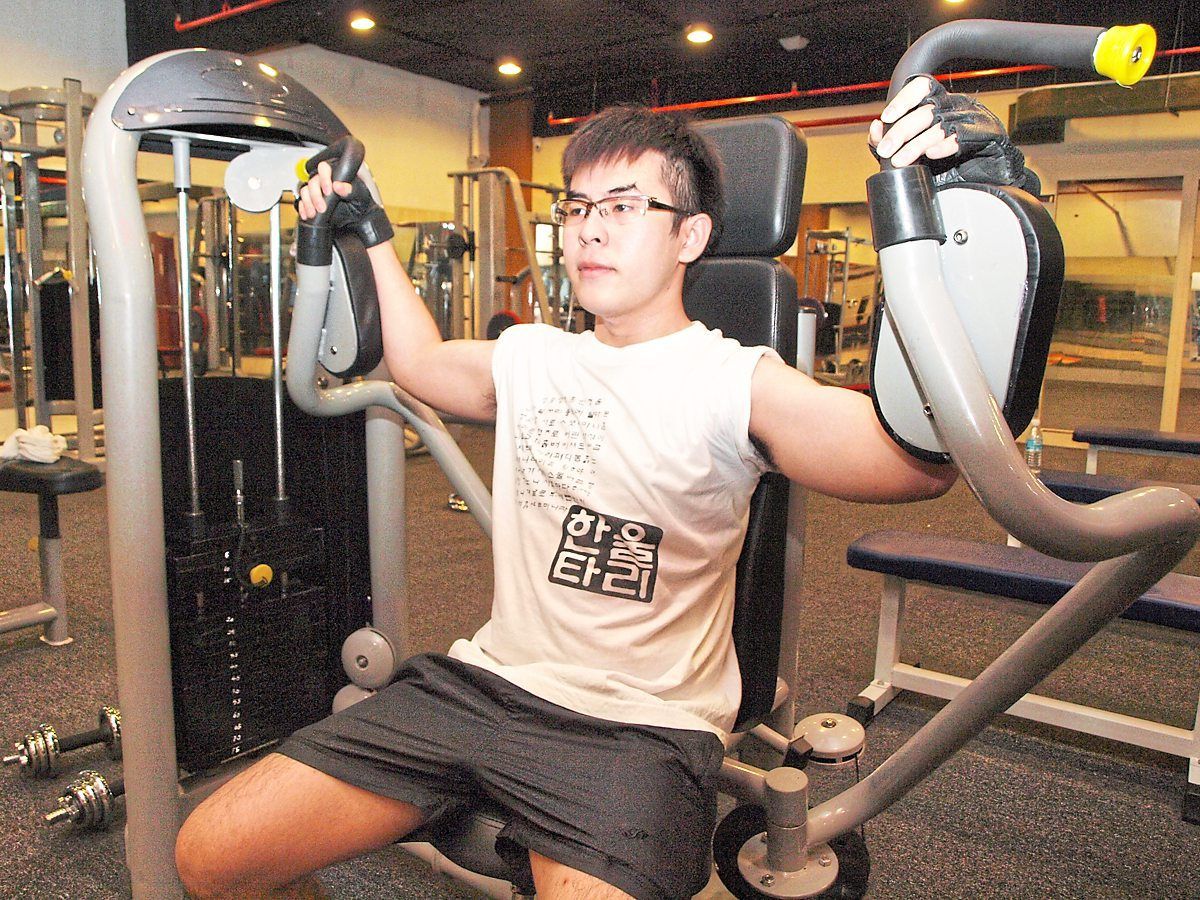
These are a type of training equipment that ... look like machines and are connected to weight plates that allow the user to move in a fixed direction or plane.
They can seem intimidating, but they’re pretty sturdy and safe.
The pros:
- Normally, there are instructions on a sticker on the machine that explain how to use the equipment and highlight the specific muscles it’s training.
- They make it easy to engage the right muscle you’re targeting, but that also means you can exhaust this muscle quicker.
- You can build specific muscles fairly quickly when using machines consistently.
A 2018 study published in the Journal of Strength and Conditioning Research found that exercisers were able to lift far more over a period of time if they trained with a weight machine as opposed to free weights.
The researchers noted that the machines provide built-in stability that allows you to make the greatest gains in specific muscles.
- You won’t have to worry about balance as the machine gives you all the stability you need.
- You don’t need a spotter when you train with heavier weights as the machines enable you to do this with a lower risk of accidents/injury.
- Machines are great for rehabilitation purposes as they help isolate muscle groups, making it safer to build strength elsewhere in your body without aggravating the injured body part.
The cons:
- Machines don’t assist with functional movements that are necessary for activities of daily living.
- Since you are isolating target muscle groups, the stabilising muscle groups around the joints take a back seat.
If you neglect these smaller muscles for too long, you run the risk of chronic injury and poor posture.
- Machines cannot help you build total body strength, balance and stability like how free weights can.
- Most of the time, you’d have to be a gym member to access weight machines.
This can be pricey, especially if you’re only patronising the outlet once a week or during the weekends.
Start slow
If your objective is to bulk up, then it’s advisable to combine both free weights and machines for maximal gains.
Use machines to work on specific muscle groups and free weights for multiple muscle groups, as well as stabiliser muscles.
That said, no matter your age, when you embark on a strength-training programme, start slowly so your body has time to adjust to the additional stress that is coming its way.
First, learn the right motion and body alignment with a light dumbbell or bare barbell (most gym barbells weigh between 15-20kg) before you progress on to heavier weights.
Depending on your needs, devote at least 30 minutes twice a week to train different muscle groups.
Pay attention to exercises that mimic movements used in daily life, e.g, squats, lunges, shoulder presses and deadlifts.
And of course, don’t neglect your abdominal muscles, as that’s where your power of movement comes from.
Revathi Murugappan is a certified fitness trainer who tries to battle gravity and continues to dance to express herself artistically and nourish her soul. For more information, email starhealth@thestar.com.my. The information contained in this column is for general educational purposes only. Neither The Star nor the author gives any warranty on accuracy, completeness, functionality, usefulness or other assurances as to such information. The Star and the author disclaim all responsibility for any losses, damage to property or personal injury suffered directly or indirectly from reliance on such information.
Already a subscriber? Log in
Get 20% OFF The Star Digital Access
Cancel anytime. Ad-free. Unlimited access with perks.