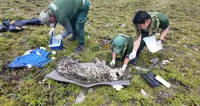
THIMPHU; A female snow leopard was fitted with a GPS collar in September in Nubri, within Thimphu, at an altitude of more than 3,000 metres.
Researchers released the animal back into the wild after fitting the collar, which will help them track its movements and gather information about its habitat and behaviour.
Two more snow leopards are expected to be fitted with GPS collars within the next year.
The collars will help researchers understand the animals’ movements, habitat use and interactions with people and livestock, strengthening conservation efforts in Bhutan.
The collaring initiative, led by the Department of Forests and Park Services (DoFPS) in partnership with WWF-Bhutan, aims to collar at least three snow leopards between 2026 and 2027.
Tandin, programme specialist at WWF-Bhutan, said existing camera-trap data had helped confirm the presence of snow leopards but provided limited information about their movements across their habitats.
“The main objective of this collaring programme is to understand more about snow leopard movement and habitat use,” he said.
The GPS collar is expected to record the animal’s location every one to two hours, providing detailed information about its movements across the landscape and its interactions with people, livestock and other elements of its habitat.
The data could help authorities better manage human-snow leopard conflict by identifying how and when the animals move into areas used by livestock. It could also support the development of snow leopard-based tourism in the Jomolhari landscape.
Another key objective is to identify movement corridors that are critical to the species’ long-term survival.
Tandin said the data could help researchers model how snow leopard movements might change under different climate scenarios. This would help identify and protect important movement corridors as climatic conditions change.
However, tracking and capturing snow leopards remains challenging because they inhabit vast, rugged and open landscapes. Tandin said field teams had spent 15 to 20 days in some areas without successfully tracking or capturing a snow leopard.
DoFPS is leading the initiative, with WWF-Bhutan as a partner and support from the Department of Livestock, WWF-US, and WWF South Korea.
The GPS collar will provide movement data for two years, helping address knowledge gaps about snow leopard ecology and improve long-term conservation planning in Bhutan.
Bhutan had an estimated 134 snow leopards, according to the 2022–2023 national snow leopard survey.
Jigme Dorji National Park has the country’s highest density of the species, while the highlands of Paro Forest Division are also important for its long-term survival.
Globally, fewer than 8,000 snow leopards are estimated to remain in the wild. The species is listed as Vulnerable on the International Union for Conservation of Nature’s Red List of Threatened Species. - kuensel/ANN