Have you ever experienced a dull ache along the front, inner or outer portion of your shin, which comes on after a long walk, hike or run?
Or you’ve just started exercising and you’ve gone much farther or faster than your body can handle, with the result that the next day (or after a few days), your lower legs feel sore?
If this has happened to you, it’s likely you have shin splints, medically termed as medial tibial stress syndrome (MTSS).
Shin splints occur when the muscles, tendons or bone tissue around the tibia (shin bone) become inflamed from overuse.
Think of shin splints as your lower legs screaming for mercy.
When you push your body too hard or too fast, the muscles and tendons around your tibia get exhausted and start pulling aggressively on the bone’s outer lining (periosteum).
This lining is packed with sensitive nerves, so when it gets tugged and irritated from all that repetitive impact, it gets inflamed and sends you a signal with a dull, painful ache.
The condition commonly affects only one leg – usually the dominant side, though bilateral (both legs) cases can happen.
Even though people assume walking is a low-impact activity compared to running, a long walk still requires your lower leg muscles to fire thousands of times to lift your foot and absorb the shock of each step.
Terrain matters
Training exclusively on hard surfaces like concrete and asphalt, or sudden shifts to incline or uphill terrain, can lead to shin splints.
Proper running tracks or grass absorb shock and are much softer and safer on your joints, compared to rigid surfaces.
Hard surfaces provide virtually no shock absorption.
This multiplies the ground reaction forces that travel up through your feet and directly into your shin bones and surrounding muscles.
Likewise, suddenly shifting to hilly terrain forces your lower leg muscles (i.e. the tibialis anterior) to work much harder to lift your toes and stabilise your foot.
This introduces uneven stress and rapid strain on muscles that aren’t prepared for the workload.
When you combine a hard surface with a sudden increase in hill training, it creates a double-whammy effect.
The repetitive impact exceeds what your bone and muscle tissues can naturally repair, triggering inflammation and pain.
In addition, if you push through and train for multiple days in a row without adequate rest, you’re preventing tissues from repairing minor micro-tears, transforming mild fatigue into active inflammation.
Biomechanical and structural factors
How your body moves and how your weight is distributed can contribute to shin splints.
When the arch of the foot collapses excessively inward (pronates) upon landing, it forces the tibia to twist internally.
This places severe, repetitive traction (pulling) on the tendons and muscles attached to the inner shin, inflaming the bone’s outer lining.
Conversely, a foot with a very rigid, high arch does not pronate enough.
Because the foot fails to naturally flex and absorb shock, the massive ground reaction forces are transmitted straight up into the tibia.
Tight calf muscles limit the ankle’s ability to bend upward (flex).
To compensate for this tightness during a stride, the foot is forced to overpronate, stressing the shins.
Landing with your foot too far in front of your body or striking heavily with your heel (e.g. quick-time marching by the military) forces your tibia to absorb massive ground reaction forces, rather than letting your hips and gluteal muscles distribute the shock.
It’s worse for individuals with naturally flat feet or rigid, high arches as they lack the natural shock absorption mechanics needed to soften the impact.
When certain muscle groups are poorly conditioned, your shins overcompensate to stabilise your body.
For example, tight calves pull constantly on the surrounding connective tissues, reducing ankle mobility and forcing the front and sides of the leg to work significantly harder.
If your larger stabilising muscles such as the gluteals and abdominals are weak, your legs lack proper control on impact, forcing the tibia to bear the brunt of the load.
Your footwear is the primary barrier between your body and the ground.
If your shoes are worn out, poorly constructed or ill-fitting, they can directly trigger or worsen lower leg injuries.
Remember that running or hiking shoes don’t last forever, no matter how expensive they are or how good they still look after a few years.
They will lose their structural shock-absorption capabilities over time.
Logging miles without proper footwear means your bones – not your shoes – absorb the pavement’s impact.
Back then, many of my university dance mates and I would frequently suffer from MTSS as ballet slippers, jazz shoes and foot thongs offer zero arch support, zero heel elevation and virtually no shock-absorbing cushioning, though they may be comfortable to wear.
Performing barefoot in contemporary and cultural dances was no better as it forced our musculoskeletal system to handle 100% of the ground impact.
We’d dance through the pain, ice the sore spots, and eventually, land ourselves at the sports medicine clinic.
Is there a remedy?
Simply resting for a few days and returning to the exact same routine will usually cause the pain to flare up again.
The long-term fix is to stop the high-impact activity that triggered the pain and switch to zero impact cardio activities like swimming or stationary cycling to maintain your fitness; ice the area daily; and wear proper footwear, even at home.
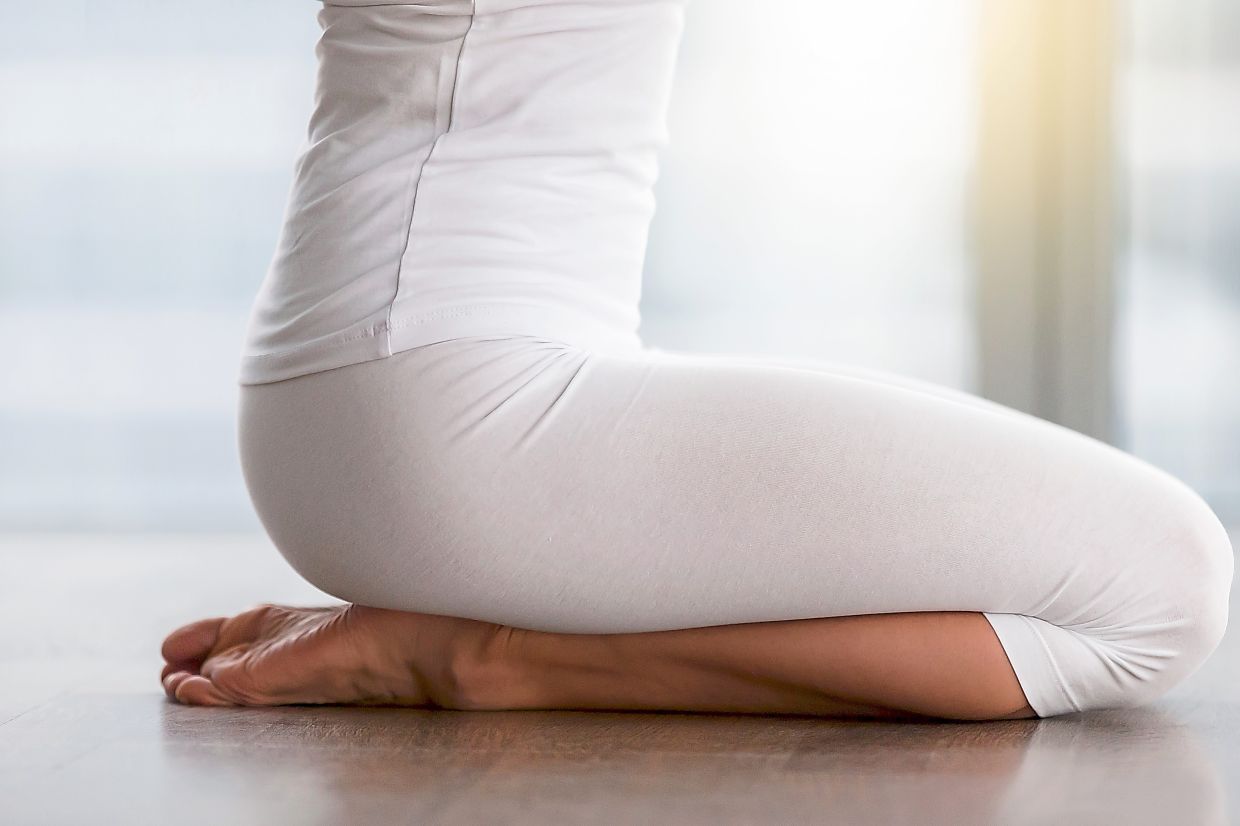
Once the ache has subsided, you need to loosen the tight muscles that are constantly pulling on your tibia, by stretching your calf muscles.
If you’re able to, sit on your heels as shown in the photo above.
Afterwards, use a foam roller or a tennis ball to gently massage the muscle belly of the calf.
Once you’re pain-free, work on strengthening the abdominal, gluteal and calf muscles.
While shin splints are highly sensitive to touch, even with very light pressure or by wearing super tight pants, an excruciating level of tenderness and swelling only in one area on the tibia can point to a more serious problem, such as a tibial stress fracture, i.e. a hairline crack.
Get it immediately assessed by a healthcare practitioner because an accidental bump into something can lead to a full-blown fracture – and you definitely don’t want that.
Revathi Murugappan is a certified fitness trainer who tries to battle gravity and continues to dance to express herself artistically and nourish her soul. For more information, email starhealth@thestar.com.my. The information contained in this column is for general educational purposes only. Neither The Star nor the author gives any warranty on accuracy, completeness, functionality, usefulness or other assurances as to such information. The Star and the author disclaim all responsibility for any losses, damage to property or personal injury suffered directly or indirectly from reliance on such information.