Prime Minister and Finance Minister I Datuk Seri Anwar Ibrahim presented the 2027 Budget earlier this month (October 2026).
The Health Ministry received RM47.7bil, with a significant amount aimed where the public health service has been most under strain, i.e. staff, buildings and waiting lists.
The most significant promise in the Budget was to end the contract system for doctors.
More than 9,000 contract doctors will be offered permanent posts in 2027.
Those who complete housemanship will move straight into permanent medical officer positions.
More than 15,000 contract doctors have been absorbed since 2023, including 4,000 this year.
For young doctors who spent years on rolling contracts, unsure of a job or a training pathway, this is a major step that settles a grievance that pushed many out of public service.
Nurses and paramedics were recognised too.
The post-basic incentive for the 47,000 who carry heavy field duties doubles to RM200 a month, and the air health service incentive more than triples to RM100.
The sums are modest for each person, but they tell staff their work has been noticed.
Meanwhile, RM1.2bil goes to repairing hospitals, clinics and staff quarters, including current dilapidated clinics.
Nine new facilities will be built, including a specialist clinic complex and day treatment centre at Hospital Sultanah Aminah in Johor Baru, a dental specialist centre in Kuching, and integrated health complexes in Gerik, Perak, and Rembau, Negri Sembilan.
The ministry says RM968mil will go to modern equipment, upgraded haemodialysis facilities and 400 new ambulances.
Impact on patients
Patients should feel the difference too.
To cut waiting times, the allocation for outsourcing to private healthcare facilities rises to RM200mil.
The Medical Assistance Fund grows from RM40mil to RM60mil.
PeKa B40 receives RM80mil for free screening, medical equipment and cancer treatment incentives for Sumbangan Tabung Rahmah recipients aged 40 and above, and fertility treatment support is extended to 2,000 couples.
The most ambitious reform targets private healthcare costs.
MediAsas, the government-backed insurance plan launching in January (2027), will pay private hospitals by diagnosis-related groups (DRGs).
From 2027, private hospital bills must use standardised charge categories so patients can see what they are paying for.
ALSO READ: What are DRGs, or diagnosis-related groups?
Licensing of private facilities moves online, with processing times targeted to fall by up to 65%.
Together, these are the government’s most serious attempt in years to restrain medical inflation.
Beyond the Health Ministry
The Health Ministry’s allocation rises about 2.5%, which sits within the Finance Ministry’s inflation forecast of 1.8% to 2.8%, while development spending rises by just RM5mil.
Permanent posts also count only when they are filled (382 of the 1,055 doctors posted to Sabah and Sarawak did not report for duty this year [2026]).
MediAsas, meanwhile, is voluntary and fully underwritten, so the government should publish its uptake among the previously uninsured every quarter.
Yet, the Health Ministry’s allocation is only part of what the Budget spends on health.
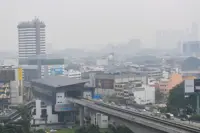
On Oct 9 (2026), as the Prime Minister tabled the Budget, schools across Johor, Melaka, Negri Sembilan, Selangor, Kuala Lumpur and Putrajaya were shut because of the haze.
Much of what decides whether Malaysians stay well, and whether illness ruins a household, sits in other line items.
Even the RM1bil drive to put electronic medical records in every public health facility runs through the communications regulator, the Malaysian Communications and Multimedia Commission (MCMC), rather than the Health Ministry.
Social security also does more for health than it is usually credited with.
Illness and injury hit a household twice: through the cost of treatment and the loss of income.
PERKESO is the main protection against the latter.
Budget 2027 gives tax relief of up to RM150 to the over 8.5 million workers who subscribe to the Lindung 24 Jam scheme, which, since June (2026), has covered employees for accidents outside working hours, and to 1.7 million self-employed contributors.
PERKESO will match 35% of e-hailing and p-hailing workers’ contributions, rising to 50% where platforms also contribute, and 70% for more than 200,000 self-employed people in sectors where cover is voluntary.
Tabung Haji will pay contributions for 40,000 imams, bilals and other mosque staff, and heavy vehicle drivers aged 40 and above will receive health screening vouchers.
Beyond PERKESO, aid for persons with disabilities rises to RM1.5bil and for senior citizens to RM1.3bil.
The weak point is that cover in many self-employed sectors remains voluntary and the lowest-paid often do not join.
PERKESO contributions should become compulsory in every sector, phased in with the matching contributions already on offer.
The haze shows where the Budget does least.
The p-hailing riders whose contributions it now subsidises spent Budget week delivering food through API (Air Pollutant Index) readings in the hundreds.
None of the measures announced for the Natural Resources and Environmental Sustainability Ministry, whose allocation rose 4.8% to RM2.51bil, dealt with haze.
Haze issues
The Environment Department (DOE) runs only 68 monitoring stations, and school closures are decided area by area from their readings.
A denser network of calibrated low-cost sensors at schools and Klinik Kesihatan (Health Clinics) would tell parents what their own children are breathing, as well as give district health officers data to act on before hospital emergency departments fill.
Better information would cost even less.
The DOE already measures PM2.5, the fine particles that do most harm to lungs and hearts, but publishes it only folded into the API.
On the DOE’s own scale, an API of 100, still classed as moderate, corresponds to about 75 micrograms of PM2.5 per cubic metre – five times the WHO’s 24-hour guideline.
Publishing hourly PM2.5 concentrations, as Singapore does, costs almost nothing, and location-based text alerts would reach people who never check the DOE website.
Part of the school maintenance allocation, doubled to RM2bil, could fit a clean-air room in every school in haze-prone districts, and the Occupational Safety and Health Department should require employers to supply proper masks to outdoor workers.
All of this costs little compared to treating the asthma attacks and heart problems that follow every haze season.
Tax matters
Tax policy is an important component for health too.
Tobacco excise was left untouched, after last year’s two-sen rise ended a decade-long freeze.
In May (2026), the Malaysian Council for Tobacco Control, Angkatan Belia Islam Malaysia (Abim) and the Malaysian Anti-Drug Association called for a 5% increase every year.
A survey of 3,200 Malaysians by Seri, the think tank I chair, found 80% support for higher tobacco tax.
ALSO READ: When inflation hits food prices harder than cigarettes
A legislated yearly increase, applied equally to heated tobacco and nicotine e-liquids, would cut smoking and raise revenue.
Illicit trade is better tackled through enforcement and ratifying the World Health Organization (WHO) protocol on illicit tobacco.
An independent study in the journal Tobacco Control found that doubling the excise in 2015 did not increase the number of illicit cigarettes.
Part of the proceeds should be ringfenced for prevention in a statutory fund, as Thailand has done since 2001 through a 2% surcharge that finances its health promotion foundation.
The Health Ministry has done well out of Budget 2027.
Parliament cannot judge the rest while health spending is scattered across ministries.
With each budget, the Treasury should publish a consolidated account of health-related spending by the Health Ministry, the social security schemes, the environment and education ministries, and local authorities.
The haze will return, and the Dewan Rakyat debate is the place to ask every ministry what its allocation does for the rakyat’s health.
Dr Helmy Haja Mydin is a consultant respiratory physician, and chairman of the Social & Economic Research Initiative (Seri) and Pusat Rehabilitasi PERKESO respectively. For further information, email starhealth@thestar.com.my. The information provided is for educational and communication purposes only. The Star does not give any warranty on accuracy, completeness, functionality, usefulness or other assurances as to the content appearing in this column. The Star disclaims all responsibility for any losses, damage to property or personal injury suffered directly or indirectly from reliance on such information.