Siti Hajar Md Radzi’s story began with an elbow fracture where screws and pins had to be surgically inserted.
She was five then.
“The bones didn’t fuse properly as another bone started growing out of my elbow and the doctor suspected it was cancer, but we didn’t do anything about it.
“At 13, my two younger brothers and I had mumps, but while they recovered, I couldn’t turn my neck any more.
“The doctor did a biopsy of my neck and diagnosed me with rhabdomyosarcoma, a soft tissue cancer,” shares the 36-year-old from Sungai Buloh, Selangor.
That’s when her nightmare started.
After undergoing chemotherapy for two years, she still didn’t get better and the neck hardened.
The family went from one hospital to another, and the doctors changed the diagnosis to lymphoma, then fibromatosis, before one doctor took a picture of her malformed toes and sent it to colleagues in the United States.
Finally, she was told that her condition was the rare genetic disorder called fibrodysplasia ossificans progressiva (FOP).
Also known colloquially as “Stone Man Syndrome”, it is a musculoskeletal condition where, after birth and progressively through life, muscles and tendons gradually transform into bone (a process called ossification).
This creates a second “skeleton” of extra bone, which makes movement impossible.
“They said I had no hope since there was no cure and that I only had a few years to live,” Siti Hajar says quietly.
Unsurprisingly, she sank into depression.
On the bright side, she started experiencing normal physical growth after stopping chemotherapy and she was able to resume her studies.
It wasn’t until after taking the Sijil Pelajaran Malaysia (SPM) examinations that both her armpits and back started to ossify.
But not knowing where to seek help, she suffered in silence.
To take her mind off the misery, she helped out at her father’s law firm.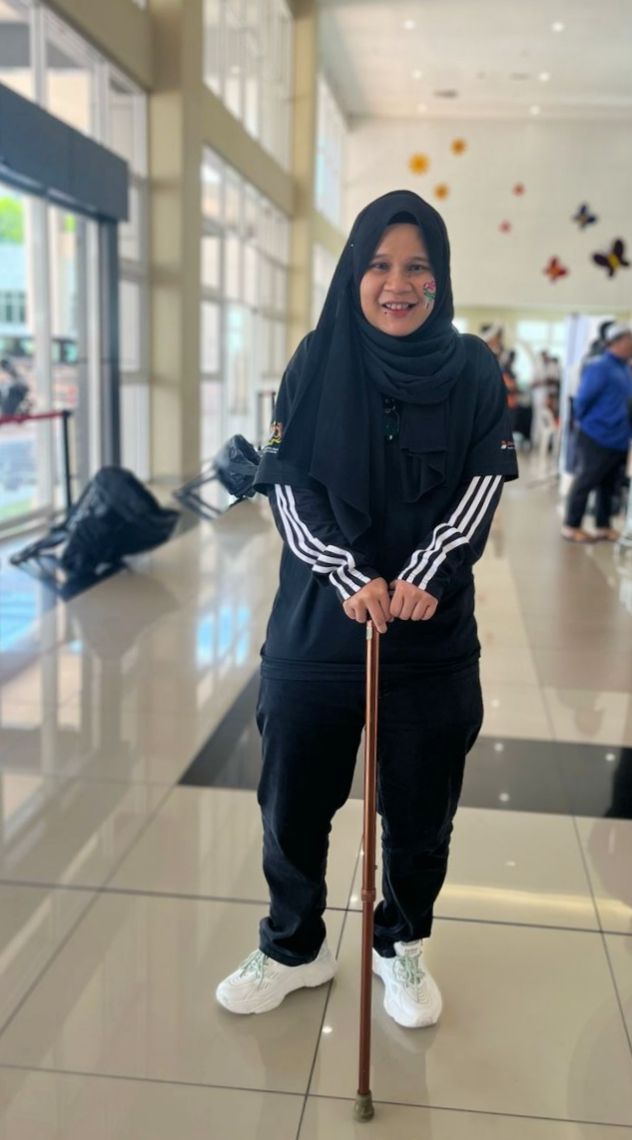
In 2015, her condition worsened and she was referred to Hospital Kuala Lumpur (HKL), but alas, since there was no specialist for the disease then, she was treated by an orthopaedic surgeon and given painkillers.
Her parents were then advised to take her to Universiti Malaya Medical Centre (UMMC).
The doctors there had not heard of FOP either, although one specialist read it up online and offered her a type of bisphosphonate, a yearly infusion usually given for severe osteoporosis.
Willing to try anything, Siti Hajar agreed and that brought her some relief.
Falls are common as most FOP patients are unsteady on their feet.
Siti Hajar fell multiple times, and once, she hit her forehead, developing a bump that grew to resemble that of a “flowerhorn fish”.
For 21 days, she vomited daily from migraines.
Since she could no longer get up from bed, she quit going to work.
At the same time, a new heel bone had started to grow and this painful protrusion would leave a gaping hole in her footwear.
She says: “At UMMC, they prescribed me orthotics and a walking stick so I have more balance.
“After five sessions of the infusion, the doctor told me I had maximised the dosage and I could no longer take the drug.
“When I was told about the clinical trial in HKL, I said yes immediately as my condition is deteriorating very quickly.
“But since I met Juliana Doraisamy, who is worse than me, but keeps positive, I’m more motivated.”
Siti Hajar’s ambition was to be a lawyer, but all that is buried now.
“My memory is poor from all the drugs I have taken ... I want to travel like normal people, but I can’t, and I’m also sad that I can’t repay my parents’ kindness.
“When people talk about their pain, I get angry because they don’t know what I go through daily,” she says.
Since participating in the clinical trial, Siti Hajar has seen some improvement as she no longer takes as many painkillers.
Still, she is reluctant to leave the house unless it’s to HKL, as she doesn’t like the stares people give her due to her peculiar gait.
“For younger patients, maybe the drug can help prevent them from becoming disabled (OKU) like the older ones.”
A mother’s love
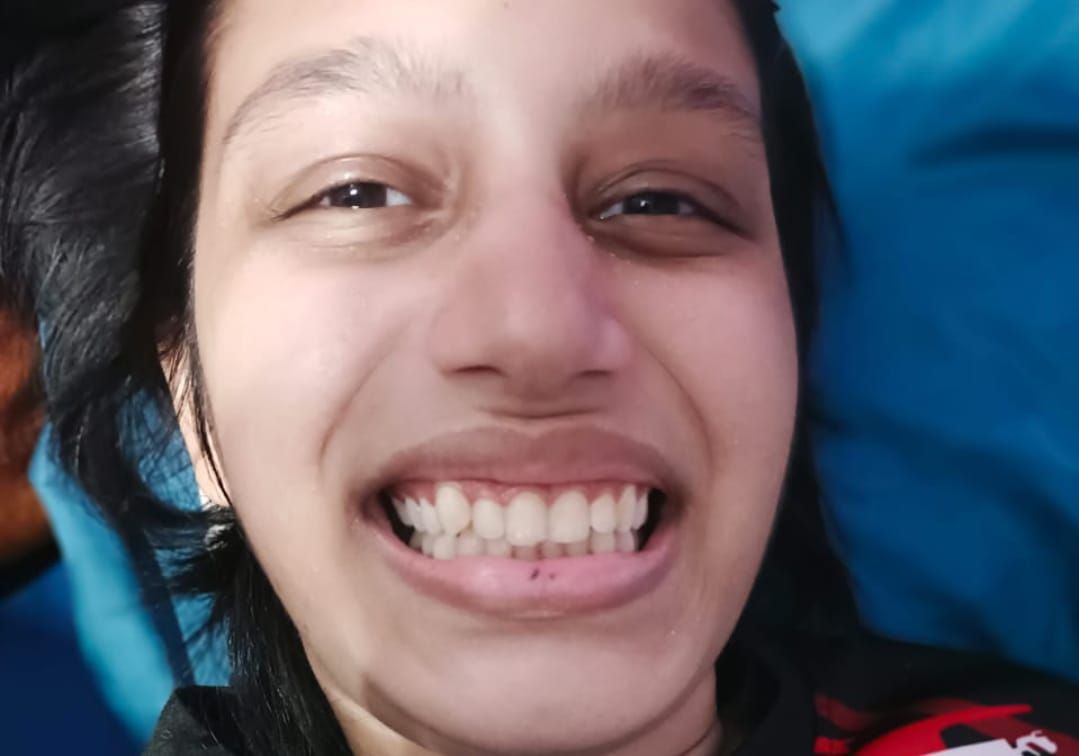
Like Siti Hajar, Aisyah Yusof Khan, 18, was born with malformed toes (a characteristic sign of FOP), but no one paid much attention as she was perfectly fine otherwise.
A cute child with dark, curly hair, the youngest of four was the apple of everyone’s eye.
A fall on her left shoulder at age three caused swelling and subsequent hardening of the armpit.
The family scuttled from one hospital to another in search of answers as Aisyah couldn’t raise her left hand.
As luck would have it, one doctor they saw had attended a conference on rare diseases and he was certain Aisyah had FOP.
He ordered more X-rays to confirm the diagnosis.
Aisyah’s mother Qureshiah Abdul Basher, 57, says: “My world collapsed when we were told she had FOP, and there was no cure.
“I was in the midst of doing my PhD in biochemistry and wanted to stop, but my supervisor convinced me to continue.
“Using my research skills, I found Professor Frederick Kaplan, an American doctor who had been researching FOP for the past 30 years.
“Based on pictures of Aisyah’s back and toes, he confirmed the diagnosis and told me to avoid giving her any medications or injections.”
Aisyah attended primary school for only two weeks.
“She fell three times and I got scared, so I pulled her out, quit my PhD and homeschooled her myself.
“For secondary school, I got two other teachers to help out and a day before her SPM exam, she missed a step and fell down the staircase, injuring her ankle.
“For months she was in pain and we decided never mind, we could enrol her in a skills course to learn computer networking,” says Qureshiah, who had to fend off all kinds of nasty comments from people asking why her kid was not in school.
The shy Aisyah smiles and lets her mother do all the talking.
Unfortunately, Aisyah had to stop after two weeks of attending the course as her body couldn’t take the 9am to 5pm classes.
Her left leg started to swell and she spent a few months bedridden in pain.
Her jaw had also frozen and she was straw-fed.
By this time, Aisyah had undergone genetic testing at HKL’s Genetic Department, which confirmed FOP.
Qureshiah says: “When the clinical trial came along, I was excited, but Aisyah didn’t qualify as she wasn’t 18 yet.
“Dr Kavitha helped get her in and we could see improvements immediately – within three months, she could walk on her own and was able to open her mouth.”
Aisyah finally speaks with tears trickling down her cheeks: “Being trapped within my body has been the greatest challenge of my life.
“I listen to music, watch movies, play computer games and connect with friends to help me cope with the pain temporarily.”
Already a subscriber? Log in
Get 20% OFF The Star Digital Access
Cancel anytime. Ad-free. Unlimited access with perks.