
Seven years ago, Zhang Jiawei was just another electrical engineering student at Nanjing Normal University until a talent scout spotted his towering 1.9m-tall frame and camera-ready face.
Today, that same young man, now known by his stage name Zhang Linghe, commands nearly 19 million followers on the Chinese social media platform Weibo and close to five million on Instagram, where each of his posts easily garners a million likes.
The would-be electrical engineer now lives under spotlights, walks red carpets, and spends his days on drama sets.
Recently, however, he appeared in the documentary The Answer Is Earth, produced by Warner Bros Discovery and the international environmental organisation WildAid.
It is set to air on Discovery Channel in Malaysia, with more details expected to be announced soon.
The three-episode series explores how China’s green shift is quietly reshaping people’s daily lives against the backdrop of the country’s latest nationally determined contributions, announced on Sept 24, 2025.
The targets to be met by 2035 include reducing economy-wide net greenhouse gas emissions by 7 to 10% below peak levels, raising the share of non-fossil energy to over 30%, and expanding wind and solar power capacity to more than six times that of 2020, aiming for 3,600 gigawatts.

Hands-on experience
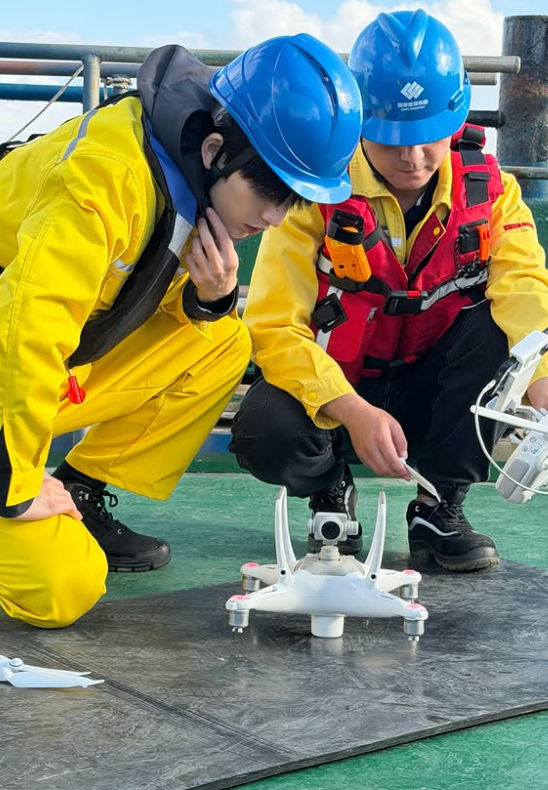
In the documentary, Zhang, 28, puts on a helmet and arc-flash protective clothing to work alongside real electrical engineers on an offshore booster station, finally getting the chance to experience the career path he could have taken.
The Chinese-language sustainability show brought Zhang to his home province of Jiangsu, where he visited an offshore wind power cluster, a pumped-storage hydroelectric plant, and an ecological dredging platform on Taihu Lake.
The actor received hands-on experience in different jobs, including as a wind farm operation and maintenance engineer, dredging boat captain, fisherman, waste collector, and eco-agricultural technician.
He also used language familiar to young audiences to explain electricity-related terms.
For instance, he described a pumped-storage hydroelectric plant – which uses surplus electricity to pump water to an upper reservoir and then releases it to generate power during peak demand – as a “giant power bank”.
Zhang believes being a “translator” in the documentary can help more people understand what energy transition and low-carbon living really mean.
In the first episode, he lived and ate alongside electrical engineers at the offshore booster station, helping them carry out routine inspections and maintenance work on the station’s power equipment.
Zhang observed that when the cameras were rolling, the engineers tended to speak in formal, academic terms.
But once the crew paused, they would open up like family. And it was in those off-camera moments that he truly felt their passion for the job.
“I could feel how proud they are of what they do,” Zhang says.
“They also want more young people to join them, but too many are chasing trendy majors and jobs instead. This documentary should show that this career has a real future and that it is truly making a difference for the environment.”
Willingness to open up
Already known for a number of highly popular drama series, the latest being Pursuit Of Jade (2026), Zhang has been widely discussed for his good looks as a rising heartthrob in the entertainment industry.
“Because many people got to know me through my characters, and then started following me as a person, I want to make good use of that attention and influence to bring more positive things to everyone,” he says.
“I hope that while following me, audiences can also see the country’s energy transition, make small changes to their own lifestyles, and contribute to the progress of our energy transformation.”
He also hopes more people can see his truest version. He describes this documentary as bringing him back to the world of Zhang Jiawei.
“In the past few years of becoming Zhang Linghe, I gradually drifted away from Zhang Jiawei, the young man surrounded by kind people, who was always willing to express his innermost, truest feelings.”
He says that after becoming a star, he insulated himself from his old life, but this documentary journey brought him back to his hometown, doing work he was once familiar with, and most importantly, being surrounded by a group of very real people.
“The journey made me more willing to open up.”
Right person for the job
Zhang once chose to become an actor partly out of a desire for freshness as he did not want a conventional nine-to-five job.
Acting allows him to live as a new character every few months, collaborating with different actors and directors.
However, by seeing and experiencing the daily lives of people doing different jobs throughout the journey, he has developed a completely different perspective.
“What they are doing is truly changing people’s lives, changing the future of our country, and changing their own futures,” he says.
“Sometimes, whether something feels fresh or not really depends on whether you can find something challenging in the repetitive work.”
According to Vikram Channa, vice president of Warner Bros. Discovery, Zhang is the right person to guide the journey because of his engineering mindset, which allows him to reconnect with the logic and natural curiosity behind these subjects.
“Our goal was to make these stories feel accessible, intimate and real, especially for younger audiences, while staying grounded in scientific truth,” says Channa.
“Today, some of the most important stories in the world are about climate change, energy, sustainability, and our changing relationship with nature,” he adds.
“These are defining issues of our time. And yet, these stories are often told through facts and figures – not always in ways that people can truly connect with. That is where storytelling has the power to make a difference.”
Channa adds: “Through that journey, science becomes personal. Engineering becomes relatable. And the future becomes something audiences can feel part of.” – China Daily/Asia News Network