
In a typical 9-to-5 office, the people we see most are our colleagues, and the truth is, we don’t always get along with everyone.
Break Room, the latest release from South Korean author Miye Lee, known for her DallerGut Dream Department Store cosy fiction series, builds on this premise and takes it further by asking: “Who is the biggest villain in your office?”
Translated from Korean by Sandy Joosun Lee, the new book follows the contestants of a reality show called Break Room, who discover they were voted by their own co-workers as the people they least want to share a break room with.
Known only by their nicknames – which reflect the workplace “crimes” that landed them on the show – the five contestants, Ice Cube, Coffee Mix, Cake, Tumbler, and Monologue, have just one week to identify the imposter in a Mafia-style game set in a break room.
Told from Ice Cube’s perspective, the story follows him as he carefully observes his fellow contestants, gathers clues, and forms fragile alliances, all in a bid to distinguish who is genuine and who is deceiving.
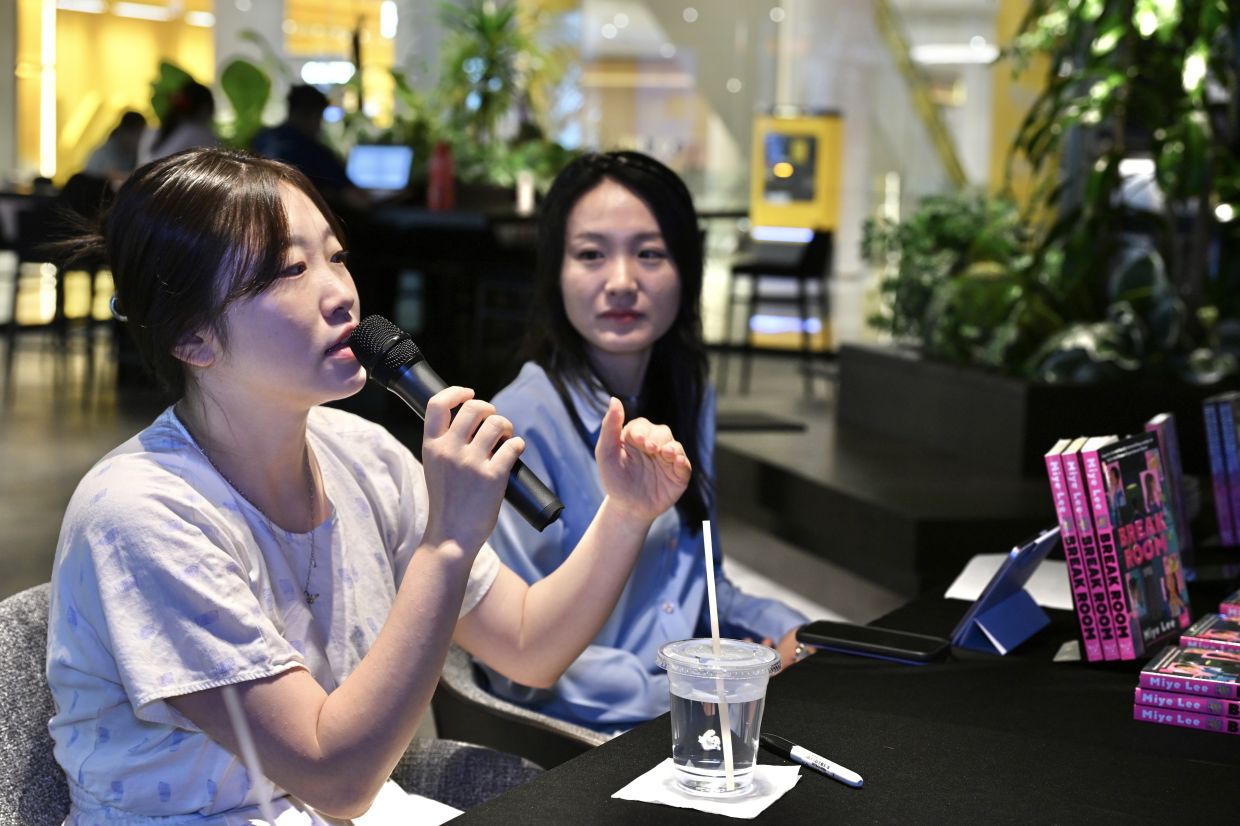
Lee, 36, from the coastal city of Busan, was in Kuala Lumpur recently to promote her book, a psychological drama that blends intensity with dark humour. Answers have been edited for length and clarity.
Break Room represents a departure from your earlier DallerGut Dream Department Store series. Could you share the inspiration behind this work?
As teenagers, I think it’s quite common to ask, “Who do you like most among our classmates?” Once you’re an adult, however, it becomes more awkward to ask who you like and who you dislike. So I wanted to write a story that touches on this, and how different people navigate social settings such as offices.
Also, at the time I wrote the book, I was pregnant and the hormones made me have bad moods every so often. So writing this book, which is filled with all my pet peeves, became a great way to release all that stress and negativity while getting to share a new story with readers.
Nearly all of the characters in the book possess traits that make them distinctly unlikeable. Are they inspired by real individuals you have encountered?
The characters are purely created from my imagination. But you know how sometimes you meet someone and they leave a very negative impression on you, but you’re not entirely sure why? You start overthinking about all the possible reasons why you feel that way, analysing their behaviours. These characters and their flaws came from the times I’ve done that.
Among all the characters in the book, what led you to choose Ice Cube as the perspective from which to tell the story?
I wanted the narrator of the story to be a somewhat neutral character, because the story’s structure requires them to be the “camera” for the reader, keeping them focused on what’s happening on the show.
I thought Ice Cube was the most suitable person for this role, because he’s not a good person, but he’s not a really bad person, either.
At the same time, I also wanted readers to wonder why Ice Cube was voted to come on the show. I think it’s interesting to see how people react to the “reveal” of why Ice Cube was brought on the show.
Having previously worked as a semiconductor engineer and now achieving success as an internationally bestselling author, what prompted you to make such a significant career change?
It was a very challenging journey to become a full-time writer. I worked as an engineer for four years, but I couldn’t bear to let go of my dream of writing. Back then, I kept wondering if I’d still be living like this 10 years later. Once I made enough to pay off my mortgage, I mustered up the courage to quit my job – I didn’t tell anyone, not even my family.
After that, for about two years, I worked part-time jobs and even founded my own startup company to support myself while I wrote my first book, which I initially had to publish through crowdfunding. I’m so thankful to all the people who have read my books and supported me.
With the growing success of Korean literature abroad, do you see yourself continuing to reach an international audience with your future works?
Now that my books are doing well internationally, it truly feels like a dream that’s only just starting to feel like a reality.
As a writer, my ultimate goal is to be able to sign on to the next book and the next and the next. Rather than having one big, tremendously successful book, what I really want to do is to write continuously. I want to write novels as long as I can.
Break Room by Miye Lee is available in all good bookstores.