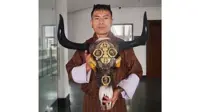
In many of his paintings, Selangor-born artist Ong Hieng Fuong, better known as Hieng in the art scene, may appear in them, but he doesn’t necessarily play a leading role.
Instead, he often sees himself as a supporting character, letting the quaint and quirky scenes from his daily life take centre stage.
In his second solo exhibition, Innocent Bystander – now showing at The Back Room gallery at the Zhongshan building in Kuala Lumpur until March 22 – Hieng draws on scenes he has witnessed in Malaysia and in Chongqing, China where he currently lives.
“The term ‘innocent bystander’ usually refers to someone who has witnessed a crime or accident. But I’m simply someone who likes to quietly observe from the sidelines,” says Hieng, 31, during a recent interview at the gallery.
“I often come across strange everyday scenes, so I naturally document them in my mind and translate them into art,” he adds.
Personal observations
Innocent Bystander marks an expansion of his practice, a world away from his July 2022 debut, That Day, I Was Sketching On The Street, which revolved around scenes from his hometown of Tanjong Sepat and Klang.
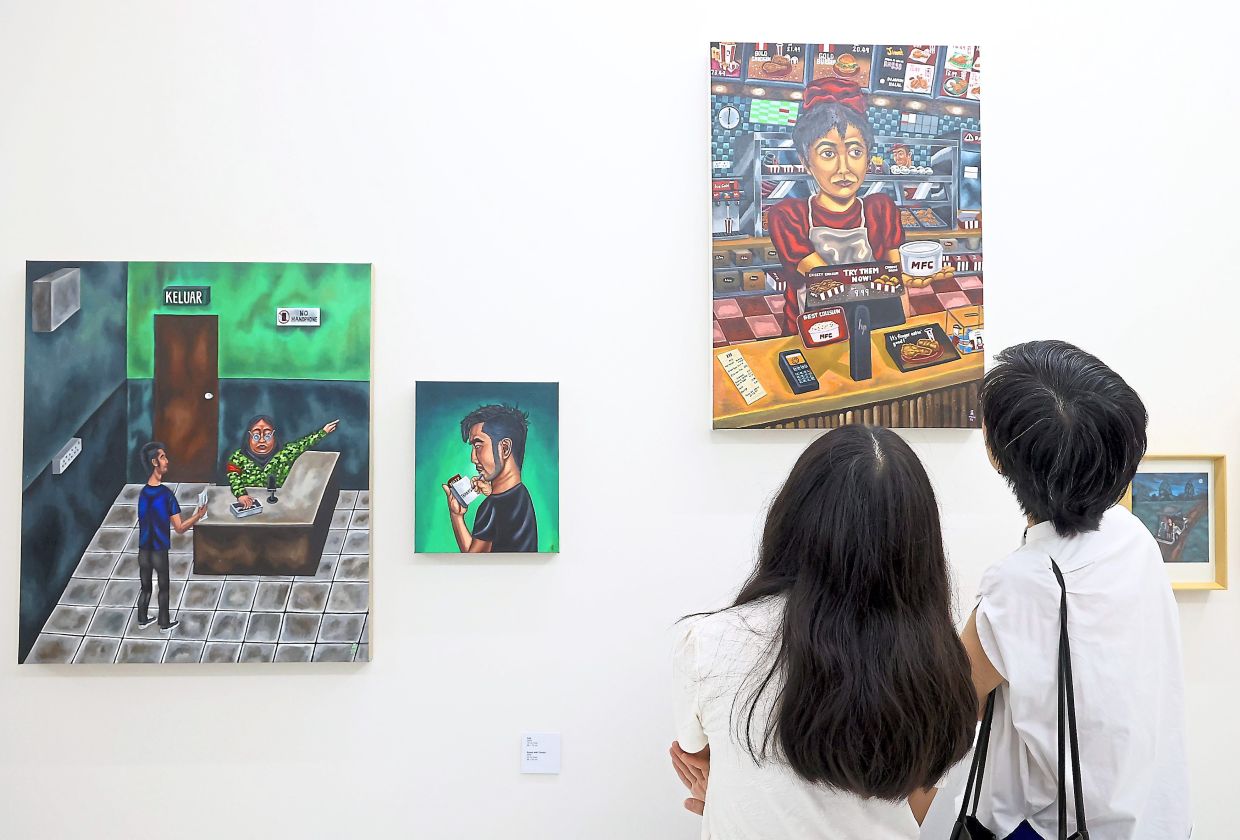
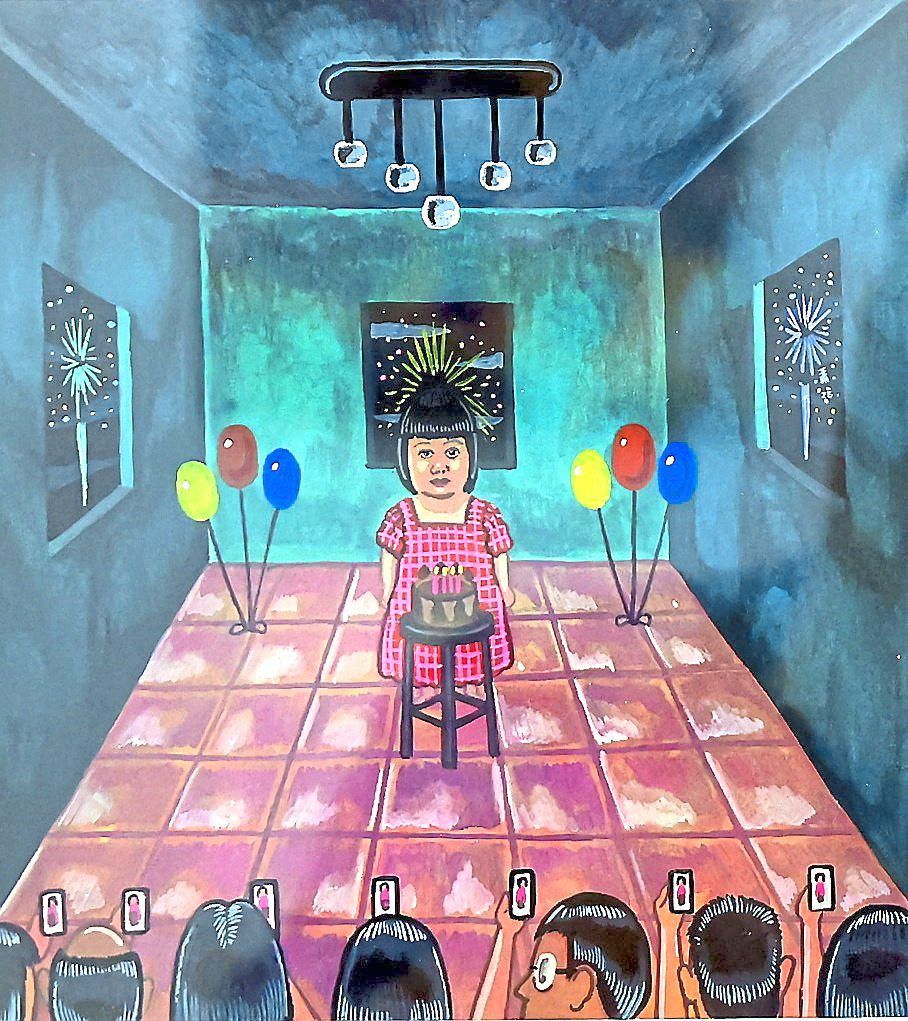
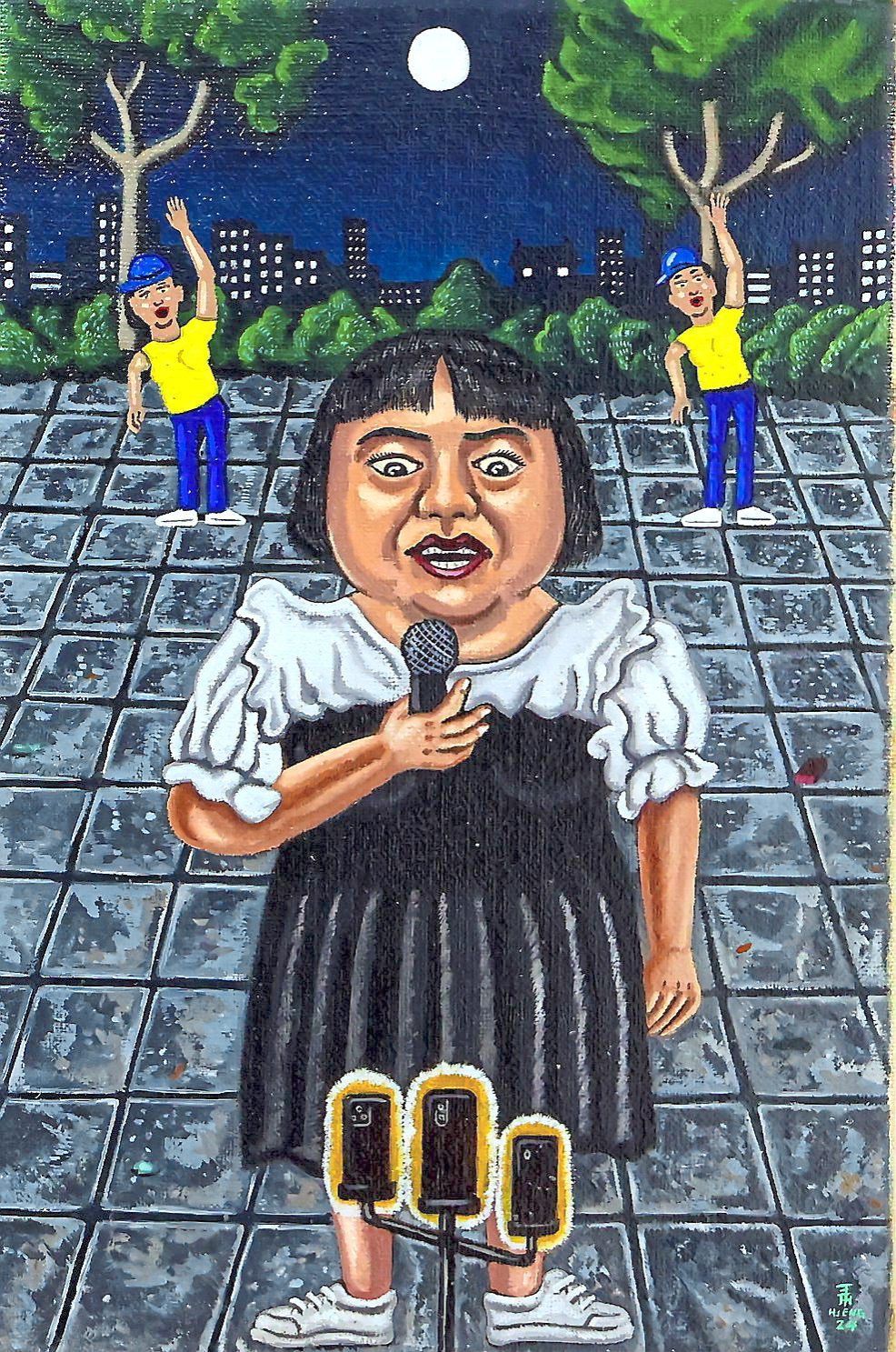
Featuring 34 paintings and nine prints produced between 2024 and 2025, Hieng’s new show captures the odd, sometimes whimsical scenes he has experienced or observed, rendered with wry humour: a man squatting on a bollard to smoke, an immigration officer on her phone beneath a “No Handphone” sign and a wide-eyed girl facing the paparazzi of family and friends’ cellphone cameras at her birthday party.
For visitors, guessing which country each scene depicts can be surprisingly tricky. Hieng emphasises that his paintings reflect personal observations, not commentary on either nation.
“I’m quite an introverted person, so I’m not particularly talkative,” he says with a chuckle.
“I’m very curious about human behaviour, so I like to watch people and wonder what they’re doing or why. I create little stories in my head. What I end up painting are the moments I find most interesting or memorable – usually a blend of real life and imagination.”
Currently pursuing a Master’s in printmaking at the Sichuan Fine Arts Institute in Chongqing, Hieng describes the southern Chinese city as a welcome change of pace from Beijing, where he spent five years completing his Bachelor’s degree at the China Central Academy of Fine Arts.
He splits his time between Malaysia and China, often returning for Chinese New Year. According to Hieng, time moves far more slowly back home in Tanjong Sepat, the sleepy fishing village.
“In Tanjong Sepat, everything’s more chill and peaceful, but every day is also the same – the village hasn’t changed much over the years, and everyone pretty much knows each other,” he says.
“But in Chongqing, while it’s more relaxed compared to Beijing, it’s still a very big city, and everything moves quickly. Every day you can see and meet new people.”
A cure for homesickness
Hieng’s days in Chongqing follow a simple routine: most are spent painting in his university studio. Outside of that, he indulges in the city’s tongue-numbing Sichuan cuisine, shops at the supermarket beneath his condo, and observes the everyday hijinks around him.
Asked what he misses most about Malaysia, he answers simply: “The people.”
Pressed further, he admits many of his Malaysian scenes were painted during moments of deep homesickness.
“When I’m working on paintings inspired by Malaysian scenes, in a way, I’m talking to myself, about why I miss that place or that moment.
“I especially miss Malaysia when it’s the dead of winter in Chongqing – there’s totally no sun, it’s extremely cold and grey ... it makes me miss the weather back home,” he says.
The young artist also misses Malaysia’s diversity and multiculturalism.
“In Malaysia, we grow up being exposed to so many different cultures and religions, but in China, there’s only one culture – this is why I feel like a lot of the paintings there have a similar look and feel to them.
“Another thing I’ve noticed is how the colours in Malaysia stand out more. Perhaps it has something to do with how we’re a tropical country. Because I think that in temperate countries like China, the colours are not as vibrant,” he says.
A standout piece in the new show, Shalimar Saloon depicts Hieng’s young cousin having his head shaved in a Malaysian Indian barbershop with a vibrant interior – a commonplace scene many Malaysians take for granted.
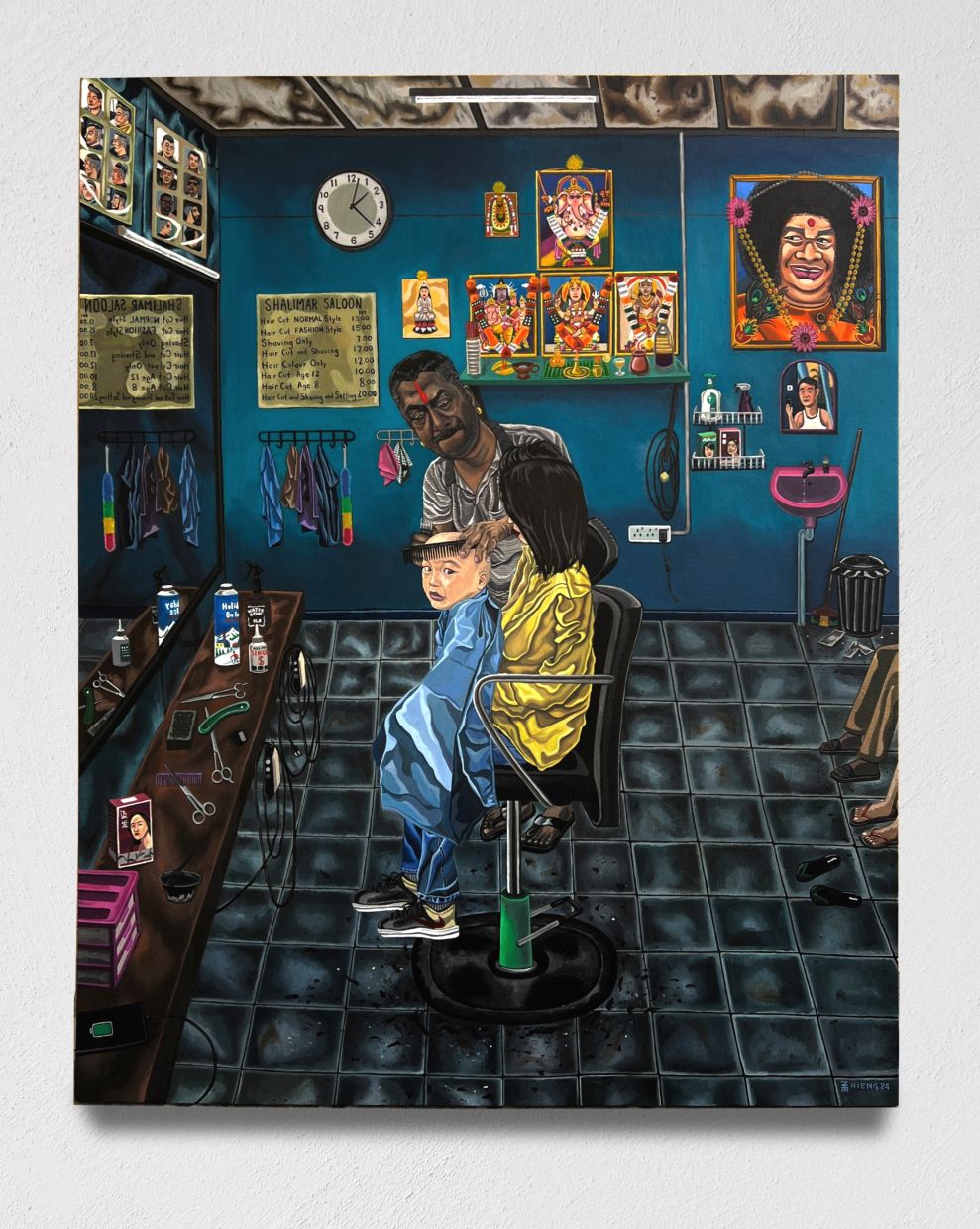
“In this painting, I bring my aunt and my cousin to a local barbershop in my hometown. My cousin – around three years old at the time – was quite nervous.
“When I worked on this piece, I felt like I was speaking to my younger self, because as a child, my mother took me to a similar Indian barbershop. It was a moment when I could connect with my past through this shared experience with my cousin,” he explains.
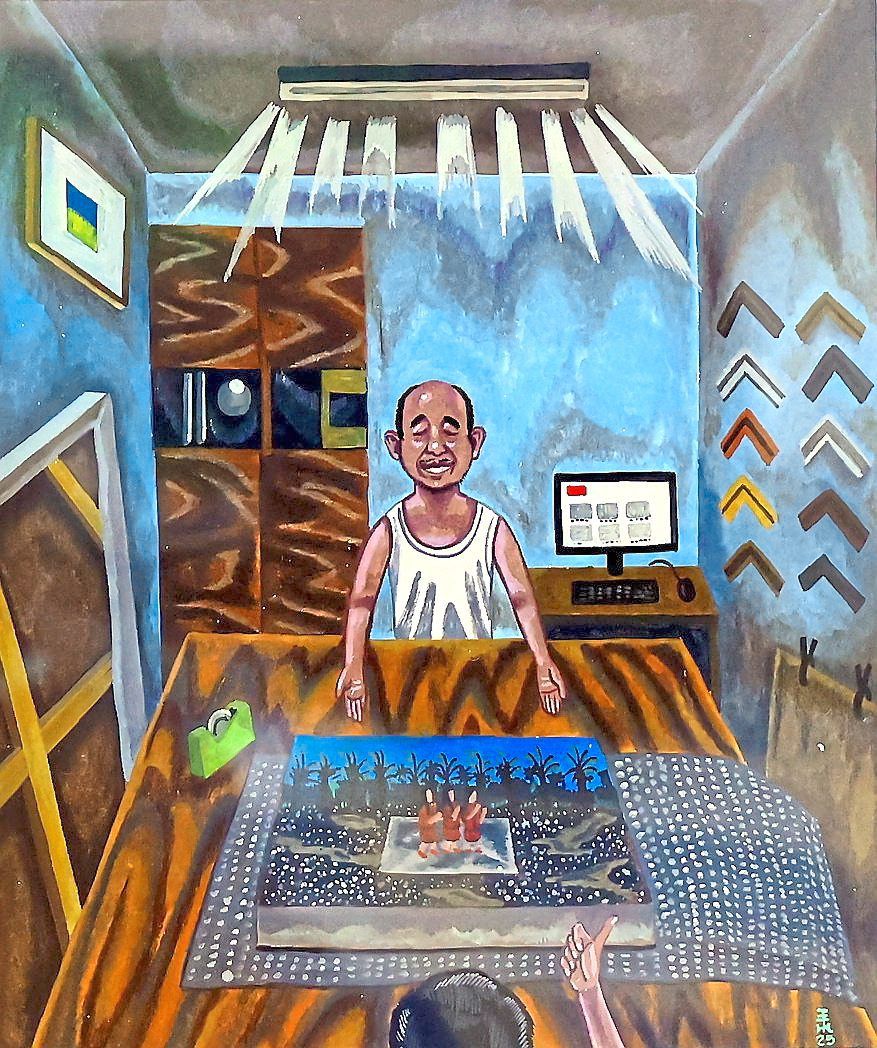
In fact, the piece also appears in one of Hieng’s self-portraits – a painting within a painting, a device he uses in several works in the show.
A fresh perspective
Most works in Innocent Bystander show the keen, precise detail that made Hieng known, echoing his 2021 woodcut-inspired art residency works at Rimbun Dahan (Selangor) and his 2022 debut at The Back Room.
In the four years since, he feels he has grown significantly as an artist. Though specialising in printmaking, he primarily produces paintings – the show features mainly oils, which he began exploring in 2024 after previously working only with poster colours.
“Before these pieces, I’d never worked with oil paint. I wanted to try something different, as printmaking has its limits – you can’t easily create large works, and the process is complex.
“With oil, I can express myself more freely. The thick paint on canvas or linen gives me an entirely new experience,” he says.
Drawing on his distinctive perspective as an observer of everyday life, Hieng says he intends to continue evolving his practice in future works.
“I’m considering moving away from overly detailed, complex paintings. It’s what I’m known for, but I want to explore abstract works and express my inner thoughts and feelings more.”
“I’ve already begun this in some pieces in the show. It felt uncomfortable at first, but as an artist, it’s important to try new things and push beyond your comfort zone. You can’t do the same thing forever,” he concludes.
Innocent Bystander is showing at The Back Room, the Zhongshan building in Kuala Lumpur until March 22. More info: thebackroomkl.com.