For the past 60 years or so, one great awakening has been to the idea that the making of the work is itself the art.
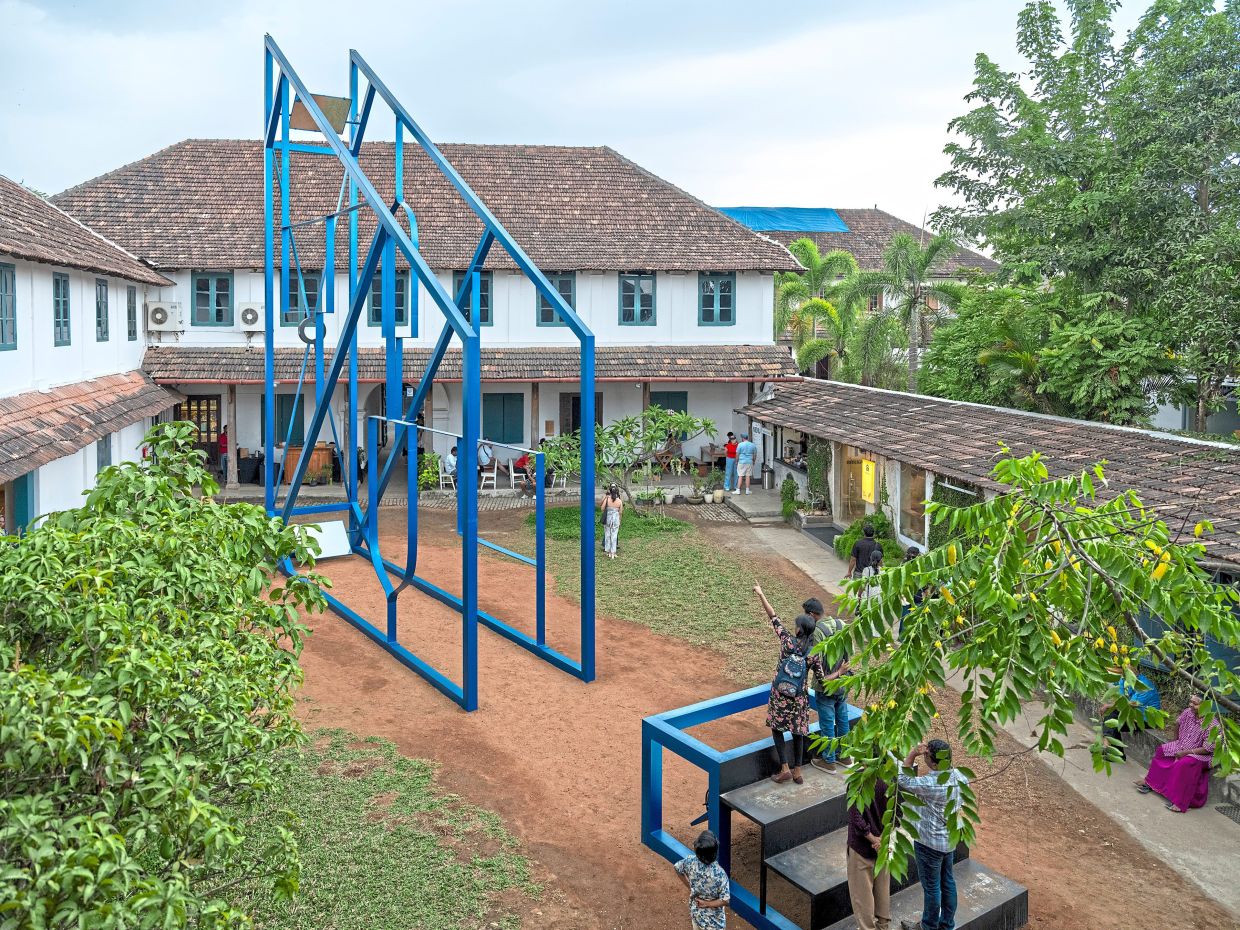
In India, art about process seems to have hit its stride in the sixth edition of the Kochi-Muziris Biennale, Asia’s largest non-commercial art event.
On view through March 31, in and around historic sites in the southwest coastal city of Kochi, the show seems intent to challenge the notion of a finished artwork – down to its title, For The Time Being, and the time stamps in its wall text.
In 2007-ongoing, a beaker full of liquid and slowly reacting copper and iron is live-projected onto the wall by Moroccan artist Hicham Berrada, like a terrarium under surveillance.
In 2015-ongoing, collections of regional compost, fish and fruit mid-rot are displayed with a Dutch still-life sensibility inside freezers by Adrian Villar Rojas, from Argentina.
And 2022-ongoing is a frightening performance by Kulpreet Singh from northern India, who sets fire to padi field stubble in the Punjab region – as farmers do – then drags canvas across them to produce lovely, diaphanous curtains of ash.
Like other global art events of recent years, this biennale runs heavy on politics, on wall text that interprets more than it informs (“formulating the gesture of hosting as holding space for verbal and nonverbal conversations on different aspects of reality”), and on organic materials like rammed earth, terracotta and mud.
Unlike those shows, it leans on art without a sense of finality, some exceptional and cinematic site-specificity, and a seamless monopoly on what Westerners like to call the “Global South”.
“I hate that term, by the way,” said this year’s lead curator, Nikhil Chopra. We spoke in his living room in Goa, about 644km up the coast from Kochi, where he lives with his wife, artist Madhavi Gore, and their two children.
“Global South” implies that geography, not class, dictates development, he explained.
Though Chopra was tired from preparing the festival, he spoke with an internal energy and wide eyes, his slender face framed by a thinning buzz cut, salt-and-pepper stubble and Lucite glasses.
Born in Kolkata, Chopra, 51, a performance artist with a theatrical bent, is probably best known for living for nine days at the Metropolitan Museum of Art in New York in 2019, when he made large-scale drawings in the galleries as visitors drifted through.
In other parts of the world, South Asian artists, with the exception of maybe Anish Kapoor, are still often exhibited on the grounds of their identity.
But Chopra, having lived in Berlin (Germany), Paris (France), Mumbai (India) and across the United States, seemed to speak on behalf of a new kind of curation, a future where Indian artists are simply artists.
“A large part of the work we’ve been doing is to break the stereotypes of what it means to be making contemporary art in India, and to beat that expectation of ‘exotic’ art that’s been placed on us,” said Chopra.
This “we” is HH Art Spaces, the art collective he co-founded in Goa in 2013. Chopra has split the curatorial work for Kochi and the stipend for Kochi with that organisation.
They chose 66 artists for the main venues at the biennale.
Other curators have exhibited dozens more artists in side shows, and this makes the biennale a sprawling affair across the dozens of crumbling warehouses and colonial spice stores of this former Portuguese port that in pre-colonial times neighboured Muziris; hence the festival’s title.
Chopra’s challenge was with the festival’s 50% quota of Indian and Keralan artists.
“My travel budget was really just spent scouting artists here,” he said.
“The international artists were the easy part,” Chopra recalled. “I just picked up the phone.”
He rattled off biennials, triennials, art fairs. “All of these people I’d just shown with around the world, and I just loved and connected with them.”
As a result, his vision of India seems to be just another spit of land where native artists speak the same exploratory and conceptual language as their peers on the other side of the globe.
For instance, in a work by Congolese sculptor Sandra Mujinga, fishing nets shroud tall and impressive dinosaur-like forms made of steel – creatures that feel both alien and, because of their references to the harbours outside, native-born.
A banner by American artist LaToya Ruby Frazier declaring Water Is Life could apply as much to India’s clean water crisis as that of Flint, Michigan, where she photographed the phrase.
Even the figurative painting on view feels provisional: like the rich, bleeding tempera landscapes of Sujith SN, and the mystical, sand-embedded archaeological scenes, in acrylic over inkjet, by Ali Akbar PN.
But context is everything. And the teaching mood is sometimes the festival’s liability.
Take Marina Abramovic, the flashiest name here, who has certainly made the doing her art since the 1970s, with her punishing and repetitive tasks.
But her work has evolved into a lifestyle brand of distracting proportions.
And at Kochi it needlessly dominates, not just with her overpowering video piece, a billboard-size grid from 2003 of Tibetan monks chanting, installed in an island warehouse full of much quieter, lovelier things, but also at the festival’s main headquarters, in a lobby full of information on the Marina Abramovic Institute, complete with a mind-numbing video of artist Mike Parr painting for 12 hours with his eyes closed, a Portrait Of Marina Abramovic.
Elsewhere, the performance art gilds the lily.
On the waterfront Bazaar Road, visitors will find a functioning repair shop by Brazilian artist Cinthia Marcelle. Guitars and radios and other wares, brought in by patrons for repair, stand on numbered platforms.
It is a lighthearted scold of single-use culture in the West and a reminder that maintenance is its own art.
But in a place of jaw-dropping resourcefulness and a dominant religion based on reincarnation, the storefront adds little.
Many HH Art Spaces residents are now on view in Kochi. But it seemed to me that the real work of art was the local scene they had incubated in Goa.
Back at Chopra’s house, the living room filled with artists from Poland, Britain, France and India – an expat hive discussing the global reach of art in India.
Under discussion this evening were the country’s international spice networks.
“Can you imagine a world without pepper?” asked Mauritian artist Shiraz Bayjoo, who has an installation in Kochi exploring similar themes.
On the big-money, virtue-signalling stage of a biennale, it’s not easy to keep alive that spirit of reciprocity
Down at Kochi-Muziris, the best artists do so by importing the actual stuff of the Indian streets into these old buildings, with a certain reverence and placelessness.
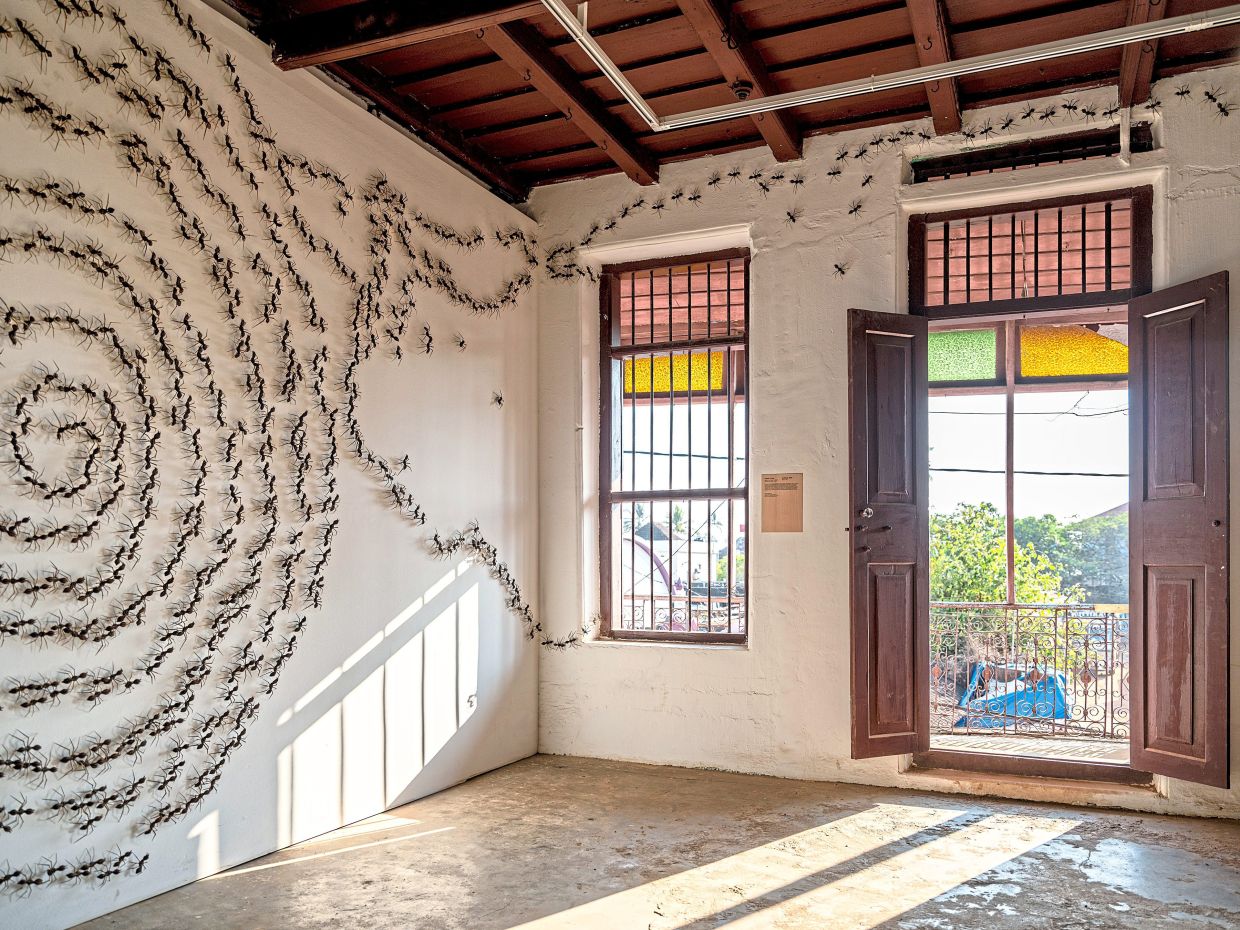
In one of the student shows, for example, I wasn’t prepared for the clean execution and creepy cleverness of a wall of giant ants made from bat’s head root seeds by Krishna Murthy PS, of the Chamarajendra Govern-ment College of Visual Arts.
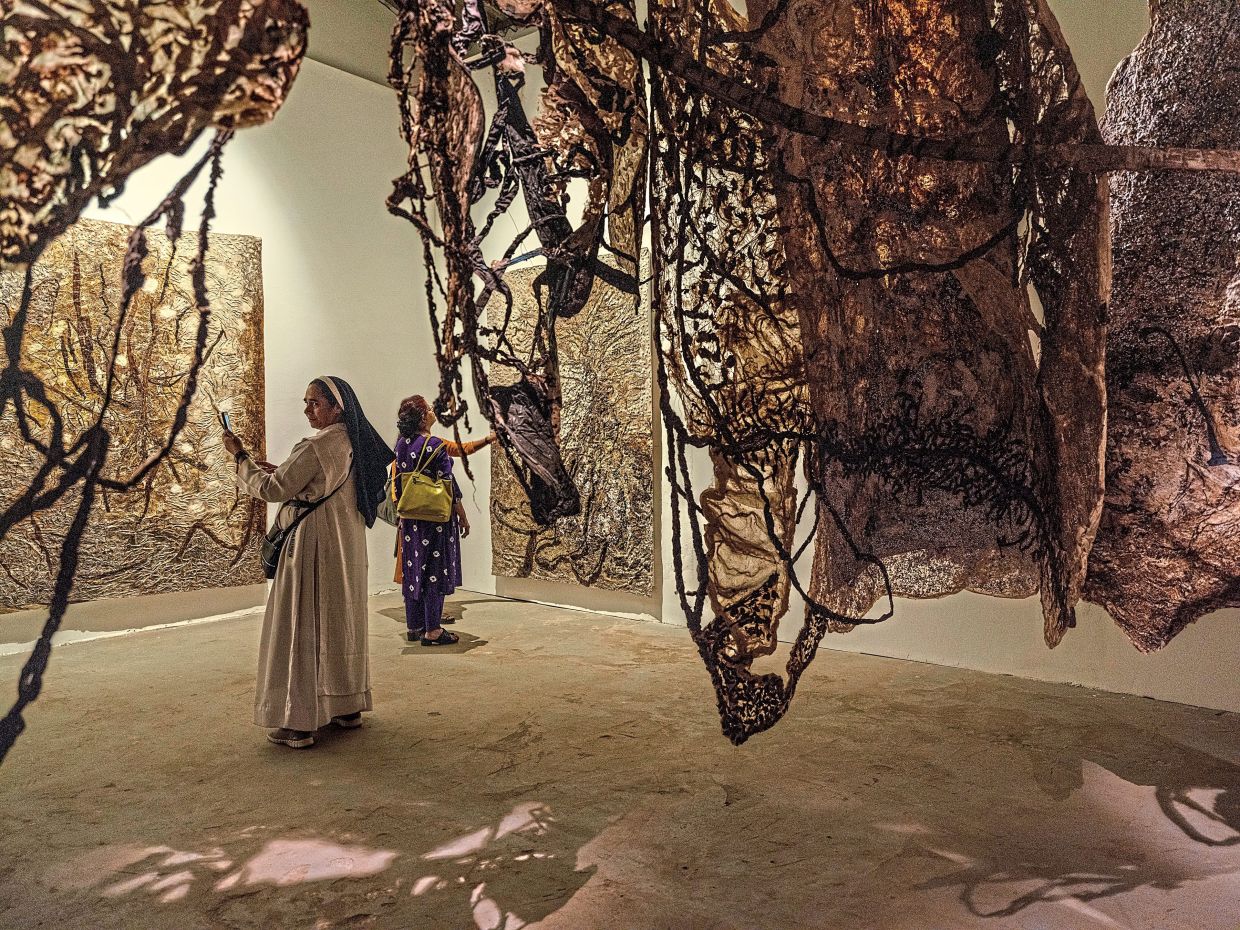
Among Chopra’s selections, a pressed betel nut and jute tent by Jayashree Chakravarty (from up north near Bangladesh) invites viewers into its womb-like interior to catch a filtered spotlight from within. The chandeliers of fired-clay ball-peen hammers by Birender Yadav (from close to Nepal) moved me in a way quite different from the fabulous hangings that Prabhakar Kamble (from near the Pakistan border) has glommed together from the bridles and baubles that festoon cows in India.
Kamble, referring to the school of Italian minimalism that has become fashionable in art-world institutions, calls his assemblage technique “Arte Povera of the subcontinent”.
These works have humour and beauty, and a total porousness with the environment in which you encounter them, that seems to welcome whatever the politics they bring into the room. (As ever, a target at Kochi is the caste system. Yadav, with his pickaxes stacked like human vertebrae, and Kamble, with his crazy sculptural cattle yoked to tombstones and LED screens, are explicit on the subject.)
In these playful correspondences of life to craft, I saw things alive and ambitious, dogmatic but not doctrinal, lived in and uniquely unstuffy. Maybe even new. – ©2026 The New York Times Company