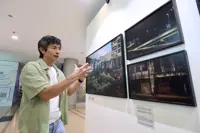
Heidi Shamsuddin remembers it vividly, like it was yesterday.
She and her siblings (she’s the second child among five) would gather around their father, eagerly waiting for the fairy tale – from Hans Christian Andersen to the Brothers Grimm – to begin.
Occasionally, the Petaling Jaya-born author’s father would narrate a local folk tale.
A particular family time session went very differently. It was not “once upon a time” or “happily ever after”.
It was about Si Tanggang, the story about a disobedient son who was turned into stone after his mother’s curse.
“I remember we were so scared and wondered if it would happen to us if we misbehaved!” exclaimed the cheerful mother of three in a recent interview.
“But Si Tanggang captured my imagination and eventually put me on this path of collecting Malaysian and Nusantara folk tales,” she continues.
For the better part of the last decade, Heidi, has been actively writing children’s books and also archiving a collection of local folk tales.
Her first short story, Johan The Honey Hunter, won the regional prize for the Eye Level Children’s Literature Award in 2012. Since then, Heidi has penned 10 books, including The Malay Tale Of The Pig King, which is based on the Nusantara epic, Hikayat Raja Babi, and eight short stories that appeared in anthologies such as PJ Confidential and Micro Malaysians.
Her recent book Nusantara – A Sea Of Tales, released by Penguin Random House SEA, is an ambitious collection of 61 folk tales, fairy tales, myths, and legends from the Nusantara and South-East Asia region.
If you don’t recognise some of the stories in Nusantara, don’t feel embarrassed.
“We don’t really have a definitive collection of our folk tales here. I thought, quite naively, that there was already such a book because it’s so basic. Most countries have their own collection of fairy tales. But we don’t,” says Heidi, who took a (pandemic) year to complete and fine-tune the book, which she began writing more than five years ago.
Like any good storyteller, Heidi, a former maritime lawyer in London for six years before returning to Malaysia in 2006, knew she had some task ahead to provide Malaysia with its own unique collection of folk tales.
Locating women’s voices
Through these ancient folk tales, she also studies their history and narratives, and often tries to locate and highlight the role of women in these stories. Her new book Nusantara continues her literary quest.
“As a woman, I consciously chose to highlight the folk tales which empower other women. For example, the story of Bawang Merah Bawang Putih And The Magic Pumpkin, The Gift Of The Winter Melon and Phikul Thong highlight the power and agency of the older woman. The story of The Maidens Who Saved Guam shows us the intelligence and bravery of women in defeating the enemy,” says Heidi, 49.
“Many of these tales feature women who face tremendous difficulties but through a journey of transformation, through their cleverness and strength, these women survive and thrive to eventually achieve their happily ever after. For me, these stories act as a guide and show us that there is always hope.”
Nusantara also offers diversity, and stories you don’t really hear about these days.
Have you read Princess Khamariah And The Male Fish, a risque folk tale about a princess who, unbeknownst to the king, takes on a lover? What about Hitam Manis And The Tualang Bees, a tragic story about a girl and her friends who were murdered and transformed into rainforest bees?
“Fairy tales are exciting because you follow the protagonist, who is normally a child, who goes through a transformation by the end of the tale. They almost grow up through the course of the story and that’s why I think people are drawn to them,” says Heidi.

Apart from preserving local folk tales, the author also wants to make them accessible to Malaysians, young and old.
“It’s not that we don’t have local folk tale books. We do but they aren’t as accessible. I also wanted to show that we have our own folk tales which are equally good and exciting,” says Heidi, who names writers such as Diana Wynne Jones, Angela Carter and Margaret Attwood as inspirations.
Outside writing books, Heidi was also a part of the Batik Girl animated film project.
In 2017, her screenplay for Batik Girl won the Intellectual Property Creators’ Challenge (IPCC) Award and was made into an award-winning short animated film by R&D Studio and Tudidut Studio. She co-created Batik Girl with Irwan Junaidi, who also directed the short film which featured a girl and her grandmother and touched on themes such as death and bereavement in a beautiful way.
“Writing the screenplay for Batik Girl allowed me to really expand my creativity. Instead of just using words to tell the story, I had to visualise how it would look like on screen, and how to incorporate the batik motifs and symbolism into the story itself,” she says.
Labour of love
Nusantara contains 54 Malaysian folk tales while the rest are from the Philippines, Vietnam, Thailand, Guam, Madagascar, Singapore and Indonesia.
Heidi also adds personal notes and musings at the end of almost every story in Nusantara.
“So far, the feedback that I’ve received is that this is the most favourite part of the book for many people,” shares Heidi.
Additionally, she took the liberty to rewrite some of the stories to fill in gaps or give an ending to any incomplete stories.
“That’s what makes folk tales very special, they are always changing and evolving, depending on the storyteller.

“I did try to maintain the core of the story and keep it as original as possible because we don’t have a definitive collection of our folk tales as a base. Something basic that other writers and even artists can refer to,” she elaborates.
But Heidi admits Nusantara was not initially an effort on her part to fill a void in the local literary scene.
“It started off as a hobby. I began collecting the stories by initially reading folk tales and when I found those that were very obscure, I wanted to make sure I had access to them. So, I would retell the folk tale in my own words and rewrite them. And anything that I found related to the folk tales, I would jot them down and include them as notes.
“I began doing this so that I could have my own archive. Eventually I found out that I have collected quite a lot of these folk tales. That’s when I thought maybe I should put these stories in one collection,” says Heidi.
The need to produce a local folk tale anthology grew stronger when Heidi, who spent part of her childhood in Seattle, Washington, the United States, was invited to give a TEDx talk at Universiti Malaya in 2018 on local fairy tales.
“I did a simple poll and asked ‘have you heard of this story?’ and I went through all the local folk tales. I was met with blank faces. The attendants really didn’t know of these tales, even something as basic as Bawang Merah, Bawang Putih,” she says.
As a long-term project, she started searching and collecting the folk tales five years ago.

“I had to go around and track down old books, some are no longer in print. And when I travelled to Sabah and Sarawak, I would walk into a bookshop and the first thing I would look for was a (local) book on folk tales.
“These folk tales are completely different from the ones in Peninsular Malaysia – there are gods, monsters, worlds beyond ours. It opened a whole new world for me. The Internet was also a great help.”
Screen time, creating awareness
In January last year, Heidi also started a Youtube channel called Nusantara Fairy Tales With Heidi for a non-reading demographic. She has nearly 50 videos now, with two seasons of content.
“These short and simple tales contain themes and motifs which are often controversial. Bawang Putih Bawang Merah explores death and abandonment, Bidasari looks at the issue of abuse and The Youngest Fairy Princess Of Kayangan looks at the power balance between men and women. These stories offer a way to discuss difficult issues in a safe environment,” she mentions.
Heidi also plans to start a podcast channel later this year and put out at least 10 recordings. She hopes more people – children and adults – will read these stories and appreciate them.
“Fairy tales are important because they open up discussions and allow us to talk about difficult and unsavoury topics. More importantly, they help us to make sense of this world we live in,” concludes Heidi.
Already a subscriber? Log in
Get 20% OFF The Star Digital Access
Cancel anytime. Ad-free. Unlimited access with perks.